Friday, October 21, 2022

Video: The Joe Giella 1998 Shoot Interview by David Armstrong

Great to see this 1998 interview with my Berndt Toast Gang friend. Gold and Silver Age Batman comic book artist and Mary Worth illustrator Joe Giella is interviewed about his career by David Armstrong. Go to Comic Book Historians to see more interviews with Golden and Silver Age Comic Book artists. 

"David Armstrong interviewed Golden and Silver Age great, Joe Giella in 1998 on set in Long Island, New York, about his entry into comic books in the 1940s with Quality Comics, Timely and DC Comics, working besides other comic book greats Mike Sekowsky, Stan Lee, Carmine Infantino, Dan and Sy Barry, inking Batman under Bob Kane, the Comics Code, his science fiction comic books, favorite editors, his opinion of Mort Weisinger, and working on modern licensing work and comic strips. 

"Interview conducted, recorded and copyrighted to David Armstrong. Remastered, edited and postproduction by Alex Grand."


Video: The John Romita Sr. 2001 Shoot Interview by David Armstrong

Here is my fellow Berndt Toast Gang member and great comic book artist (and former Marvel Comics Art Director) John Romita talking about his career with David Armstrong. Thanks to Comic Book Historians for releasing this 2001 interview. 

"David Armstrong interviewed Silver & Bronze Age great, John Romita Sr. in 2001 on set at San Diego Comic Con about his entry into comic books with Les Zakarin, first meeting Stan Lee at Timely, his suspense science fiction stories like IT!, working for Famous Funnies, his relationship with Stan Lee in the 1950s, and again in the 1960s, getting inking advice from Joe Maneely, why he joined DC Comics to work on Romance Comics with Zena Brody and Robert Kanigher, discussing Alex Toth, the editorial culture at DC compared to Marvel, Jack Kirby, Martin Goodman, terrible distribution through Independent News, and DC Comics' achilles heel. 

"Interview conducted, recorded and copyrighted to David Armstrong. Remastered, edited and postproduction by Alex Grand."


Video: The Marv Levy 1998 Shoot Interview by David Armstrong

Golden Age Comic Book artist Marv Levy is the subject of this1998 video interview that was just posted over at Comic Book Historians. Great to see my Berndt Toast Gang friend talk shop!

"David Armstrong interviewed Golden Age great, Marv Levy in 1998 on set at Long Island, New York about his entry into comic books in the early 1940s while in high school, working for Harry Chesler, Leon Harvey at Harvey Comics, Lloyd Jacquet, Bernard Baily, analyzing the Lou Fine comics vs the Jack Kirby style, serving in the military and leaving comic books for newspaper comic strips and advertising. 

"Interview conducted, recorded and copyrighted to David Armstrong. Remastered, edited and postproduction by Alex Grand."


Video: The Creig Flessel 1998 Shoot Interview by David Armstrong

Just up via the Comic Book Historians, is this terrific interview with Golden Age Comic Book artist Creig Flessel. I was fortunate to know Creig (We were both members of the Berndt Toast Gang.) and he was a knowledgeable, friendly artist of great talent. So glad to see this 1998 interview. 

"David Armstrong interviewed Platinum and Golden Age great, Creig Flessel in 1998 on set at Long Island, New York about his early training in the Grand Central Art School, his entry into comic books in the mid 1930s with Vincent Sullivan on More Fun Comics for Major Malcolm Wheeler-Nicholson's National Allied Publications, his covers for Detective Comics, other artists like Leo O'Mealia, Bert Christman, Jerry Siegel and Joe Shuster, early Superman, depicting African American protagonists, why he left comic books for advertising at Johnston and Cushing, comic strips and his relationships with other comic book professionals. 

"Interview conducted, recorded and copyrighted to David Armstrong. Remastered, edited and postproduction by Alex Grand."


Video: The Sy Barry 1998 Interview by David Armstrong

One of the nice things in my life is being part of the Berndt Toast Gang, the Long Island chapter of the National Cartoonists Society, and getting to regularly have lunch with some of the great comic strip and comic book artists of the 20th century. Comic Book Historians has, just today, dumped a bunch of video interviews with some of my Berndt Toast friends. Here is the great Sy Barry from 1998, talking to David Armstrong about his career. 

David Armstrong interviewed Golden & Silver Age great, Sy Barry in 1998 on set at Long Island, New York about his entry into comic books with his brother Dan Barry, the work they did together, working for DC Comics, Hillman, Lev Gleason, Ziff-Davis and others, discussing his influences, other professionals he admired like Alex Toth, Carmine Infantino, Joe Kubert, Joe Giella and Ed Cronin, the degrading effect of EC Comics, leaving the Phantom newspaper comic strip, and his post retirement art projects. 

Interview conducted, recorded and copyrighted to David Armstrong. Remastered, edited and postproduction by Alex Grand.


Thursday, October 20, 2022

Video: 1977 Stan Lee Interview

Here's a clip from CBC's 90 Minutes Live TV show in 1977. Stan Lee (1922-2018) explains how Spider-Man's problems make him a more relatable and popular superhero.He is a character people can relate to - moreso than the so-called perfect heroes of the past.

Full story at CBC Archives here.  


Wednesday, October 19, 2022

Dick Tracy's Chester Gould Talks About the Value of Persistence

Chester Gould created Dick Tracy, which debuted way back on October 4, 1931. It wasn't the first comic strip he created. I have read that he tried out about a hundred ideas for comic strips, all of them unsuccessful. Why he did this -- kept on pitching idea after idea -- ? Even he isn't absolutely sure.

Here's Chester Gould from Guideposts Magazine, writing way back in 1976, about the value of persisting. He would retire from Dick Tracy the following year, handing it off to his assistant Rick Fletcher and writer Max Allan Collins. The strip continues today with the team of Mike Curtis and Shelley Pleger.


Chester Gould on the Value of Persistence
 
Quite often friends or fans who follow my comic strip ask me how Dick Tracy came into being. To answer that, I have to go back a long way, to the days of the Depression when a frustrated and unsuccessful young cartoonist sat up late one night before his easel in his very modest home in Chicago, Illinois.

It was 1931, the Prohibition era, and organized crime in Chicago was at its height. Almost every day there were stories of gang “rides” and mob takeovers. It often seemed to me that the forces of good were powerless against this onslaught.

At that point in my life my best efforts to become a successful cartoonist seemed to be standing still. I was making a living as an ad illustrator for the Chicago Daily News. But ambitions die hard—and mine wasn’t dead by a long sight.

On that particular evening, my wife Edna and our daughter had gone to bed. On the couch lay the daily paper where I had thrown it in disgust and frustration—its headlines screamed of another crime massacre. A spring night breeze whispered at the window, and as I sat there leaning back from the drawing board, my mind grappled with the situation.

Who could solve this crime problem? Sherlock Holmes certainly could, I thought. I smiled as my mind drifted back to my boyhood hero. What would he look like today? I wondered. As I thought, my hand automatically began sketching. Yes, he’d be a sharp-looking young man. Instead of a deerslayer hat, a snap-brim fedora. There. The pencil continued—the face: a firm square jaw showing determination; the aquiline nose of a searcher; now the eyes, sharp, analytical.

Suddenly there he was on paper, keen visage staring across the page. A name? Ah, being a detective, he’d be a tracer. That’s it—Plain-Clothes Tracy! Now to put him to work! As enthusiasm flooded me, my pencil sketched furiously.

I did not hear the clock strike the hours—one—two—three—as my hero came to life. There he is crawling over a rooftop on the trail of Big Boy and his gang! He leans over a skylight, trying to catch the words of the gang as they plan their next takeover. Tracy moves closer … Oh no! Crash! He falls through the skylight.

Strip after strip of daily panels seemed to fly off my easel.

As I inked in the final panel of the last strip, daylight filled the sky outside the porch window.

At breakfast I excitedly showed the strips to Edna. She studied them for a moment, then handed them back to me. “It will go.” she gasped. “You’ve got it!”

Artist friends did not agree. “You’re going too far, Gould,” they warned. “This has never been done before in comics.” Editors at the Daily News where I worked said they were “atrocious and impossible.”

I looked at them again. True, a continuing realistic adventure story had never been done before, but there was one newspaper publisher in New York who might just possibly see something in my hero. Without much hope, I packed the five strips and put them in the mail. Months went by—and I forgot about them.

My desire to be a cartoonist went far back into my childhood in Pawnee, Oklahoma, where my father worked for the Pawnee Courier Dispatch. One day he found me sketching on bits of copy paper I had fished from the newspaper’s baskets. “Chester,” he said, “there’s a county Democratic convention going on at the courthouse. How about going over there and drawing some cartoons of some of those people?”

Full of enthusiasm, I rushed over, did my work and proudly took it back to Dad who taped the sketches in the front-office window under the caption: “Convention cartoons by C. Gould.” I stood inside the window and watched the people stop, look and chuckle. “That’s what I’ll be,” I vowed. “A cartoonist!”

In later years, Dad, who thought all artists inevitably starved, suggested law as a more stable profession, and I dutifully attended Oklahoma A & M. However, I felt that I had been given a talent to entertain people with my drawings. And so, at age 21, I headed for Chicago with $50 and a bag full of cartoon ideas.

My target was Captain Joseph Medill Patterson, co-publisher of the Chicago Tribune, who had the reputation for having an uncanny knowledge of what the public wanted. Thanks to him, readers were already laughing over Gasoline Alley, The Gumps and Harold Teen.

But he wasn’t interested in what I had to offer. Undaunted, I attended Northwestern University’s night school and held minor art jobs with various Chicago newspapers and studios. In the meantime I continued to barrage Captain Patterson with ideas. There was never any response.

However, I remembered someone saying that great things are accomplished not so much by strength as by perseverance. And so I decided to keep trying.

Even when Captain Patterson moved East to publish the New York Daily News, I kept mailing him ideas. Where I got my persistence, I don’t know. Maybe it came from my grandfather, a United Brethren preacher, who rode circuit on the plains, fighting storms and blizzards. Dad, superintendent of our Sunday school, kept up the family tradition, and I remembered him saying again and again, “Don’t give up.” He’d pick up his old leather-bound Bible and read from Psalms. “The steps of a good man are ordered by the Lord, and he delighteth in His way. Though he fall, he shall not be utterly cast down, for the Lord upholdeth him with His hand.” (Psalm 37: 23-24)

Through all my failures I did have a feeling that God was there upholding me. That’s why I worked on, and why I mailed my Plain-Clothes Tracy strips to Captain Patterson in New York.

On August 13, 1931, I was working on a rug account, finishing in the details to show the rug’s fibers, when the phone rang. It was Edna.

“A wire came for you,” she said. “It’s from Captain Patterson. Do you want me to read it?”

My brain began to go numb. “Please!”

“Your Plain-Clothes Tracy has possibilities. Would like to see you when I go to Chicago next. Please call Tribune office Monday about noon for an appointment.”

Cold sweat broke out on my brow as I hung up the phone. But the following week, wearing a new suit, shoes and hat, I walked into Mr. Patterson’s office at the Tribune. An Army man, tall and erect, he was dressed with his usual informality—open shirt, coatless, scuffed Army boots.

Holding my comic strips in his hand, he paced thoughtfully around his office. I watched him closely. This was the man who had said, “We want to reach the man on the street.”

Finally he said, “ ‘Plain-Clothes’ is too long. How about a shorter word for detective, like, ‘Dick’?”

By this time I had learned that often a dispassionate outsider can improve your best ideas.

“Yes, sir,” I said.

“Okay, Dick Tracy it will be. Have two weeks of daily strips ready by the first.”

And so it began.

From the start, people predicted the strip would run out of ideas. But I found that the Lord makes each day new. He causes the seasons to change. And if we keep alive to His world by staying alert and allowing our minds to roam through its many wonderful possibilities, new ideas always come up.

One morning while driving to work from my farm in Woodstock, Illinois, I passed abandoned gravel pits that abound in this area. As I looked, I noticed a little shack in the bottom of one cavernous pit. Hansel and Gretel thoughts of my childhood rose and I chuckled. What would happen, I wondered, if one climbed down and found a witchlike creature living there?

As my mind played with the idea, a toothless old hag materialized and a name came to me—Gravel Gertie. She turned out to be a new Dick Tracy character who later married the old reprobate B.O. Plenty, and out of ugliness came their beautiful golden-haired child—Sparkle Plenty.

Today, Dick Tracy has been proving that crime does not pay for 44 years, and he is now seen by millions of readers in hundreds of newspapers around the world.

We reach a lot of youngsters and if we can simply plant in their minds that one reaps what one sows, and that good will always overcome evil, then Dick Tracy will continue doing his job.

Now, at age 75, I hope to keep working as long as the Lord allows me. Every morning at the breakfast table, Edna and I give thanks for our blessings and the chance to do what we’re supposed to do.

Dick Tracy, I’m sure, would join us in that.
 

Related:

Jay Lynch and R. Crumb Meet Chester Gould

WBBM Channel 2 - Channel 2 News at Six - "Someone You Should Know: Chester Gould" (1980)

Video: "John Nesbitt's Passing Parade: 'People on Paper'" 1945

200 Characters from Dick Tracy 1931-1977

Vintage TV: Cartoonist Chester Gould on "To Tell the Truth" (October 4, 1965)

Vintage TV: Chester Gould appearance on The Fred Waring Show

Chester Gould's Early Years of Struggle


-- Edited from an original blog entry of August 11, 2020. 

Tuesday, October 18, 2022

Video: Love and Rockets: The Great American Comic Book | Artbound | Season 13, Episode 1 | KCET

From KCET studios, here is the complete episode of the series "Artbound," which is all about the Hernandez Brothers' comic book series "Love and Rockets." 

"'Love and Rockets' astounded the alternative comic book scene and garnered a world-wide fanbase by pushing the edge of storytelling through graphic art. Originally published by three brothers from Oxnard, California, 'Love and Rockets' has been praised for its diversity and nuance. Its storylines have continued for the past 40 years with its characters aging and situations developing in real-time. Want to learn more? Watch more Artbound at https://bit.ly/3E5coFQ"


Monday, October 17, 2022

The Garden As of Mid-October

The garden as of mid-October. The first three are before I pulled out the tomatoes and peppers. Zinnias are still blooming!


Friday, October 14, 2022

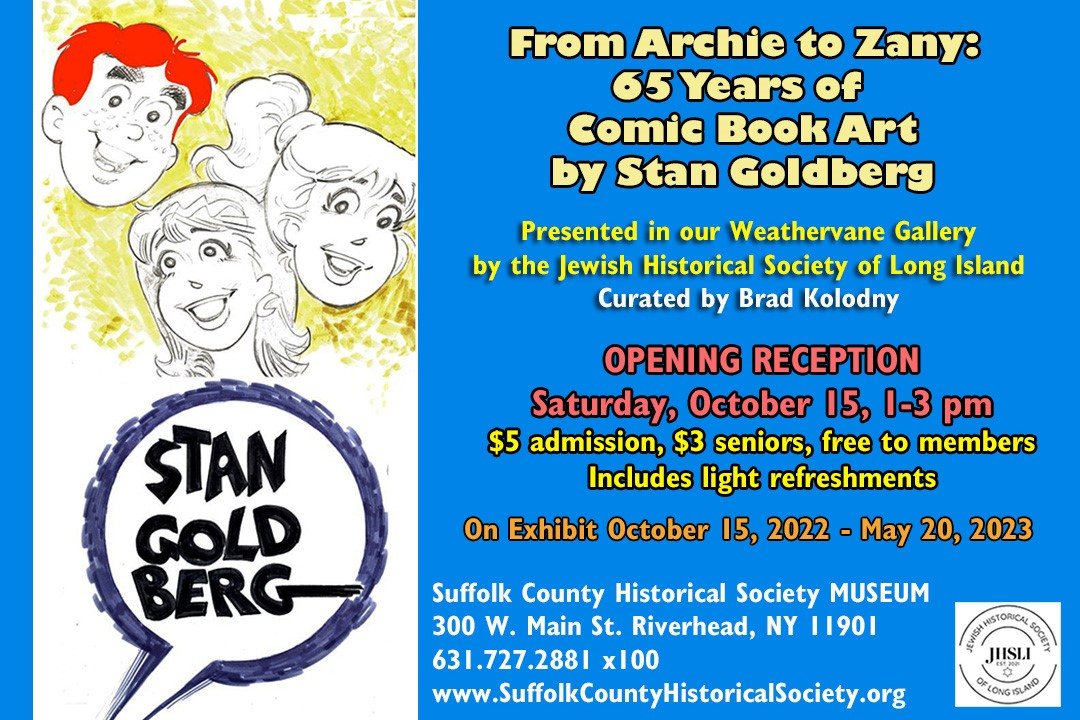
Suffolk County Historical Society: "From Archie to Zany: 65 Years of Comic Book Art by Stan Goldberg" Gallery Show October 15, 2022 - May 20, 2023


Stan Goldberg has a gallery show in Long Island. Here's Stan's son, Stephen Goldberg, with the details:


Looking for something to do next Saturday? If you are out on Long Island (or are up for a nice ride), join us for what should be a fun afternoon at the Opening Reception for the exhibit celebrating my dad, Stan Goldberg and his life in comics. If you can't make it for the Opening Reception, the exhibit itself will be going on through May 20th.

OPENING RECEPTION
From Archie to Zany: 65 Years of Comic Book Art by Stan Goldberg
Saturday, October 15, 2022: 1:00 - 3:30 pm
$5 admission, $3 seniors, free to members.

The Suffolk County Historical Society is located at 300 West Main Street, Riverhead, New York. (631) 727-2881.

Tuesday, October 11, 2022

Have a Good Week


I'm away this week and the blog will be quiet until I return.

Monday, October 10, 2022

Happy Birthday, Orlando Busino!

Today is the birthday of the one and only Orlando Busino born this day in 1926.

He grew up in "cow country," in Binghamton, New York. He developed an interest in cartooning at the age of nine, and sold his first cartoon to the New York Mirror at the age of 14. "Bulldog, with Central, the Wonder Dog" was the name of the comic strip he created for his high school paper. Look at an old copy of the magazine Open Road for Boys, and you will see Orlando's cartoons winning many of their contests. Orlando was drafted into the army and served in Panama from 1945 to 1947. He drew cartoons for the army unit newspaper there. Returning home, he attended Binghamton State, and then the University of Iowa, drawing cartoons for their school papers.

My friend Dick Buchanan picks up the story, and shares some of Orlando's great gag cartoons:


ORLANDO BUSINO

GAG CARTOONS 1957 TO 1968


After graduating in 1952, he moved to New York City. He worked in the ad department of the Macmillan Publishing Company. At night he attended the Cartoonists and Illustrators School. A year later he sold his first cartoon to The Saturday Evening Post, launching his career as a freelance cartoonist.

Busino also worked for Archie Comics in the 1960s, doing covers, illustrations, and stories for "Tales Calculated To Drive You Bats." This work was later reprinted in Archie's Madhouse.

Orlando Busino’s created “Gus,” the antics of a large white dog, which first appeared in Boys' Life in January 1970. It took over the honor spot on the "Think & Grin" page (the spot headed for nearly 20 years by Clyde Lamb “Millicent” and briefly by John Gallagher’s “Cartoon Bug”). Gus appeared on the cover of Boys' Life in December 1981.

Orlando Busino received the National Cartoonist Society Gag Cartoon Award for 1965, 1967, and 1968. This selection pf a few of his gag cartoons chronicles his fine work from 1957 through the 1968.


1. ORLANDO BUSINO. The Saturday Evening Post June 29, 1957.


2. ORLANDO BUSINO. The Saturday Evening Post July 27, 1957.


3. ORLANDO BUSINO. True Magazine October 1958.


4. ORLANDO BUSINO. The Saturday Evening Post January 25, 1958.


5. ORLANDO BUSINO. American Legion Magazine November, 1960.


6. ORLANDO BUSINO. For Laughing Out Loud April-June, 1961.


7. ORLANDO BUSINO. The Saturday Evening Post December 22-29, 1962.


8. ORLANDO BUSINO. The Saturday Evening Post March 10, 1962.


9. ORLANDO BUSINO. True Magazine August, 1962.


10. ORLANDO BUSINO. The Saturday Evening Post February 22, 1964.


11. ORLANDO BUSINO. 1000 Jokes Magazine December, 1963 - February, 1964.


12. ORLANDO BUSINO. The Saturday Evening Post May 21, 1966.


13. ORLANDO BUSINO. The Saturday Evening Post May 21, 1966.


14. ORLANDO BUSINO. Boys’ Life March, 1967.


15. ORLANDO BUSINO. Boys’ Life May, 1968.


16. ORLANDO BUSINO. Boys’ Life October, 1968.


Friday, October 07, 2022

From the Dick Buchanan Files: The Cartoon Clip Album

Dick Buchanan has a better memory than I do, but I think it's been six or seven years since he started sharing his amazing Cartoon Clip File with me here on this blog. I am very grateful for the scope of his collection and his amazing research into the lives of the great single panel cartoonists of the golden age of gag cartoons. Here's Dick with some (very) kind words and over two dozen terrific cartoons. Thanks and take it away, Dick!

---

THE CARTOON CLIP FILE ALBUM


The Cartoon Clip File originated in the late 1950’s when your friendly crackpot curator was merely an eccentric teenager, struggling as a minor market cartoonist. As was the custom of many cartoonists at the time, cartoons were clipped from magazines to comprise a morgue. This morgue was intended to help one draw unfamiliar objects or locales and, more importantly, to spark gag writing. Over the years the Clip File was maintained with cartoons found in magazines we obtained here and there. Inspired by our friend, the late great Leopold Fechtner, curator of “the world’s largest” collection of more than a million jokes, our simple pile vintage gag cartoons became a collection. It grew and grew. Now, some have called it a trove. Go figure. 

One day we decided it would be a good idea to share our trove of vintage gag cartoons with others. After searching high and low, we stumbled upon the Mike Lynch Cartoon Blog, right in front of our so-called face. Lo and behold, Mike kindly provided the Cartoon Clip File some space to share what we have accumulated over many years. It goes without saying, Mike Lynch, a gentleman and scholar, has been supportive and helpful in many ways. It has been a pleasure to be able to contribute our trove with others and we truly appreciate the time and effort Mike made to bring the Cartoon Clip File to life. Thanks!


The Cartoon Clip File staff, both real and imagined, thought it would be a good idea to look back over the many previous Mike Lynch posts and comprise a special collection of mid-century gag cartoons which are our particular favorites. Take a look . . .


1. ED NOFZIGER. The Saturday Evening Post March 5, 1949.


2. ALEC. Punch October 3, 1953.


3. DICK CAVALLI. Collier’s February 21, 1953.


4. CHON DAY. Collier’s June 22, 1956.


5. JOHN DEMPSEY. The Saturday Evening Post January 21, 1951.


6. JERRY MARCUS. American Legion Magazine November 1, 1958.


7. VIRGIL PARTCH American Legion Magazine March, 1948.


8. AL ROSS. 1000 Jokes Magazine Summer, 1950.


9. SEVIOUR. Punch June 17, 1953.


10. L.H (Lawrie) SIGGS. September 23, 1953.


11. MARTHA BLANCHARD. 1000 Jokes Magazine September – November, 1964.


12. ROY WILLIAMS. Collier’s September 18, 1948.


13. GAHAN WILSON. Look Magazine April 16, 1957.


14. GEORGE WOLFE, This Week Magazine October 25, 1945.


15. ORLANDO BUSINO. For Laughing Out Loud May – July, 1957.


16. CLYDE LAMB. Judge October 26, 1953.


17. SMILBY (Francis Wilford-Smith) Look Magazine July 18, 1963.


18. CHARLES ADDAMS. True Magazine June, 1949.


19. JOHN GALLAGHER. Collier’s January 7, 1955.


20. STAN & JAN BERENSTEIN. Collier’s December 16, 1950.


21. LEO SALKIN. Judge March, 1947.


22. FRED LUNDY. 1000 Jokes Magazine Spring, 1950.


23. TOM HENDERSON. The Saturday Evening Post March 20, 1948.


24. JEFF KEATE. 1000 Jokes Magazine September – November, 1964.


25. LARRY HARRIS. 1000 Jokes Magazine Spring, 1951.


26. WILLIAM STEIG. True Magazine July, 1949.