Thursday, January 26, 2023

TOPSYS & TURVYS by Peter Newell

TOPSYS AND TURVYS by Peter Newell (1862-1924) was originally published over a hundred years ago. It's the same with all of Peter Newell's work: all published over 100 years ago, and all of his six "novelty books" (such as THE SLANT BOOK, THE HOLE BOOK) are still in print. Newell also wrote and drew a newspaper comic strip titled THE NAPS OF POLLY SLEEPYHEAD (1906-07). There were, at the beginning of the 20th century, a slew of fantasy strips -- of which only LITTLE NEMO is recalled today.

Above is the cover of the Dover edition ("designed for years of use!") and it includes selections from his books TOPSYS AND TURVYS (1893) and TOPSYS AND TURVYS - NUMBER 2 (1894). No copyright information at all in here.


"The Elephant leans o'er the fence and wonders why it is"

The idea is that you look at Newell's drawing and read the line -- and then, physically turn the book over:


"The Ostrich has a longer neck and smaller mouth than his."

And that's the gimmick: you see a different picture, with a rhyming conclusion.

Note: other blogs would just snidely tell you to turn your monitor/iPad/whatever upside down, but here at Mike Lynch Cartoons, we're all about customer service. Below is the same picture, upside down. No need to strain, gentle blog reader! Thank you and have a nice day.


"This troop of soldiers, all in a file, are looking near and far"


"To find the famous Forty Thieves, each hid within a jar."

Most of the time, I look at that first picture and can't figure out what the upside down version will be and how it relates. Some wonderful work.

"Peter Newell liked to say that he and the Civil War both broke out in this country at the same time. He was born near Rice's Corners, McDonough County, Illinois, on March 5, 1862, the fourth child of George Frederick Newell, an Ohioan, and Louisa Dodge of Chautauqua County, New York. His childhood years were spent in Bushnell, a small town in west-central Illinois."

- from the Peter Newell Family Papers at Yale University; bio by Sandra J. Markham


"A hermit with a long red beard dwelt in a lonely place"


"The squirrel gazed with wonder upon his gloomy face."


"By the spring of 1883 he had moved east to New York, where he enrolled in classes at the Art Students' League while hoping to find steady employment as an illustrator for periodicals. His work had been published in the New York Graphic and Harper's Bazaar by the fall of 1883; the appearance of his simple line drawn comics was the beginning of a career in humor that would make Peter Newell one of the more prolific and best-known illustrators of his day."


"Fernando bears his cradle in, a cradle strong and deep"
Newell had good timing.

"By 1893 the development of halftone reproduction had made possible the style of illustration for which Newell is best remembered, the continuous tone drawing. His single-frame comics underscored with short, whimsical rhymes began appearing in Harper's Monthly and other magazines at this time. He was catapulted to fame by one in particular, "Wild Flowers," which appeared in the August 1893 issue of Harper's Monthly; several of these comics were compiled in one volume as Peter Newell's Pictures and Rhymes, published by Harper in 1900. Soon nearly every issue of most of the Harper magazines, as well as some Cosmopolitan, Metropolitan, McClure's and Collier's, carried a Newell comic or a Newell-illustrated story by authors such as John Kendrick Bangs, Stephen Crane, Philip Curtiss, Burges Johnson, Frank Stockton and Mark Twain."


Ahh! Those were the days!

"Then, placing it upon a rug, he rocks himself to sleep."


In 1894, the successful illustrator Newell and his family moved to Leonia, NJ.

"Over the next twenty years Leonia grew to become an illustrators' colony much like the one centered around the Pyle-Wyeth group near Wilmington, Delaware. The lively community of artists formed clubs, theatrical and lecture societies, and held exhibitions, costume parties and pageants. The Leonia School of Illustration was opened there by artists Harvey Dunn and Charles Chapman. The Newell family participated in all aspects of the intellectual, musical, religious and social life of the community. Peter Newell was a founding member of the Men's Neighborhood Club of Leonia and served on the village's first Board of Health. He played the cello, though apparently not well, and was a popular toastmaster and lecturer known for his "chalk talks" and other impromptu presentations. Both of the Newell daughters married illustrators, and Howard and Josephine Newell McCormick became leading members of the second generation of artists to live and work in Leonia."

The house wasn't just any house. It was featured in an article in Scientific American and a picture postcards as well!


"Why do these scurrying, frightened hares come coursing through the vale?"


"Because they know three hunting dogs are close upon their trail."


He traveled quite a bit. Like a lot of artists of the time, there were "sketching trips" to Europe. He was deeply grieved upon his only son's death in The Great War. In 1923, the Newells moved to Little Neck in Queens, NY.

"By the end of that year Peter Newell had become physically crippled by amyotrophic lateral sclerosis and was unable to work; he died in his home on January 15, 1924, at the age of 61."

More: "Peter S. Newell, Cartoonist," an article by Mabel Hall Goltra that appeared in the Journal of the Illinois State Historical Society (1908-1984) Vol. 41, No. 2 (Jun., 1948), pp. 134-145

Related: Cartoonist Gustave Verbeek also tread the same ground with his latter comic strip THE UPSIDE DOWNS in which he drew a six panel Sunday page which your would read all the way through and then turn it 180 degrees to read the conclusion.


-- Edited from an original blog entry dated May 9, 2008.

Wednesday, January 25, 2023

Video: Cathy Guisewite Talks Cathy and Her New Book: Scenes from Isolation


Via Bookstore1Sarasota:

Award-winning cartoonist Cathy Guisewite chats about her Cathy comic strip, which ran in about 1,400 newspapers for 34 years, and her latest work from Simon and Schuster: Scenes from Isolation.


Tuesday, January 24, 2023

Vintage Snow Machines

I have decided that anything that's shaped like a box and zooms around is something I like.  For instance, Rey's Speeder, at was introduced in the movie Star Wars: The Force Awakens.


It's just shaped like an electric razor.


Which reminded me of the Santa-riding-an-electric-Norelco-razor TV commercials when I was growing up.

But Rey's Speeder is waaay cooler.

In real life, there are many great, boxy vehicles that handle the snowy terrain, and from time to time, I see them in my New Hampshire neighborhood. I am collecting pics of them from the Internet.

I remember a comic book artist, Mark Schultz, who, when developing his own book in the 80s, decided it would be named after the two things he loved to draw the best. His comic book, "Cadillacs and Dinosaurs," ran from 1987 to 1996. If I drew a comic book named after two things I love I guess it would be called "Cats and Vintage Snow Machines." I dunno. I just like the look of them. Here are a few. See if you agree:


I wish I owned one of these since we are about to get our third storm in a week -- another foot or so of snow. I'm not complaining. It is winter after all. But it's a lot of winter all at once now.

Monday, January 23, 2023

From the Dick Buchanan Files: Snow Cartoons 1938 - 1962

My friend Dick Buchanan showcases a small portion of his gigantic collection of vintage magazine cartoons for your enjoyment. Look, you can't do anything about the snow and ice and freezing rain and school closings, so you might as well laugh about it. Thank you, Dick, for sharing.

--

LET IT SNOW!
(1938 – 1962)

No doubt about it, snow is funny. That’s why we have reached deep into the Cartoon Clip File and retrieved some gag cartoons about snow and ice. One thing’s for sure, snow is funnier when viewed from afar so stay inside and enjoy these cartoons from the past.


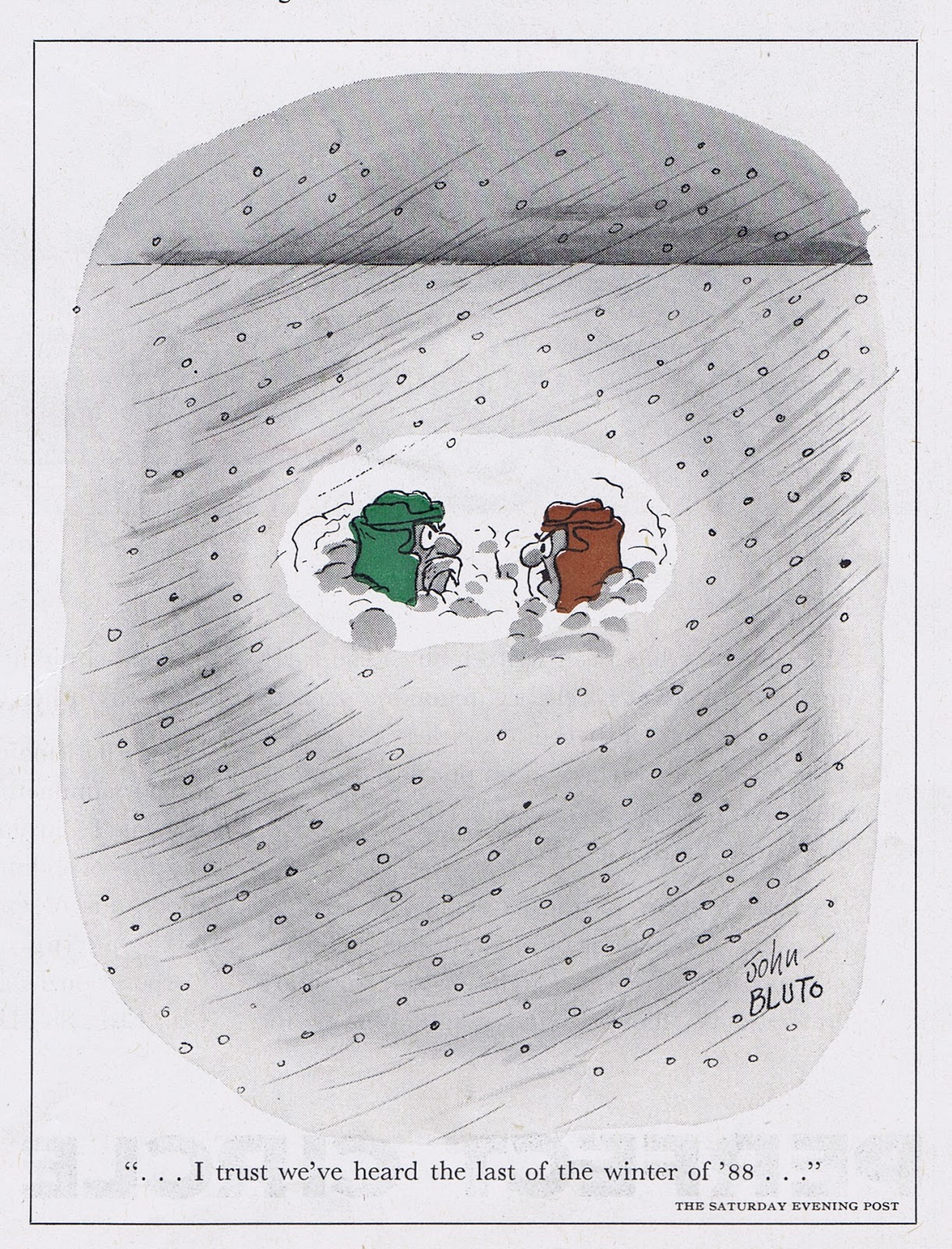
1.  JOHN BLUTO.  The Saturday Evening Post  January 25, 1958.


2.  CHON DAY. Collier’s January 30, 1943.


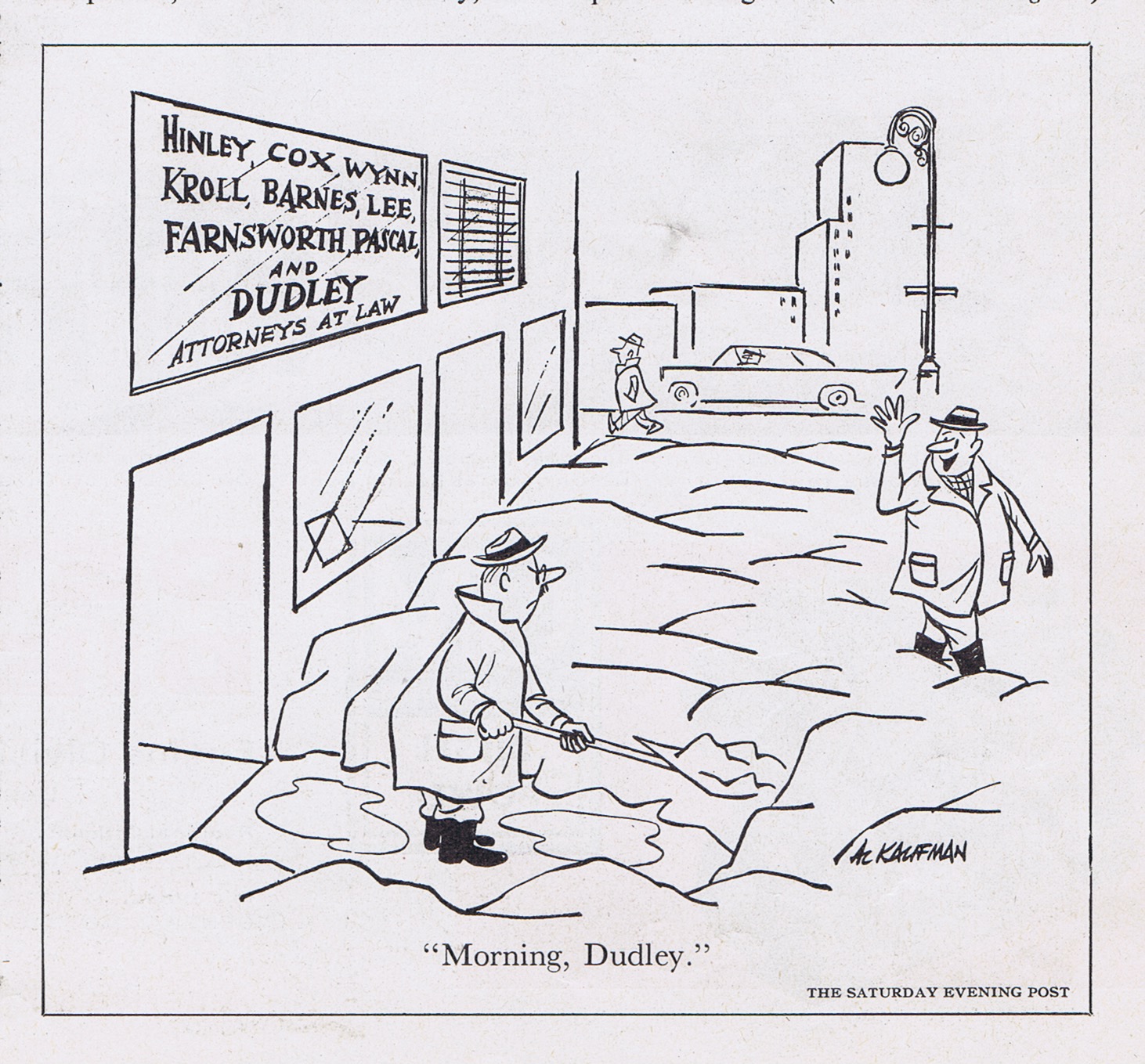
3.  AL KAUFMAN.  The Saturday Evening Post  March 9, 1957.


4. REAMER KELLER. Collier’s  March 12, 1938.


5.  STAN HUNT.  The Saturday Evening Post  January 6, 1951.


6.  DICK ERICSON.  True Magazine  March, 1952.


7.  BRAD ANDERSON. The Saturday Evening Post  January 6, 1951.


8.  BOB BARNES.  The Saturday Evening Post  January 6, 1951.


9.  SCOTT  TABER.  The Saturday Evening Post  February 8, 1958.


10.  AL KAUFMAN.  The Saturday Evening Post  February 11, 1950.


11.  CHON DAY.  The Saturday Evening Post  February 8, 1958.


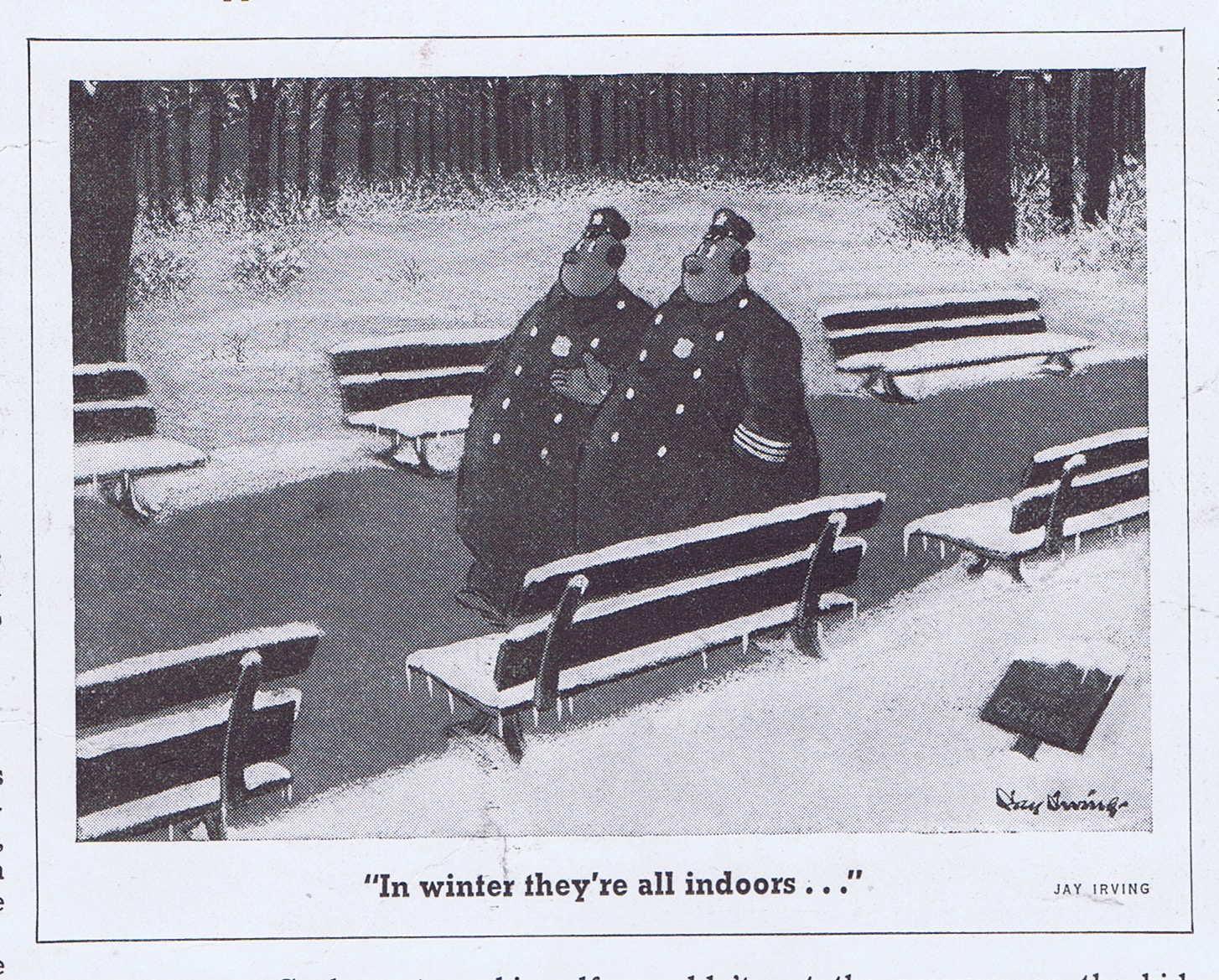
12.  JAY IRVING.  Collier’s  March 2, 1940.


13.  DAVE GERARD.  Collier’s March 6, 1952.


14. TED KEY.  Collier’s  The Saturday Evening Post  November 29, 1949.


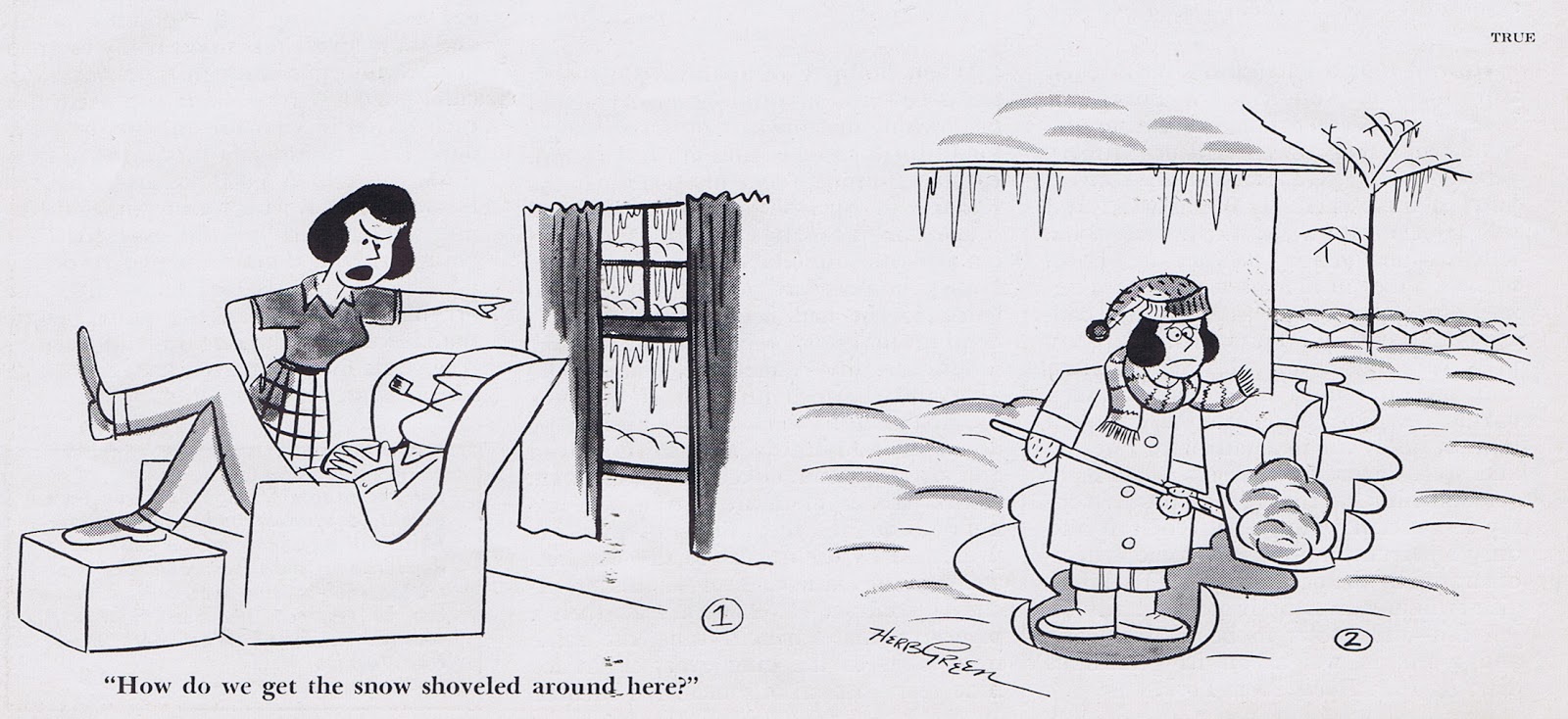
15.  HERB GREEN.  True Magazine  March 1962.


16.  NED HILTON.  Collier’s  December 23, 1950


-- An edited version of the blog that originally appeared on February 21, 2019.

Thursday, January 19, 2023

Suffolk County Historical Society: "From Archie to Zany: 65 Years of Comic Book Art by Stan Goldberg" Gallery Show


There was a Newsday article on the wonderful Stan Goldberg retrospective show at the Suffolk County Historical Society Museum, which is on exhibit until May 20, 2023. Stan was there at the beginning of comic books, and worked for everyone including Stan Lee and Archie Comics. Here's a look at the piece, originally published on Sunday.


Wednesday, January 18, 2023

Dick Buchanan: "Can Cartoonists Predict the Future?" Gag Cartoons 1948 - 1959

Well, here is something really interesting that Dick Buchanan put together for all of us fans of the golden age of cartooning: Can cartoonists predict the future? Are they creative visionaries? Can they predict things like tech support, selfies, identity theft, the rise of AI??? What did they think the future might look like from their view in post-war America? Walt Kelly phrased it as "the will be that was," which is more poetic than "retro-future." Well, take a look below and you'll see how gag cartoonists fared.

Take it away, Dick -- and thanks!!!

---


THE FUTURE LIES AHEAD


GAG CARTOONS 1948 - 1959


There was a fascinating symposium at last summer’s annual Crackpot Convention that dealt with a subject of particular interest to gag cartoonists and readers alike. The subject was “Visionary Cartooning . . . can cartoonists predict the future?” As expected, it was a lively session but in the end the subject never came up.

Returning to my Greenwich Village inner sanctum, undaunted, I delved into the Cartoon Clip File and much to my surprise I learned that several mid-century cartoonists did provide readers with a glimpse into the future.

Here are a few examples of cartoons that demonstrate ability of prognostication. In the interest of full disclosure, cartoonists weren’t infallible.


1. THE BABY MONITOR -- IRWIN CAPLAN --The Saturday Evening Post August 7, 1948.


2. ARTISAN BAKING -- GEORGE RECKAS. Liberty Magazine June 1948.


3. THE CONFERENCE CALL -- ROY L. FOX. The Saturday Evening Post April 18, 1953.


4. THE FOOD TRUCK -- CLYDE LAMB. True Magazine, May 1955


5. THE “SELFIE” -- HARRY MACE. The Saturday Evening Post October 29, 1955.


6. THE “ADULT ENTERTAINMENT” BAR -- CHARLES PEARSON. Collier’s September 11, 1948. It was the decline of burlesque rather than the advent of home television but nonetheless Pearson foresaw the coming of the “Adult Entertainment” bar.


7. COMPUTERS -- BOB SCHROETER. For Laughing Out Loud January-March, 1958. In the 1950’s, most folks had a tough time understanding computers purpose. Bob Schroeter got it right.


8. COMPUTERS -- BOB BARNES. Look Magazine March 17, 1959. Not everyone got it. Bob Barnes was one of many who missed the mark.


9. CREDIT CARDS -- BOB SCHROETER. For Laughing Out Loud September-November, 1954. Believe it or not, when credit cards appeared in the 1950’s many cartoonists assumed they were not worth stealing. Most Cartoon Editors agreed, publishing many variations of this gag.


10. CREDIT CARDS -- JOHN DEMPSEY. Look Magazine February 3, 1959. Wrong again. Many readers wrote to the Look Letters Dept. pointing out that credit cards were better than cash. But Dempsey’s holdup man was different . . . see why below.


11. Letters Dept. Look Magazine March 17, 1959


- This was an edited version of a blog entry from April 5, 2018.