What if 2001: A Space Odyssey was directed by George Lucas? Youtuber poakwoods supplies the answer. And also take a look at the companion video: Star Wars directed by Stanley Kubrick?

Wednesday, February 22, 2023
Video: "2001: A Space Odyssey" directed by George Lucas?

Tuesday, February 21, 2023
Download "How to Create Cartoons" book by Frank Tashlin

Cartoonist, film writer and director Frank Tashlin's (1913 - 1972) How to Create Cartoons book has been scanned and put online in its entirety.
Tashlin started off in life in animation, working for Schlesinger, Disney and Warner Brothers. He then worked as a gag writer for the Marx Brothers and Bob Hope. He wrote screenplays and became the go-to comedy director. His first film was Bob Hope's The Lemon Drop Kid. Tashlin also directed six of the Jerry Lewis solo pictures, as well as two 1960s movies starring Jayne Mansfield (The Girl Can't Help It and Will Success Spoil Rock Hunter?)
His How to Create Cartoons book was self-published in 1952 and it's about cartoon drawing, not animation.

Monday, February 20, 2023
Illustrator Istvan Banyai 1943 - 2022

Illustrator Istvan Banyai, whose distinctive line art decorated the covers and interiors of many of the major print magazines beginning in the 1990s, passed away on December 15, 2022 in a hospital in West Harrison, NY. The cause was lung cancer. His death, as the New York Times notes, was not widely reported at the time.


"By 2013, the celebrated Hungarian-born illustrator Istvan Banyai had achieved a place of prominence and influence in his profession. Blending a gimlet-eyed satirical sense with fantastical whimsy, Mr. Banyai had produced frame-worthy covers for The New Yorker, along with eye-catching work for New York magazine, The Atlantic and other publications.
"His ambitiously conceptual children’s book, 'Zoom,' had earned rave reviews. And that year, Mr. Banyai’s work was the subject of a solo retrospective at the Norman Rockwell Museum in Stockbridge, Mass.
"But if he was savoring his rise, Mr. Banyai, ever arid and ironic, rarely let it show. “Really,” he said in a video interview
promoting the exhibition, 'I feel like I’m an outsider. I’m really an
oddball guy who managed to, like a jackal, eat whatever the pigs leave
behind.'"

He grew up in Hungary, in a Russian-controlled regime that discouraged creative thinking.
"'We grew up like paranoid people,' said [his wife Kati] Banyai, who is also from Hungary. 'You had to salute the Russian flag. You had to sing the Russian anthem. There was no sophistication. Everything cultural was bourgeois, and that was not allowed.'"
He attended the Moholy-Nagy University of Art and Design in Budapest, seeking a degree in the more acceptable major of architecture, but, according to his wife, once designed a two story home without a staircase. "Maybe my heart is not in it," he told her.
Inspired by The Beatles' Yellow Submarine animated feature, he created his own film,
"'... Gobble Gobble,' about a ravenous man who grows absurdly enormous as he devours first restaurant meals, then cars, buildings and eventually the stars in the heavens.
"The French director René Laloux saw a screening of 'Gobble Gobble' and invited Mr. Banyai to France to work on his animated science fiction film, 'The Masters of Time,' which would be released in 1982. Mr. Banyai obtained permission from the Hungarian government to travel to France, and for his wife and their son, Simon, to visit him, after which the family 'declined to return,' as he later put it."
After trying unsuccessfully to emigrate to France, the family moved to Los Angeles in 198a. Mr. Banyai created the graphics for the video game "Love Connection," as well as the cartoony hand lettering on the "Fast Times at Ridgemont High" movie poster.
From The New York Times:
"As much as he loved the sun-drenched airiness of California, he knew that the real opportunities were in New York, the capital of publishing and advertising. So, in 1993, he and his family moved to Manhattan and settled in the West Village.
"His big break came two years later with the weekly assignment for New York magazine. It was an opportune era.
"'The 1980s and ’90s, right before the internet really made American magazines as we knew them an endangered species, and magazine illustration even more so, were also the final golden age for both,' [author Kurt Andersen, a former editor in chief of New York magazine] said. 'Istvan was one of the handful of great illustrators of that generation.'
"Mr. Banyai would never have described his career in such grandiose terms. Thanks to his weekly appearance in the magazine, he said in the 2013 video interview, 'I ended up next to everybody’s toilet. So in a way, that really made me visible.'"

Friday, February 17, 2023
Documentary "Bad Attitude: The Art of Spain Rodriguez" Now Available for Rental Streaming

The new documentary of underground cartoonist Spain Rodriguez, Bad Attitude: The Art of Spain Rodriguez, is now available to stream on Amazon, says David Talbot in his post about Spain.
"I'm very happy to announce that Bad Attitude, the documentary about the late underground cartoonist Spain Rodriguez by the filmmaker Susan Stern -- who is also his widow -- is now available for streaming on Prime Video. Spain, a gentle bear of a man and a legendary artist, was my friend and neighbor and sometime collaborator. He drew some of the most memorable art for the serial 'Dark Hotel' when I ran Salon. He also illustrated my 'pulp history' book about antiwar Marine hero Smedley Darlington Butler, Devil Dog.
"Spain was an eclectic historian, radical, patriot, connoisseur of women's bodies (and their power), lover of vintage cars (and old, weird America), devoted husband and father. He represented the best of the lost San Francisco. There's not a day that I don't miss him whenever I walk by his old house.
"During a rowdy Christmas party at our house, where the guests were required to sing a song or recite a poem for their meal in the Irish tradition, Spain was strangely quiet. But as he and Susan headed for the door at the end of the drunken evening, Spain suddenly turned and belted out 'No Pasaran!' (They Shall Not Pass), the defiant anthem of the anti-fascist cause during the Spanish Civil War."
Related:
eLL Animation: "I Got Fired From Pizzuh Hut"

eLL Cartoons is new to me, despite her doing her autobiographical animated cartoons for the web for a a while now. Her real name is Lauren and the animated videos that she makes are autobiographical tales of adolescent triumphs and tragedies. Here's one and there are a lot more online. She's a lot of fun and these are addictive. Go look!
Thursday, February 16, 2023
Washington Post Comics Contributor Nathan Gray, MD "Lifelong couples told me their secrets. This is what they said."
Why marry? I always remember the scene in Some Like It Hot, written by Billy Wilder and I.A.L. Diamond.
When Tony Curtis asks why a boy would marry another boy, Jack Lemmon responds, "Security."
There are a lot of reasons.
"Lifelong couples told me their secrets. This is what they said." is a short nonfiction sequential narrative by Nathan Gray, MD, who is the Washington Post's


Wednesday, February 15, 2023
From the Dick Buchanan Files: Captions Courageous 1946 - 1968
Just last Friday, meeting over bagels and hot beverages, fellow gag cartoonist John Klossner and I casually complied a list of magazine cartoon gag lines that imply a silly picture. These are typical pieces of dialogue that you might see in a cartoon. Standard lines like, "Well, that's gotta hurt." or "Are you toying with me?" or "If I tell you, I'll have to kill you." or "George, stop mumbling." or "He thought it was a good idea at the time." You get the idea. Dick Buchanan was on the same wavelength this week! ("Hey, it's déjà vu all over!") And he was not so casual. He entered his enormous cartoon clip file and emerged with eighteen examples that he shares with all of us today. Wow! Thank you and take it away, Dick!
--
CAPTIONS COURAGEOUS
(1946-1968)
Where do cartoonists get their gags? The answer is simple, gags are pretty much everywhere, just look around. One approach is to start with a caption, one with which many readers are familiar, the sort of things many of us have heard or said ourselves at one time or another. Here are a few examples exhumed from the Cartoon Clip File crypt . . . Take a Look.
“WE HAVE TO STOP MEETING LIKE THIS.”
1. CLYDE LAMB. 1000 Jokes Magazine March-May, 1956.

2. HERB GREEN. 1000 Jokes Magazine March-May, 1964.

3. SLIM (Robert Johnson). 1000 Jokes Magazine September-November, 1968.

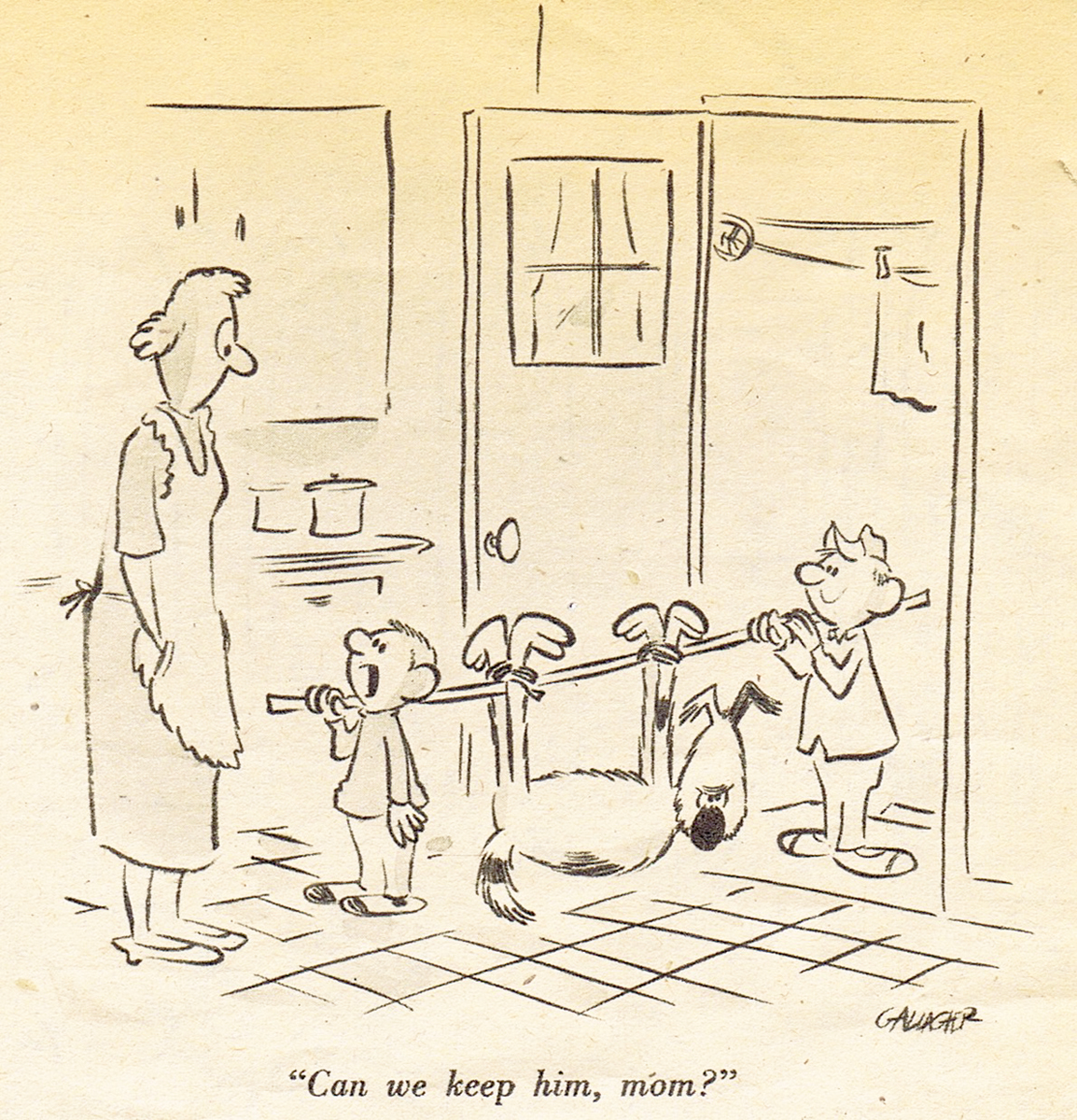
“CAN I KEEP HIM?”
1. JOHN GALLAGHER. 1000 Jokes Magazine March-May, 1957.
2. JACK TIPPIT. The Saturday Evening Post September 28 – August 4, 1962.

3. BARNEY TOBEY. Collier’s July 27, 1946.

“YOU KNOW TOO MUCH.”
1. AL KAUFMAN. Collier’s October 21, 1950.

2. ERNEST MARQUEZ. 1000 Jokes Magazine Summer, 1951.

3. VIRGIL PARTCH. Collier’s September 20, 1947.

“YOU RANG, SIR?”
1. FRANK BAGINSKI. Argosy Magazine September, 1965.

2. GERALD HOFFNUNG. Lilliput May, 1954.

3. DON OREHEK. The Saturday Evening Post September 28-August 4, 1962.

“I LIKE IT BETTER OVER THERE.”
1. RICHARD (DICK) CAVALLI. American Magazine August, 1950.

2. HERB WILLIAMS. Collier’s September 23, 1950.

3. CHARLES RODRIGUES. Cartoons & Gags February, 1962.

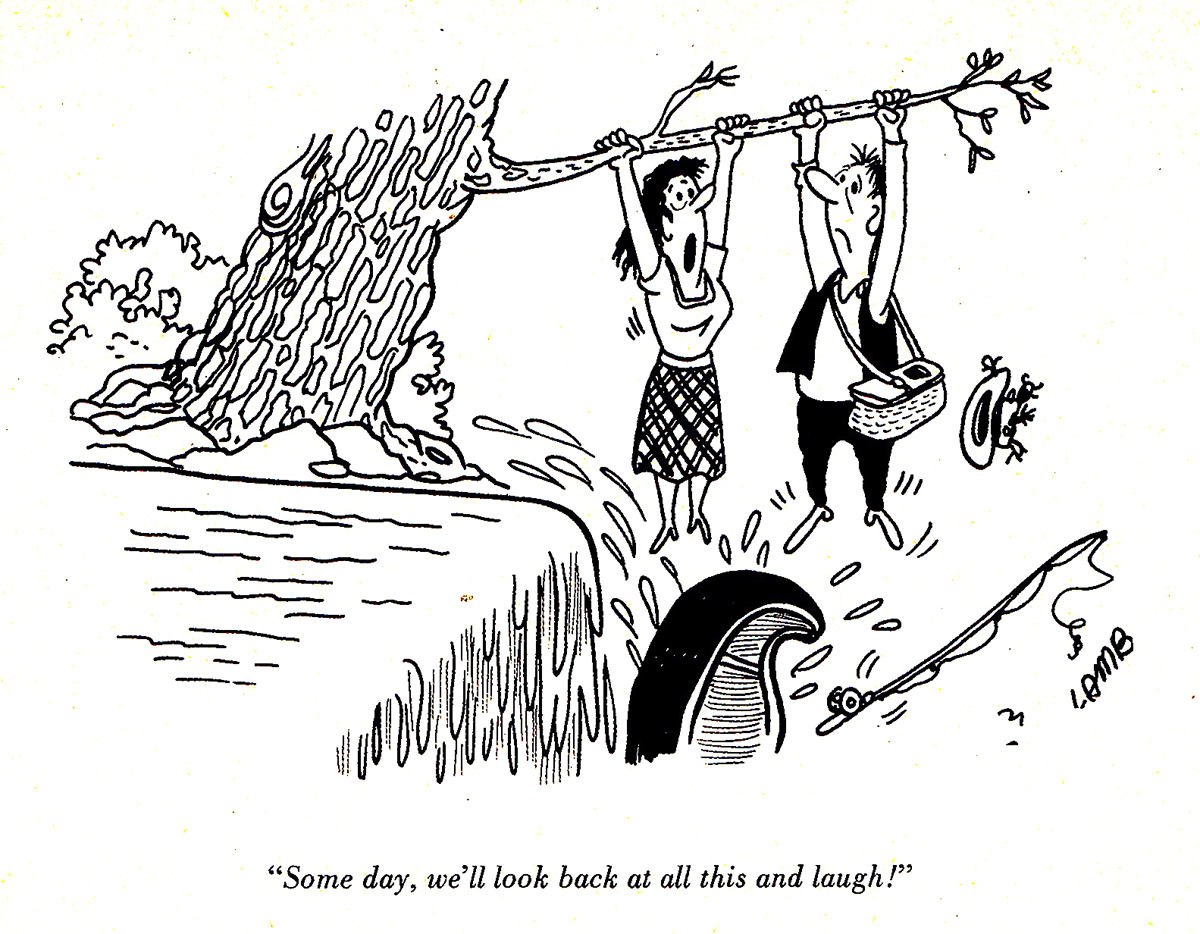
“SOMEDAY WE’LL LOOK BACK ON THIS AND LAUGH.”
1. MARTHA BLANCHARD. The Saturday Evening Post May 7, 1949.


3. CLYDE LAMB. Call of the Wild Brown & Bigelow, 1950’s
Tuesday, February 14, 2023
Richard J. Anobile 1947 - 2023

Film writer and producer Richard J. Anobile, who was known for his large-format books
that, in the pre-VCR days, transcribed motion pictures with stills and text (like Frankenstein and
Casablanca) as well as his volumes on the great comedians like The Marx Brothers and Abbott and Costello, passed away. No cause of death was given.
For a lot of people who grew up in the pre-DVD and VHS era, his books were vital for film fans back in the day when actually seeing a particular old movie was a rare event. I grew up reading a couple of his books, checking out of my local library at least once a year. For me, it was an introduction into the lore of classic movies.
My friend and colleague, Abrams ComicArts Editorial Director (and editor of the best-selling Diary of a Wimpy Kid series by Jeff Kinney) Charlie Kochman, posted a wonderful remembrance of Anobile on his Facebook page. Here's Charlie:
RICHARD J. ANOBILE, 1947–2023
Long before cable TV, VCRs, LaserDiscs, DVDs, DVRs, and streaming services, there was Richard J. Anobile.
In the 1970s and early ’80s, Anobile wrote close to fifty books on classic movies. These hardcovers were comprised of frame blowups taken directly from 35mm prints, arranged in sequence and captioned with dialogue, each film meticulously laid out on paper. Here, for the first time, we could pause and study a film in detail—the sets, costumes, and makeup, scene by scene, as they appeared on screen.
With clips and movies now easily available on all manner of devices and apps, these “photonovels” are pretty much obsolete, but at the time they were invaluable, and the only way to “see” some of these classics without scouring the TV GUIDE and waiting until they were broadcast on TV—more often than not, late at night, and all with commercial interruption. These books allowed us to pause on a frame before there was a button on our remotes that enabled us to do so with ease.
To me, Anobile’s books on the Marx Brothers—WHY A DUCK?, HOORAY FOR CAPTAIN SPAULDING, and THE MARX BROTHERS SCRAPBOOK—were essential reading, as were those on W.C. Fields, Laurel and Hardy, and Abbott and Costello. In some instances, his Film Classic Library was how I first “saw” THE MALTESE FALCON, CASABLANCA, PSYCHO, and FRANKENSTEIN.
In 1973, Anobile was sued by Groucho Marx for publishing THE MARX BROTHERS SCRAPBOOK. Apparently, Groucho did not realize that the interviews he and his brothers gave were going to be transcribed and published verbatim, with profanity and degrading comments on every page.
I have a copy of the scrapbook with Groucho’s handwritten notes annotating his objections, and it’s interesting to see what the great comedian objected to and wished he could have rescinded from the public record. Anobile prevailed, and the book remains one of the most candid records of the Marx Brothers, vulgarity aside, even if Groucho and Gummo and Zeppo conflated facts with impunity.
Growing up and hanging out with my friends, these books adorned our bedroom shelves, and the posters of their covers (some of which were by Al Hirschfeld and sold at head shops at the local mall) hung on our walls. In addition to the records we listened to, these were the books we read along with our comic books and MAD magazines.
Anobile remained active in film over the years, working for Paramount and as a producer and production supervisor. As recently as a month ago, he graciously provided research for an upcoming Marx-related project.
Thanks, Richard. Your books may be artifacts of a bygone era, but you are one of the unsung heroes of cinema, and your passing deserves that we hit pause and honor you for making movies accessible and bringing them into our homes.

Monday, February 13, 2023
Happy Birthday Abraham Lincoln and the NAACP
Heather Cox Richardson writing on her Letters from an American substack reminds us that February 12th was the birthday of Lincoln and the NAACP.
"The spark for the organization of the NAACP was a race riot in
Springfield, Illinois, on August 14 and 15, 1908. The violence broke out
after the sheriff transferred two Black prisoners, one accused of
murder and another of rape, to a different town out of concern for their
safety.
"Furious that they had been prevented from
vengeance against the accused, a mob of white townspeople looted
businesses and burned homes in Springfield’s Black neighborhood. They
lynched two Black men and ran most of the Black population out of town.
At least eight people died, more than 70 were injured, and at least $3
million of damage in today’s money was done before 3,700 state militia
troops quelled the riot.
"When he and his wife
visited Springfield days later, journalist William English Walling found
white citizens outraged that their Black neighbors had forgotten 'their
place.' Walling claimed he had heard a dozen times: 'Why, [they] came
to think they were as good as we are!'
"'If these
outrages had happened thirty years ago…, what would not have happened in
the North?' wrote Walling. 'Is there any doubt that the whole country
would have been aflame?'"
The NAACP was born in 1909, and issued a letter.
"The call continued, 'Silence under these conditions means tacit
approval,' and it warned that permitting the destruction of Black rights
would destroy rights for everyone. 'Hence,' it said, 'we call upon all
the believers in democracy to join in a national conference for the
discussion of present evils, the voicing of protests, and the renewal of
the struggle for civil and political liberty.'
"A
group of sixty people, Black and white, signed the call, prominent
reformers all, and the next year an interracial group of 300 men and
women met to create a permanent organization. After a second meeting in
May 1910, they adopted a formal name, and the NAACP was born, although
they settled on the centennial of Lincoln’s birth as their actual
beginning."
The NAACP brought racial injustice to the public's attention.
"In 1946 it was NAACP leader White who brought the story of World
War II veteran Isaac Woodard, blinded by a police officers after talking
back to a bus driver, to President Harry S. Truman. Afterward, Truman
convened the President’s Committee on Civil Rights, directly asking its
members to find ways to use the federal government to strengthen the
civil rights of racial and religious minorities in the country.
"Truman
later said, 'When a Mayor and City Marshal can take a… Sergeant off a
bus in South Carolina, beat him up and put out… his eyes, and nothing is
done about it by the State authorities, something is radically wrong
with the system.' And that is what the NAACP had done, and would
continue to do: highlight that the inequalities in American society were
systemic rather than the work of a few bad apples, bearing witness
until 'the believers in democracy' could no longer remain silent."
Consider subscribing to Heather Cox Richardson's column. Consider a gift to the NAACP.
Friday, February 10, 2023
Chris Browne 1952 - 2023

Above via Chris Browne's Facebook page.
Chris Browne, who took over the Hagar the Horrible syndicated comic strip, passed away after a long illness on February 5th, 2023. He was 70 years old. Chris continued the strip for some thirty years, after the death of its creator Dik Browne, Chris's father. Hagar the Horrible had just celebrated its 50th anniversary.
Via Comicbook.com:
"His sister Tsuiwen Browne-Boeras confirmed the news in a statement on Facebook, writing: "With much sadness, I am here to announce, my brother Christopher Browne passed away peacefully in Sioux Falls, SD after a long-term illness. After our father passed away, he was the face of our family's cartoon strip Hagar the Horrible. Besides drawing Hagar, Chris drew and illustrated children's books. He always had a sketchbook in hand and loved to draw for people. He will be very much missed by his family and friends as well as his fans throughout the world."
"The National Cartoonists Society also wrote about Brown's death, adding: 'We are sad to announce the passing of one of our longtime valued members of the NCS community, Chris Browne. Hagar had only just celebrated his 50th anniversary the day before...We will miss his talent and his gentle and kind soul.'"

Via Comics Beat:
"Hägar the Horrible, which satirised contemporary American society under the guise of its faux Viking-era setting, began February 4, 1973. It was created by Richard Arthur Allan 'Dik' Browne for the King Features Syndicate. The strip proved immensely popular and is syndicated in approximately 1900 newspapers, across 56 countries, around the globe. A framed copy of the cartoon was even spotted in the background of President Joe Biden’s Oval Office at the White House.
"Following the retirement and death of its creator, Dik’s sons Chris
and Chance Browne – plus illustrator and cartoonist Gary Hallgren who
has drawn the series since 2015 – took over the reins. Chris’
thirty-plus year tenure on the character (his brother Chance works
mainly on the continuation of their father’s other series Hi and Lois
but assisted with edits) – from 1989 to 2023 – makes him the strip’s
longest serving cartoonist (his father retired in 1988, accumulating 16
years of material)."
The Daily Cartoonist lists his many other cartooning accomplishments.
"Then in the late 1970s well into the 1980s Chris was a regular contributor to the Playboy Funnies pages creating an assortment of strips and characters. (Chris wasn’t as lewd as most of the others in the Playboy Funnies.)
"Through the years he found time to contribute to Heavy Metal, Esquire, Sarasota Magazine, The New Yorker, Dope Comix, and others. And even a children’s book. "

In the 1990s and early 2000s, Chris created two comic strips, each with an autobiographical approach. Chris Browne’s Comic Strip (1993-94) and Raising Duncan for five years beginning in 2000.
Chris also has an extensive site collecting sketches, paintings and cartoons.

Thursday, February 09, 2023
Silly About Cats

SILLY
ABOUT CATS was edited by Marbeth Reed. It's Copyright 1959 Doubleday
& Co., Inc., and features "The Best Cat Cartoons from American and
British Periodicals." So, if you do not find these too funny, I am very
sorry. These are the best and you can't do better.

Above:
a clearer version of Herb Green's cover cartoon, originally published
in the Saturday Evening Post. That's the biggest dang cat I ever saw.
Noted: husband and kitty have matching smiles.
Henry
Syverson manages action, humor and, ultimately, a little bit of
sadness, in this epic cat & mouse tale in 10 drawings. The book, as
you'll see, is heavy on Syverson. He's a fellow who knows his cats.
Click to supersize and really enjoy.
Al Johns (above) with a wordless cartoon depicting the cat/milkman struggle with the cats mounting a surge.
Mort
Walker, he of the gorgeous pen line, gives us a cartoon that, once you
see the cat with the bean bag musculature held by the Mrs., gives one a
smile. The cartoon is funny, the goofy looking cat makes it funnier.
Above:
Henry Syverson with an 8 panel wordless cartoon (read the four across
the top, then the bottom four). Once again: another Syverson
mini-graphic novel of a story.
Vahan
Shirvanian composes a ballet of man v. cat. The cat wins, of course. I
like his triumphant trotting pose in the final panel.
Above:
more Syverson, one of the unsung heroes of cartoons. He was a mainstay
at the Saturday Evening Post. If you described this cartoon to someone, I
don't think they would find it funny. But seeing the cat's expression
and the mouse peering over the corner, all zestily done to perfection by
Syverson, makes this one a rowser.
Above:
Gustav Lundberg. Dig the 1950s table & lamp detail. Even though
most of those lines in the table do not meet, it still "reads" as a
table.
John
Gallagher with a usual doozy. Look at all of those doggy noses are
bee-lined at the unaware cat. Adding that little bow on the kitty kicks
this up a notch.
Henning Gantriis
was a prolific cartoonist in his native Denmark. Virtually unknown in
the States, here is a rare peek at one of his cartoons. It requires no
caption, and is therefore accessible to people worldwide.
Above:
we finish up with more Syverson. Just look at that silly cat and the
way he washes each foot. I said if before and I'll say it again: the man
knows his cats!
-- This is an edited version of a blog entry originally published on March 19, 2008.
Subscribe to:
Posts (Atom)


 Posts

