Thursday, July 12, 2018

MAN THE BEAST by Virgil VIP Partch Part 2


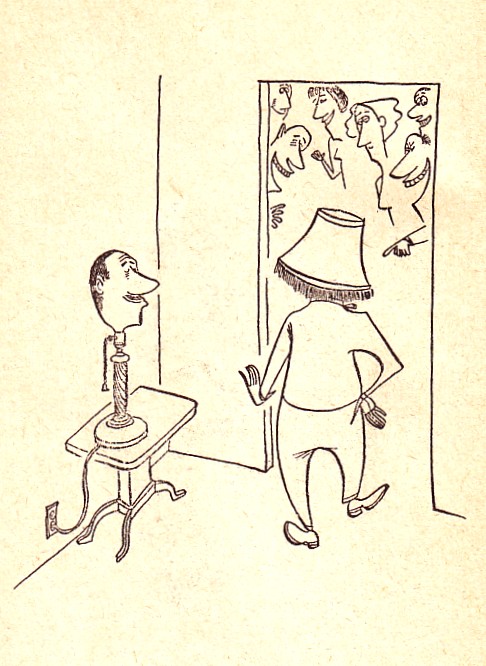
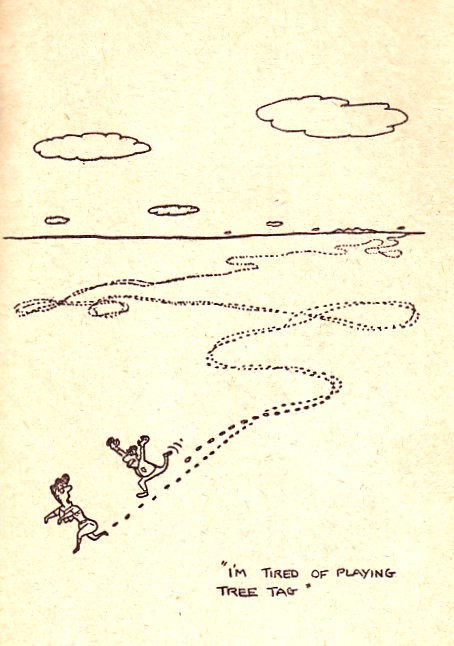
Here are some cartoons from MAN THE BEAST. It's copyright 1951, 1953 by Virgil Franklin Partch, II, "the funniest cartoonist in the world."

This is Part 2. Part 1 is here.


There is an apocryphal story that Virgil VIP Partch never got into The New Yorker magazine.

"It's because how his characters looked. He drew nostrils on his people," I was told, more than once, by a cartoonist colleague."The New Yorker didn't like it."

It's not true. I mean it's true that VIP did draw nostrils -- but he DID get into The New Yorker more than once. (According to Michael Maslin's great NYer Cartoonists A-Z list, six cartoons of Partch's appeared between 1942 and 1976.)

And does everyone know about Virgil Partch drawing six fingers?

Cartoonist Ed Nofziger said of his friend:

"As a 'Disney man,' Partch was required to follow such strict edicts as, for example, drawing four fingers on Mickey Mouse to make it easier for animating. So VIP went the other way and drew six to eight fingers on his cartoons. It was sort of teasing (the Disney style) in a way." -- LA Times

More Partch to come ...


Wednesday, July 11, 2018

MAN THE BEAST by Virgil VIP Partch Part One

This fall, specifically the 17th of October, will be the 102nd birthday of cartoonist Virgil "VIP" Partch. Let's celebrate early and look in on some rare photos and cartoons:


Here's a 1953 Dell paperback, reprinting two books in one: MAN THE BEAST AND THE WILD, WILD WOMEN by Virgil VIP Partch. It's copyright 1951, 1953 by Virgil Franklin Partch, II, "the funniest cartoonist in the world."

Dell marketing department hyperbole may have not exaggerated. It's over a half century later, and lovers of Partch are all over the place.

Partch, like other beloved cartoonists Booth and Addams (to name just two), created a whole comic world of blue collar bars, desperate passion-driven cavemen, absurd visual puns, scheming libidinous suitors, and a good helping of guys-crawling-in-the-desert and desert island gags.

This is a thick paperback of his 1950s gag cartoons. It looks to be published from his actual cartoons with NO typeset caption, just his hand-written gag line. My guess is that these are all cartoons that TRUE Magazine (and his other major markets) did not buy.

These scans are from MAN THE BEAST:


-- From an April 13, 2012 blog entry.

Tuesday, July 10, 2018

Video: Ellen Forney Talks About Being Bipolar and ROCK STEADY: BRILLIANT ADVICE FROM MY BIPOLAR LIFE

Ellen Forney has spent a lifetime expressing herself through cartooning - including the part of herself that can be difficult to broach. Rock Steady: Brilliant Advice from my Bipolar Life "is the eagerly awaited sequel/ companion book to Forney’s 2012 best-selling graphic memoir, Marbles: Mania, Depression, Michelangelo, and Me. Whereas Marbles was a memoir about her bipolar disorder, Rock Steady turns the focus outward, offering a self-help survival guide of tips, tricks and tools by someone who has been through it all and come through stronger for it."

Monday, July 09, 2018

Steve Ditko 1927 - 2018


Co-creator of Spider-Man and Doctor Strange, comic book artist Steve Ditko, died in his apartment in New York City on June 29th. He was 90 years old.

From The Guardian:


Steve Ditko, who has died aged 90, was the artist who brought Spider-Man and Doctor Strange to life, one of the three crucial creators of the Marvel explosion that redefined comic books in the 1960s. The trio – Ditko, the writer Stan Lee and the artist Jack Kirby – created and refined the iconic characters who moved from featuring in 12-cent comics to dominating film screens in productions costing hundreds of millions of dollars.

Like Kirby’s, Ditko’s work was stylised, but where Kirby’s square-jawed characters’ power exploded through the panels, Ditko’s characters stretched through them, their faces almost cartoonishly expressive. He was the perfect artist to combine the grace of Spider-Man with the nerdish insecurity of his alter ego, the teenager Peter Parker.

Spider-Man was Lee’s idea and he first gave it to Kirby to develop. Unhappy with the result, he passed it on to Ditko, who came up with the costume, powers and back-story. He was an immediate hit when he debuted in Amazing Fantasy 15 in 1962. Marvel stories were all produced in much the same manner. The writer, in the early days almost always Lee, provided the artist with a plot line, sometimes just an idea, which the artist turned into a story. Lee then added dialogue to the finished panel art.


 Obituaries and remembrances are everywhere for this giant of the comic book world.

Friday, July 06, 2018

Mike Lynch Cartoon Classes


I still have these "drawing parties," but now they are called "cartoon classes." I teach kids and adults in the New England and New York area. Here's a little bit of my philosophy ....


Making art and telling stories was something I always liked to do as a kid. But, when I was a kid, I never met a grownup who did what I did in real life, and could talk about how it all works.

Now I am that grownup.

I want to teach because I remember what it was like to be a kid who, living in a small town, would never meet someone who drew for a living. I grew up in small Midwestern towns, in "states the planes fly over."

I remember one of the first how-to-cartoon classes I taught, maybe fifteen years ago now. I talked for five minutes, and then drew a cartoon on the class blackboard. The kids laughed and then they did a thing that astonished me: they all applauded. I really was surprised I had forgotten that in this age of image-addled kids, that they probably had never seen anyone draw in front of their eyes before; creating something from nothing.


Teaching kids to create something from nothing empowers them. Telling stories, whether humorous or dramatic or autobiographical, is the way to parse meaning from life. By beginning to master the medium of sequential art, they know they are able to achieve a successful standalone story that only they could tell.

But let's peel back the core experience here; a student can realize that nothing -- drawing, algebra, biology, mathematics -- is beyond their ability. They can be what they want to be.

The first question I ask in a cartooning class is, "Where do you see cartoons?" The answer is: all around us -- cereal boxes, video games, t-shirts, advertisements, magazines, movies. And I remind them that each time they see these drawings or animations or ads, they are created by actual, real people. People like me, a person from a small town that the planes fly over, can become anything. Anyone who wants to achieve can achieve, if they are willing to work and challenge themselves and be persistent, patient. This aphorism is what I seek to instill. 

You can reach me at mike at mikelynchcartoons.com.

Thursday, July 05, 2018

Dick Buchanan: Some Favorite Magazine Gag Cartoons 1940-60s

A public belated happy two year anniversary since Dick Buchanan started contributing to this here blog. I am so pleased that he continues to pass along these hidden classic gag cartoons from his huge collection of old magazines piled up in his Greenwich Village apartment. Here's the first batch he sent that appeared on the blog two years ago now, on June 14, 2016.

----

Dick Buchanan was kind enough to pass along some favorite old magazine gag cartoons. I agree with Dick that these cartoons, most of them unseen for over fifty years, deserve an encore. Here's Dick:

----
"As an aspiring cartoonist long ago, I kept a file of cartoons clipped from every magazine I could find. I still have I still use it for reference and amusement. I am happy to share it's contents. I have forwarded a few samples. There are more."

Gahan Wilson, one of his early cartoons from Collier's, June 24, 1955:


George Booth, The Saturday Evening Post, October 17, 1953:


John Gallagher:


Hank Ketcham in an early 1950's Saturday Evening Post:


Clyde Lamb, American Legion Magazine, October 1952:


Mel Lazarus (not "Mell" yet), in the Saturday Evening Post, January 20, 1951 -- still 6 years away from Miss Peach:


Virgil Partch, Collier's, 1940s:


Rowland Wilson, in that same Saturday Evening Post issue (October 17, 1953) as George Booth (see above):


Henry Syverson. In 1963, even the furniture was funny. From Look Magazine, December 3, 1963:


Jack Tippit, Look Magazine, July 22, 1958. Two-time NCS Gag Cartoonist of the Year (1963 and 1966):


Thanks, Dick, for sharing these great gag cartoons!

Tuesday, July 03, 2018

Rob Rogers: I Was Fired For Criticizing Trump

This just out: Rob Rogers writes and draws the story I Was Fired For Criticizing Trump for The Nib.