Dick Buchanan has once more pulled some vintage magazine cartoons cartoons from his Greenwich Village flat to share with us. Here are some gag cartoons about clowns, fishing, dogs, William Tell, husbands and wives, magicians, department stores, furniture refinishing, monks, and a wonderful construction cartoon by Peter Porges. They all have one thing in common: no gag line. Thanks, Dick, and take it away:
---
NO-CAPTION VARIETY
GAG CARTOONS
(1946-1968)
Cartoonists themselves are particularly fond of their caption-less cartoon creations. They comprise but 10-15%% of all published cartoons. And they have a special place in the Cartoon Clip File—a simple manila folder with a blank label.
So here is another sampling of cartoons of the no-caption variety. As usual, some require minimal reading, while others require no reading whatsoever. And it’s all in fun . . .
1. TON SMITS. Look Magazine August 5, 1958.
2. JOHN GALLAGHER. The Saturday Evening Post April 17, 1954.
3. NED HILTON. The Saturday Evening Post July 18, 1959.
4. CLYDE LAMB. The Saturday Evening Post February 11, 1950.
5. VIRGIL (VIP) PARTCH. Liberty Magazine January 1, 1944.
6 VAHAN SHIRVANIAN. The Saturday Evening Post July 18, 1959.
7. CHARLES E, MARTIN (CEM) The Saturday Evening Post June 6, 1962.
8. CHARLES SHARMAN. Collier’s August 12, 1950.
9. HENRY SYVERSON. The Saturday Evening Post December 7, 1946.
10. JACK TIPPIT. The Saturday Evening Post August 28, 1965.
11. WALT WETTERBERG. The Saturday Evening Post January 20, 1951.
12. PAUL PETER PORGES. The Saturday Evening Post July 18, 1959.
13. HENRY MARTIN. 1000 Jokes Magazine September-November, 1968.
14. JOHN ART SMILBY. The Saturday Evening Post November 11, 1947.
15. TON SMITS. Boys’ Life January, 1967.
Wednesday, May 22, 2019
Tuesday, May 21, 2019
From the Dick Buchanan Files: Cops and Robbers Magazine Gag Cartoons 1899 - 1965
Good guys and bad guys matching wits is the staple of a lot of entertainment, the magazine gag cartoon being no exception. Here's two-thirds of a century of samples from the massive clipping files of my friend Dick Buchanan. Thanks and take it away, Dick!
---
COPS AND ROBBERS
GAG CARTOONS
(1899-1965)
From the earliest days of humor magazines one of the most popular subjects was Crime & Punishment. Criminals were always one comical step ahead of bumbling law enforcement, usually stumbling over themselves in the process. Victims were remarkably unfazed by home invasions and burglary, often remaining comfortably in bed while their home was ransacked. As usual, in Cartoon World no one got hurt.
1. F.M. HOWARTH. Howarth was one of the great cartoonists published in Puck Magazine during 19th Century. Puck September 16, 1899.
2. ORLANDO BUSINO. The Saturday Evening Post September 5, 1964.
3. DAVID PASCAL. 1000 Jokes Magazine August-October, 1963.
4. LARRY REYNOLDS Look Magazine March 17, 1959.
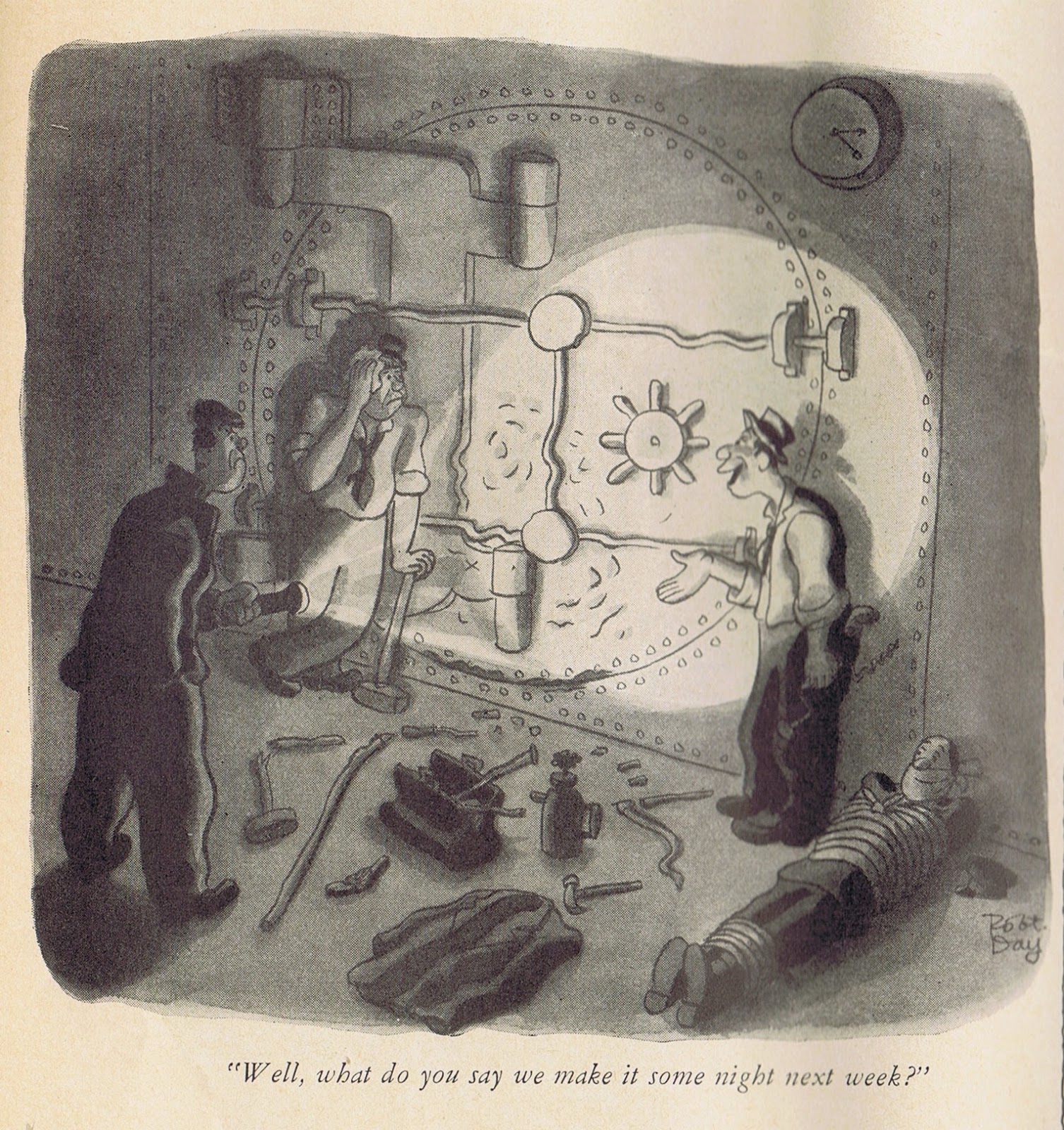
5. ROBERT DAY. Life March, 1935.
6. JAY IRVING. Colliers November 11, 1936.
7. GUSTAV LUNDBERG. Colliers October 10, 1948.
8. JOSEPH MIRACHI. True Magazine November, 1963.
9. GARDNER REA. Colliers March 8, 1952.
10. JOHN NORMENT. Colliers May 23, 1953.
11. JOHN GALLAGHER. The Saturday Evening Post July 18, 1959.
12. JERRY CALLAHAN. The Saturday Evening Post March 9, 1957.
13. VAHAN SHIRVANIAN. February 8, 1958.
14. IRWIN CAPLAN. Collier's July 8, 1955.
15. HERB GREEN. Saturday Evening Post July 11, 1959
16. VIRGIL PARTCH. True Magazine June, 1948.
Monday, May 20, 2019
Friday, May 17, 2019
Lee Ames Illustrations for CIRCUS PARADE (1954)
Lee Ames (1921- 2011) was a prolific illustrator of many books, including over two dozen of his Draw 50 book series. Lee was also a member of the Long Island National Cartoonists Society chapter, the "Berndt Toast Gang." He retired to California, and although we never met, we chatted on the phone from time to time. Lee was always very friendly and knowledgeable. He was also the guy who coined the phrase "Berndt Toast Gang."
Here is the background on the Berndt Toast Gang, which I originally wrote and is now part of a Wikipedia entry:
"The Berndt Toast Gang, named in honor of Walter Berndt, is a group of Long Island cartoonists who meet on the last Thursday of each month. As explained by cartoonist Lee Ames:
"When the Long Island group, Creig Flessel, Bill Lignante, Frank Springer, Al Micale and I got together to work for Hanna Barbera in the 1960s, we decided to have a Finnegan's Bar lunch every last Thursday of the month. During that period, Creig brought Walter Berndt to join us. We fell in love with the cigar-smoking old-timer (look who's talking!), as he did with us. After a couple of years he passed away and left us grieving. Thereafter, whenever we convened on Thursdays, we'd raise a toast to Walter's memory. On one such, my big mouth opened and uttered, 'Fellas, it's time for the Berndt toast!' I wasn't trying to be cute at the time, but I'm not displeased that it stuck and we became the Berndt Toast Gang, one of the largest branches of the National Cartoonists Society."
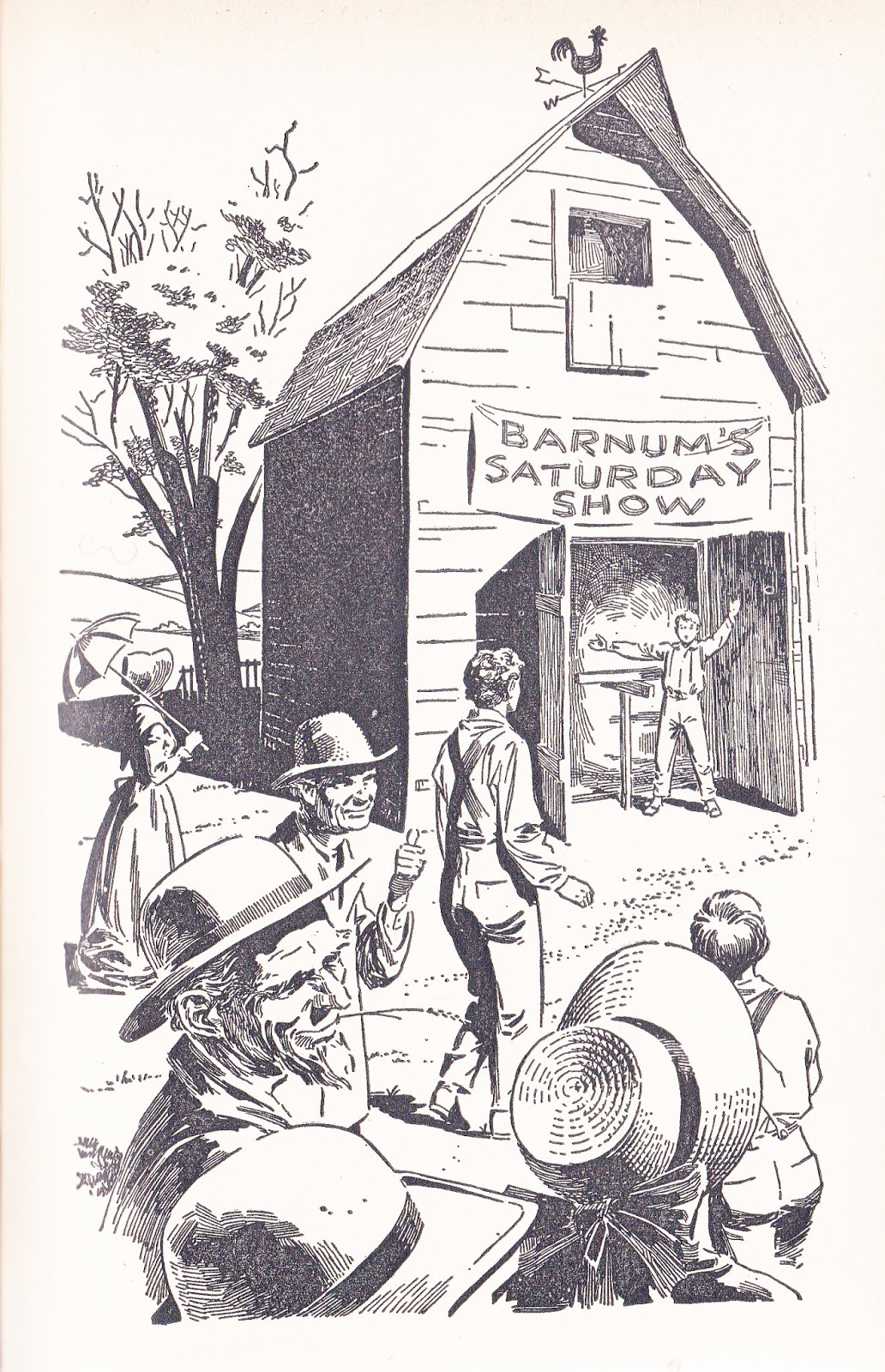
Here's a peek at just one of the books he did the illustrations for. You can see why, at the age of eighteen, he was all ready working for Walt Disney. The man had an amazing mastery of the pen. CIRCUS PARADE is a collection of short storied selected by Phyllis R. Fenner. It was published in 1954 by Knopf and is copyright that year by them.
Related:
The Comics Reporter obituary
Thursday, May 16, 2019
Jim Davis Ball State University College of Business Commencement Address, May 24, 1986
From 1986, here is Garfield cartoonist Jim Davis, giving a commencement address at his alma mater Ball State University. This is the same year that he won an Emmy for his Garfield's Halloween Special CBS TV special and "Best Comic Strip" Division Award from the National Cartoonists Society. He tells them that his one message is to pursue happiness. (Despite this being on YouTube, this is audio-only. Ball State University Libraries has just uploaded this, along with other historic BSU audio events here. Take a listen to a 1968 address by Arthur C. Clarke talking about what life will be like in 2001.)
Wednesday, May 15, 2019
Tuesday, May 14, 2019
Video: Mort Drucker and John Reiner - The NCS Masters Collection
From 2015, here is an interview with Mad Magazine's Mort Drucker by his friend John Reiner. Mort needs little introduction here. He had just been awarded the Milton Caniff Lifetime Achievement Award by the National Cartoonists Society, and this video commemorates that. John is, of course, the artist on The Lockhorns newspaper comic panel. John was also, before The Lockhorns, an assistant to Mr. Drucker. This was shot and edited by The Family Circus artist Jeff Keane.
Monday, May 13, 2019
TED Talk: New Yorker Cartoonist Amy Hwang
In 2018, New Yorker cartoonist Amy Hwang decided to leave her architecture job to pursue freelance cartooning full-time. Using her own cartoons and drawings, she explains the thought processes she used to help her reach this decision. Amy Hwang’s cartoons have appeared in The New Yorker since 2010. Born and raised in Texas, Amy moved to New York to study architecture at Barnard College where she started drawing cartoons for the Columbia Daily Spectator. She concurrently worked in architecture jobs and worked as a cartoonist until 2018 when she made the decision to focus on cartoons full-time. She lives in Scarsdale with her daughter. This talk was given at a TEDx event using the TED conference format but independently organized by a local community.
Thursday, May 09, 2019
Nurit Karlin 1938 - 2019
New Yorker cartoonist and children's book author Nurit Karlin died April 30 at a hospital in Tel Aviv, Israel. She was 80 years old. No cause of death was given.
From Michael Maslin's Inkspill:
"Ms. Karlin’s first New Yorker cartoon ran in the issue of March 18, 1974. At the time she was the only female cartoonist whose work was appearing in the magazine (the last before her was Mary Petty, who passed away in 1976, but whose final contribution to the magazine was in the issue of March 19, 1966). Ms. Karlin was the only female cartoonist in the pages of The New Yorker from April of 1966 through July of 1978 when Roz Chast’s first cartoon was published. Ms. Karlin went on to draw 77 cartoons for the magazine. Her last was published October 24, 1988. "
From "Nurit Karlin, Israeli-born cartoonist who broke into a men’s club at The New Yorker, dies at 80" in the Jewish Telegraphic Agency:
"Before coming to the United States to study animation at the School of Visual Arts in New York, she served in the Israeli army and studied at the Bezalel Academy of Arts and Design in Jerusalem.
"Fellow cartoonist Liza Donnelly recalled that when she asked Karlin where she got her ideas, she replied, 'If I knew where they came from, I would be the first in line! I used to doodle. Then something would be there.'
"Karlin published a collection of her work, 'No Comment,' in 1978. She also wrote and illustrated children’s books, including 'The Tooth Witch' (1985), 'The Dream Factory' (1988) and 'I See, You Saw' (1997).
"Karlin, who never married, is survived by her sister, Dina Wardi, and two nieces.
"After retiring about 13 years ago, she returned to live in Israel, according to The New York Times. She was active in Yesh Din, a group that aims to protect the human rights of Palestinians living under Israeli military control."
Monday, May 06, 2019
This Week on the Blog
MacBook screen broken. Suspect: one of the cats. But I didn’t see it happen, or hear it, and the primary suspect (fattest cat who likes to jump) is sooooo cute I can’t blame him.
When I get a new monitor, the blog will return to normal.
Please stand by.
When I get a new monitor, the blog will return to normal.
Please stand by.
Friday, May 03, 2019
Kazuo Koike, creator of ‘Lone Wolf and Cub,’ ‘Lady Snowblood’ manga, dies at 82
Kazuo Koike, writer of seminal manga such as "Lone Wolf and Cub," "Lady Snowbird" and "Crying Freeman," died on April 17, 2019. He had been hospitalized for pneumonia. He was 82.
His work influenced many creators in comics and movies.
From the AV Club:
"Born in 1936 in Japan’s Akita prefecture, Koike was as much an educator as a writer, having helped establish the Koike Gekiga Sonjuku training school for manga creators. He was the perfect teacher, after all, his innovations in the realm of samurai manga being some of the very first to be published in North America. His work was also adapted into numerous films that helped launch the career of Tomisaburo Wakayama and inspire the likes of Frank Miller and Quentin Tarantino, who drew heavily upon the Lady Snowblood adaptation while making Kill Bill. There’s been recent talk of a stateside adaptation of Lone Wolf And Cub, with Ghost In The Shell producer Steven Paul having bought the rights.
"A prolific creator, Koike also produced manga like Samurai Executioner, Crying Freeman, Mad Bull 34, and Mad Bull 2000, as well as Hulk: The Manga for Marvel. In 2004, he was inducted into the Will Eisner Award Hall of Fame."
From the Washington Post:
"Mr. Koike’s manga featured stylized graphic violence that benefited from the black-and-white color scheme of manga. He regarded most samurai films and manga as insufficiently violent and overly ritualized in their swordplay.
"'Black and white gave him the ability to render blood graphically without the intensity that you would have in color,' said Andrew Farago, curator of the Cartoon Art Museum in San Francisco. 'If you tried that in American comics, you wouldn’t get away with that and have mainstream distribution. It was a very cinematic approach, but it wasn’t gratuitous.' Mr. Koike and his artists, he added, 'were very aware of the audience and the boundaries and limitations of what the publisher would allow.'
"Although the series did not appear in a U.S. edition until 1987, Farago noted that its hyperkinetic style influenced American comic book artists such as Frank Miller ('Batman: The Dark Knight Returns'), Larry Hama ('G.I. Joe') and Walt Simonson ('Manhunter').
Thursday, May 02, 2019
Mort Walker on Lichtenstein
The time Lichtenstein was invited to a National Cartoonists Society meeting by Mort Walker. This is via Craig Yoe:
Related:
Russ Heath on Lichtenstein
Related:
Russ Heath on Lichtenstein
Wednesday, May 01, 2019
Video: Cartoonist George Booth Drawing At a Crown Heights Block Party
Video by Sarah Booth.
I think this was last year. Anyway, if I am able to get down and draw on the pavement when I'm in my 90s, like spry George does, I would be a happy man.
Related:
My Interview with George Booth in Hogan's Alley #22
I think this was last year. Anyway, if I am able to get down and draw on the pavement when I'm in my 90s, like spry George does, I would be a happy man.
Related:
My Interview with George Booth in Hogan's Alley #22
Subscribe to:
Posts (Atom)