Friday, April 10, 2020

Mort Drucker 1929 - 2020


Thanks to Stephen Goldberg and Adrian C. Sinnott for the pic. From left: Stan Goldberg, John Reiner, Art Cumings, myself, Mort Drucker. This is at the Great Neck Arts Center where Stan and I co-curated a comic art gallery show in 2006. There's a link to one of the panels I moderated with Mort Drucker below. 


Legendary Mad magazine caricature artist Mort Drucker passed away on Wednesday in Woodbury, Long Island. He was 91. He was a revered, one-of-a-kind talent, as well as one of the kindest gentlemen I knew.

There are a lot of obits and accolades online. Here are a few, along with some photos.


From the NY Times obit for Mort Drucker:

"Movie studios often threatened to sue Mad for its parodies. A 1980 spoof of 'The Empire Strikes Back' — portrayed by Mr. Drucker as 'The Empire Throws Up' — prompted a nasty letter from lawyers representing director George Lucas. They demanded all profits from that issue of the magazine and asked that the original art be turned over or destroyed.
"Publisher William Gaines sent them a copy of a letter received days before from Lucas, in which he gushed about the Mad parody and praised Mr. Drucker as the 'Leonardo da Vinci of comic satire.'
"'That’s funny,' Gaines wrote on his letter to the lawyers. 'George liked it.'"
Michael Cavna for the Washington Post:

"It was at a Reuben Awards Convention weekend, in 2015, that I sat with Drucker at a Washington hotel, as he recalled his career with a sense of gratitude. Sitting in the shade poolside, grinning beneath his shock of white hair, he spoke as if fortune had smiled on him.

"'I never wanted to be mean,' he said of his screen-parody work. 'I tried to be kind.'"


Adrian Sinnott, chair of the Long Island National Cartoonists Society Berndt Toast Gang chapter:

"In 1995, while visiting family in Ireland, my brother and I went down to Rathdrum in the Wicklow mountains to the 'Rathdrum International Cartoon Festival.' We met the organizer, Terry Willers and his lovely wife, Valerie (she was indispensable, the festival wouldn't have happened without her). I asked Terry if he'd like any American cartoonists to come over for future festivals. His first choice without having to take any time to consider was, Mort Drucker. I said I'd see what I could do. The next year Mort and Barbara made the trip to the festival and made the news all over Ireland and beyond. Over 20,000 people a day came from Ireland, England and Europe that weekend (to a town with 2000 residents). Years later, when the festival was winding down, Terry wrote to say how wonderful that and the subsequent visits of American cartoonists were."


"It’s no exaggeration (pun intended) that between his influence on my work as an artist, his encouragement, support and friendship, that I owe much of my career to Mort Drucker. But it’s really the friendship I valued the most. He was one of the most humble and genuine people I’ve ever met. We haven’t been able to stay in touch the last few years as much as I would have liked, but I will miss him dearly…. and so will the rest of the world."


In a 1985 Tonight Show appearance, when Johnny Carson asked Michael J. Fox, 'When did you really know you'd made it in show business?' Fox replied, 'When Mort Drucker drew my head.'"


More links:


Video: Mort Drucker and John Reiner - The NCS Masters Collection
 

Thursday, April 09, 2020

THE KATZENJAMMER KIDS by Joe Musial


Hello Dollinks! Here are a few hi res scans from the tiny KATZENJAMMER KIDS paperback collection of Sunday strips by Joe Musial. It's copyright 1970 by King Features.

THE KATZENJAMMER KIDS were created by Rudolph Dirks who, at William Randolph Hearst's request, nicked them from the German cartoon MAX AND MORITZ. 

"The strip relates in the frenzied style the war-to-the-death carried on by Hans and Fritz against any form of authority, whether parental, educational, or governmental."

I had this paperback when I was a kid and studied it. It was lost and so, last week, I bought a copy off of eBay. Such wonderful manic writing and terrific cartooning by Musial. Reading it now for the first time since I was nine years old, I was surprised at how many of the gags I remembered. 

Obviously, these are great fun (if not politically correct) to read out loud. 


That last panel, where Hans and Fritz kiss with a "smak!!" is funny and chilling and perverse at the same time.

Wednesday, April 08, 2020

Jean-Jacques Sempé: CHARLIE MENSUEL No. 104 September 1977


Before CHARLIE HEBDO ("Charlie Weekly"), it was called CHARLIE MENSUEL ("Charlie Monthly").

Here's the front and back covers, and an interior cartoon sequence by Jean-Jacques Sempé from issue number 104, September 1977.

Sempé is one of my favorite cartoonists. Born in 1932 in Bordeaux, France, he started drawing cartoons in the 1950s and could be found in many French magazines and newspapers. He drew a schoolboy character called Nicolas and the writer René Goscinny suggested a series of stories about him. The result was serialized, and then collected in a series of Le Petit Nicolas books, which are all still in print.

Sempé is still at work, and his cartoons make the cover of The New Yorker from time to time.

This cartoon is a portrait of men and women through the decades. It works like a cartoon and reads like a lovely short story. You may want to open these scans onto a new page so you can really enjoy all of the wonderful drawing.


The back cover:


Related:

Video: Jean-Jacques Sempé Draws

CARTOONS THE FRENCH WAY by Jean-Jacques Sempé

Tuesday, April 07, 2020

Video: Meet Top British Cartoonist Royston Robertson

Here's a short video of magazine cartoonist Royston Robertson, talking about how he started and we get a good glimpse of how he draws his cartoons.


Monday, April 06, 2020

From the Dick Buchanan Files: New Yorker Cartoonists 1935 - 1962

Dick Buchanan has a twist. Here are some of the great, classic New Yorker cartoonists with some gag cartoons that you never saw. Well, to be more to the point, these were NEVER seen in The New Yorker, despite these cartoonists' association with the magazine.

If all of these cartoonists were under contract to The New Yorker at this time (Some may have been, some not, but I'm guessing most were.), then one of the caveats in the contract is that the Magazine gets "first look" at their cartoons. So, these were looked at by The New Yorker, but then rejected. No Sale. So, the cartoonist was free to shop them around, trying to sell them to another publication.

So here are some virtually unseen cartoons by Addams, Hokinson, Shermund, Steig, Steinberg, Wilson and others from publications OTHER than The New Yorker. 

Take it away, Dick! (And, thanks!)

---

NEW YORKER CARTOONISTS
(1935—1962)

Some of the Cartoon Clip File’s favorite cartoonists are those who worked for The New Yorker. It was in the pages of The New Yorker in the 1930’s when the modern cartoon was crafted and perfected. Here, clipped from a variety of mid-century magazine, are some gag cartoons by some of our favorite New Yorker cartoonists . . .


1. CHARLES ADDAMS. True Magazine March 1946.


2. WHITNEY DARROW, Jr. Collier’s October 11, 1941.


3. CHON DAY. This Week Magazine November 26, 1961.


4. RICHARD DECKER. Look Magazine December 31, 1962.


5. ELDON DEDINI. Baseball Yearbook 1953


6. SYDNEY HOFF. 1000 Jokes Magazine Spring, 1953.


7. HELEN HOKINSON. Collier’s March 15, 1941.


8. GEORGE PRICE. Life Magazine January, 1935.


9. GARDNER REA. Look Magazine May 15, 1956.


10. AL ROSS. For Laughing Out Loud October – December, 1957.


11. BARBARA SHERMUND. Collier’s September 2, 1939.


12. WILLIAM STEIG. Collier’s February 4, 1941.


13. SAUL STEINBERG. Collier’s June 20, 1942.

14. RICHARD TAYLOR. March 15, 1941.


 15. GAHAN WILSON. Collier’s August 19, 1955.


Friday, April 03, 2020

Remembering Sam Cobean

I was reading a book whose name I forget. It was a history of comics kinda book. Oh, wait a minute. It's here in this messy studio somewhere ...

Rummage, rummage, rummage.


OK, found it. It's Stephen Becker's COMIC ART IN AMERICA. You may know it. I know I read it years ago when I was a kid. It was probably one of those books I checked out of library over and over way back when. I just bought it for myself last year. Anyway, it's a good book and a lot of fun. I did not remember this book when I was teaching my History of Comics class. I wish I had. (I will this fall, since I've been asked back by the college to teach it again.)

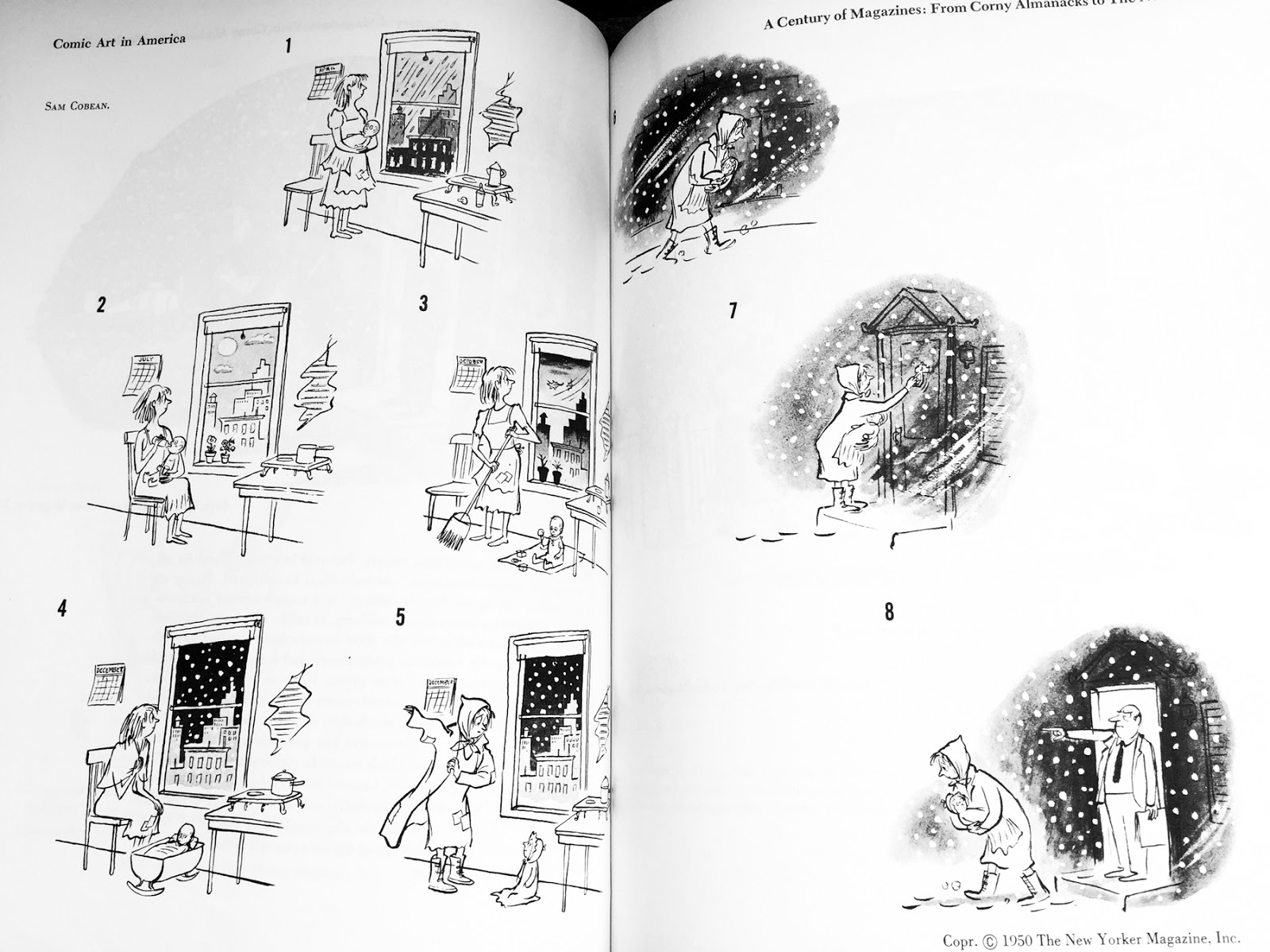
One problem: it was published in 1959. It's dated, but that's OK. Anyway, the thing I did not recall was an absolute love letter to Sam Cobean in the midst of the book. Becker goes on for a while about Cobean, reprints a loving forward by Addams from the posthumous collection of Cobean's. And then there are several pages of "unwed mother" gags. Yeah. Unwed mother gags! All by Cobean. Um ... OK, but where's the men undressing women in their thought balloons? (Becker cites these as trademark Cobean gags and there are some below.) I counted and there are FIVE unwed mother gags, one after another, including an eight panel wordless sequence. I'm scratching my head over this.

And those unwed mother gags are really OVER. Up there in gag cartoon heaven with the boss chases secretary cartoons, etc.

Someone asked me "What are unwed mother gags?" and I better clarify. FYI: unwed mothers gags -- It's a creaky old meme. The daughter has had a child out of wedlock and wants to live at home. Angry and full of shame, dear old Dad turns daughter and child out (preferably in the snow) to fend for themselves. Here they are:


Let's delve more into the short and influential life of cartoonist Sam Cobean.


Here's a quote from Playboy/New Yorker gag cartoonist Brian Savage on Sam Cobean:

"I was living in San Francisco when I definitely made up my mind I was going to become a cartoonist. I was really at loose ends. I had gone to school, college, army, and I was in San Francisco just because a friend of mine was going to the University of California. We were sharing a place together, and he went on to get his Ph.D. I saw a book and it turned me on. It sounds dramatic, but this really happened. It's a book by Cobean. I fell in love with it. It just gave me an electric shock. It really was sort of like love. I said, This is what I want to do."

- Cartoonist Brian Savage in JUMPING UP AND DOWN ON THE ROOF AND THROWING BAGS OF WATER ON PEOPLE, CARTOONS & INTERVIEWS FROM SIX OF AMERICA'S FAVORITE CARTOONISTS, Introduction and Interviews by Mark Jacobs, copyright 1980 Mark Jacobs.

Below are just a few samples of Sam Cobean's work. These were from the comprehensive Sam Cobean site which appears to now have been vacated and replaced by a sumo wrestling site or something.


Sam Cobean (1913-1951) was attending the University of Oklahoma when he entered a contest sponsored by Walt Disney. After winning the contest, Sam quit school and moved to Hollywood to work as an in-betweener on Disney's SNOW WHITE for $16 a week.

In 1942, he participated in the Screen Cartoonists Guild strike against Disney, and left the studio soon after that. He married fellow U of O student Anne McCool that same year.


Above: an illustration by Cobean. Just look at the motion in those lines.

Cobean applied for the army and the navy, but was classified 4F on account of his flat feet. He was, the following year, drafted into the army. There, Cobean worked on Army training films in New York City alongside fellow soldier Charles Addams. Addams introduced Cobean to The New Yorker magazine cartoon editor James Geraghty. Cobean began to sell to the magazine.

While still in the Army, Cobean shared a New Yorker office with Addams.


Above: another cartoon from the site. That touch of grey on the ski instructor's sweater effortlessly gives us our point of interest in the cartoon. I like the details here: the bear skin rug, the beams, the luggage, the skis leaning against a wooden pillar, the circles that Cobean's drawn to denote a big stone fireplace. It all tells us we're in a lodge.


In 1946, he was discharged and he and Anne bought a summer home in Watkins Glen, NY. Sam would be involved in the Watkins Glen Grand Prix races there. Cobean began doing a lot of work for advertising, in addition to his cartooning.

In 1950, COBEAN'S NAKED EYE, the first collection of Cobean cartoons (titled by Anne) was published.


Above: a concept sketch for the cover.

Here's the next entry from the Sam Cobean chronology page (unfortunately not there as of this writing):

1951 On Monday, July 2, Sam drove his shiny red Jaguar into Watkins Glen to mail some cartoons to The New Yorker for the regular art meeting the following day. While there, he met a friend, Cameron Argetsinger, who was having car trouble. He offered him a ride home. On the return trip they were involved in an automobile accident. Cobean swerved to avoid hitting another car, lost control and hit a tree. Cobean was killed instantly. His friend survived the crash.

Sam Cobean would be a major name -- as well known as Addams -- if his career wasn't cut short by that accident. He was a wonderful cartoonist.


Related:

Michael Maslin has some of Cobean's advertising work reproduced here.

The Hairy Green Eyeball blog has a good number of Cobean's "Naked Eye" cartoons here and  here.


Thursday, April 02, 2020

From the Illustrators Partnership: Summary of Relief for Visual Artists available under CARES Act

From Cynthia Turner and Brad Holland of the American Society of Illustrators Partnership:

---

At our request, Bruce Lehman Esq.,of Lehman Nilon & Associates has analyzed available relief to illustrators and artists under the CARES Act. We are grateful to Mr. Lehman for his quick action and expertise to decipher some dense material and give guidance to visual artists.

Mr. Lehman is Pro Bono Advisor to the American Society of Illustrators Partnership (ASIP), Legislative Advisor to Association of Medical Illustrators (AMI), and Legislative Advisor to Artists Rights Society (ARS).

As the economic disruption continues and extends these resources may be helpful, or even vital, to visual artists.

Sincerely,

Cynthia Turner and Brad Holland
Co-Chairs, American Society of Illustrators Partnership

  
____________________________________***___________________________________ 


Summary of Relief Provided to Small Businesses, the Self-Employed and Non-for-Profits under the Coronavirus Aid, Relief and Economic Security (CARES) Act
The emergency economic relief legislation signed into law last week contains several provisions that can provide support for artists who either are self employed or work in small businesses.  Illustrators and fine artists can avail themselves of three separate programs under the new law:  
* Pandemic Emergency Unemployment Compensation; 
* Emergency Injury Disaster (EIDL) Loans, and
* The Paycheck Protection Program.  
In addition, Quarterly Estimated Tax Payments can be deferred until the end of the calendar year without penalty.
Pandemic Emergency Unemployment Compensation
Normally, self-employed individuals are not covered under state-operated unemployment compensation programs as the premium for unemployment compensation insurance is paid by an employer. However, the emergency legislation covers self-employed persons who lose their income. The new legislation expands eligibility to include anyone who is:  
"self-employed, is seeking part-time employment, does not have sufficient work history, or otherwise would not qualify for regular unemployment under State or Federal law...."   
Under this provision of the CARES Act, a self-employed person will receive the weekly payment that their state normally provides under unemployment compensation insurance plus $600. The benefit lasts for up to 39 weeks. The applicant for unemployment compensation may self-certify that he or she is otherwise able to work and available to work except for their unemployment or because they have been diagnosed with the Covid-19 virus, are unable to reach their place of employment because of the Covid-19 virus or are caring for someone with the virus. 
To participate in this program a freelancer or self-employed artist needs to apply through their state's unemployment office. In most cases this can be done online. The following URL from the U.S. Department of Labor contains information and has a menu option that will link you to your state office. 
Economic Injury Disaster Loans (EIDL)
EIDL loans are normally used in the case of natural disasters such as a hurricane. Small businesses with fewer than 500 employees may borrow up to $2 million under the program. However, the CARES Act extends the EIDL program to self-employed individuals and non-profits with fewer than 500 employees who have suffered economic loss as a result of the Coronavirus pandemic.  
The program is administered by the Small Business Administration (SBA). Anyone falling into these categories may apply for loan "advance" of up to $10,000 for the purpose of maintaining payroll, meeting increased costs to obtain materials, or making mortgage or rent payments. There is little paperwork and the applicant can self-certify that he or she meets the criteria. The SBA is supposed to provide the loan advance within three days of application.  
While these advances are called loans, repayment is waived if the applicant uses the money for the enumerated purposes.  Information about applying for an EIDL advance, including a link to an online application, may be found on the SBA website at https://www.sba.gov/disaster-assistance/coronavirus-covid-19.
If an applicant also applies for a loan under the Paycheck Protection Program, separately provided in the CARES Act, the $10,000 advance will be deducted from any loan under that program.  
The Paycheck Protection Program
The CARES Act provides $ 349 billion in 

forgivable loans for small businesses and non-profits of fewer than 500 employees as well as self-employed individuals. The loans can be used for salaries and other payroll expenses, rent and utilities, mortgage interest and interest on other debts incurred before February 15, 2020.
Applicants can seek amounts that are two and a half times monthly payroll expenses for full-time employees. The limit is $10 million with repayment within ten years at a 4% interest rate. However, the loan in effect converts to a grant if the recipient keeps all employees on the payroll through June 30, 2020 and uses the money for allowable expenses. Allowable expenses are: (1) payroll costs; (2) continuation of employee health care benefits; (3) employee salaries, commissions and similar compensation, (4) mortgage interest; (5) rent; (6) utilities; (7) interest on pre-existing debt.
The loan program will be administered by banks and credit unions that that have agreed to participate. As of this writing the program is not up and running, but cooperating banks and credit unions should be able to begin processing applications in the very near future. Since the loans will be processed on a first come, first serve basis until the $349 billion limit is reached, it is important to move quickly if there is a desire to participate in this program. If you have a bank with which you normally do business, you may wish to contact them as soon as possible to get in the que for this program.  


Some related links: 

How to get a small business loan under the $349 billion aid bill

American Artists' Petition to Congress - US artists need a federal bailout now: Congress needs to protect this country’s creative workforce
 A Way to Help Local Comics Shops Stay in Business: ComicHub announces plan to distribute digital comics via comics shops

Wednesday, April 01, 2020

CovidComics: How Life Has Changed by My Sister-in-Law

My sister-in-law wrote about how her life has changed in unexpected little ways due to #covid19. I asked if I could draw up what she had written, and she said OK. Thanks, Jenny! #coronacomics #CoronavirusUSA #covidlife