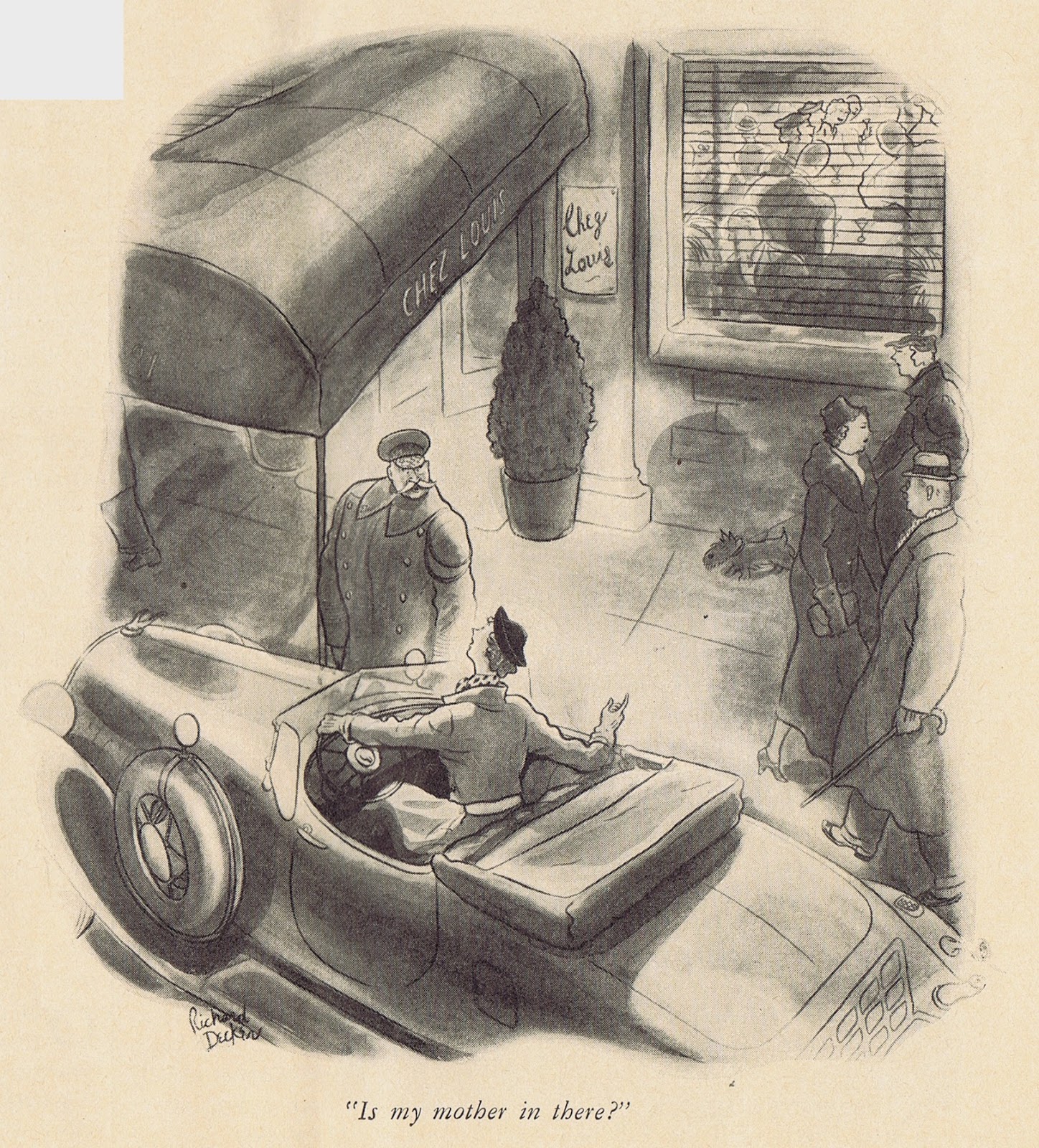
I'm away this week, and so have handed the blog reins over to the one and only Dick Buchanan. Dick has dived into his file of gag cartoons, just like Scrooge McDuck dives into his pile of money, and has come out with some great gems of single panel cartooning to share. Thank you, Dick!
----
GAG CARTOONS
(1941 – 1968)
The Cartoon Clip
File, housed somewhere in the friendly confines of New York’s Greenwich
Village, contains thousands of gag cartoons. Each week more are clipped
and neatly filed away for posterity. Now that posterity has arrived,
it is time to present some of the best recent additions to this growing
collection of gag cartoons from the funny mid-century--sometimes funny
strange, sometimes funny “Ha! Ha!” It was faithfully recorded by an
array of great American cartoonists who witnessed it all.
1. TOM HENDERSON. Boy’s Life November, 1968.
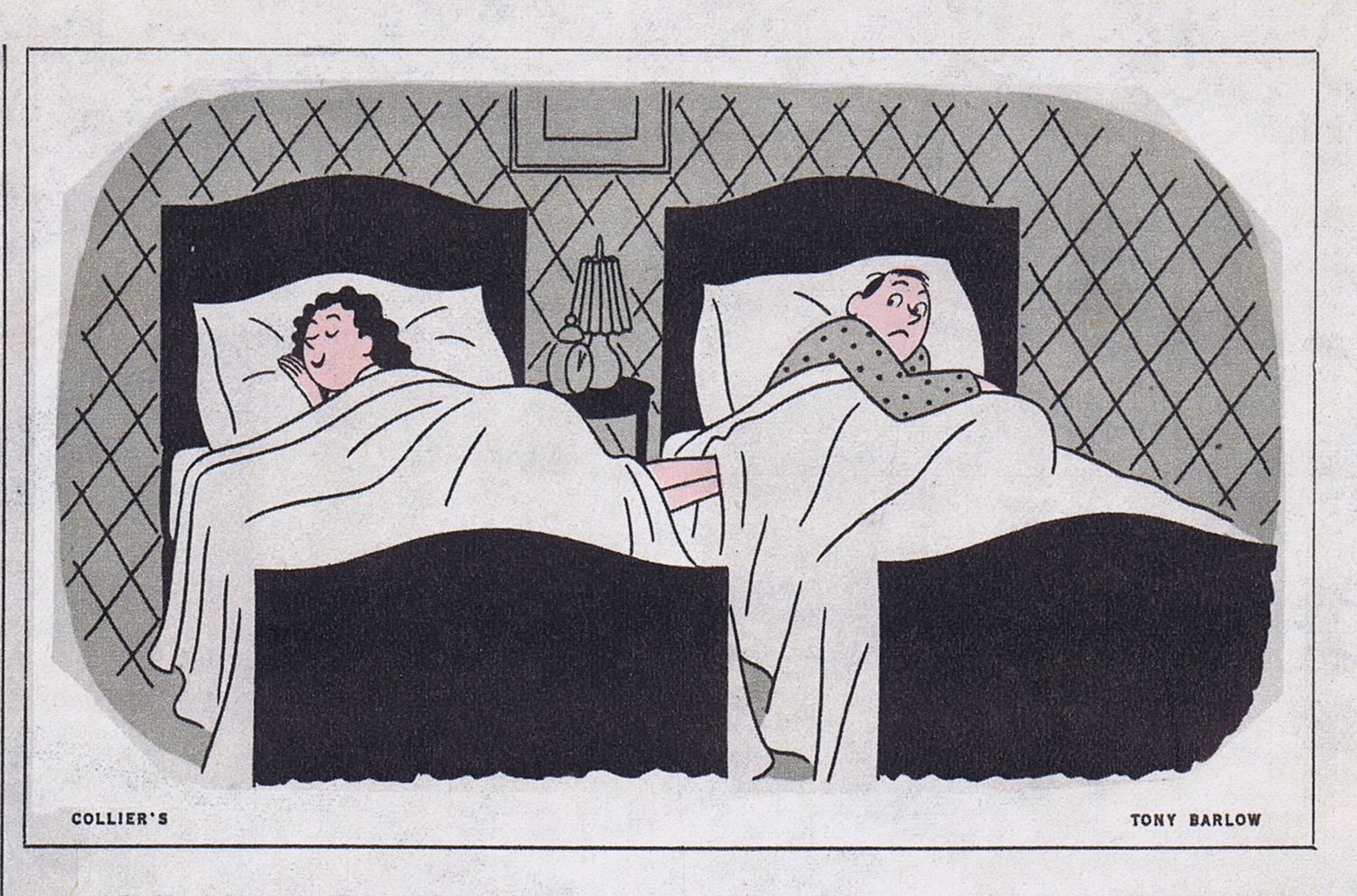
2. TONY BARLOW. Collier’s March 2, 1946.
3. BILL BERG. Collier’s December 14, 1946.
4. DON OREHEK. The Saturday Evening Post November 17, 1962.
5. MORT TEMES. The Saturday Evening Post April 17, 1954.
6. JOHN RUGE. Collier’s December 9, 1950.
7. GARRETT PRICE. Collier’s April 18, 1942.
8. SALO ROTH. February 16, 1946.
9. NED HILTON. The Saturday Evening Post February 24, 1951.
10. JOHN GALLAGHER. The American Legion Magazine August, 1958
11. CHARLES SAXON. The Saturday Evening Post January 11, 1947.
12. ED KOREN. 1000 Jokes Magazine March-May, 1964.
13. ROY WILLIAMS. The Saturday Evening Post January 11, 1947.
14. VIRGIL PARTCH. Collier’s October 30, 1948.
15. JOHN MILLIGAN. Collier’s October 4, 1941.
Tuesday, April 23, 2019
Monday, April 22, 2019
From the Dick Buchanan Files: New Yorker Luminaries 1933 - 1942
I'm away from the studio, so it's great when it comes to blog-time, I can ask a friend to contribute. Dick Buchanan is such a friend. From his Greenwich Village apartment full of gag cartoons, he has assembled a generous sampling of seven great gag cartoonists. Thanks and take it away, Dick!
---
NEW YORKER LUMINARIES
(1933 – 1942)
The Cartoon Clip File contains cartoons by the great, near-great and the not so great. This selection of cartoons is by the great . . . Charles Addams, Whitney Darrow, Jr., William Steig, Syd Hoff, Barbara Shermund and Richard Taylor. These were some of the artists who became identified with The New Yorker. One may surmise The New Yorker was the first to look at their work, but it couldn’t publish everything. Undaunted by New Yorker rejection, these cartoonists would proceed to submit them to other magazines, and the first in line would be Collier’s. The second most prestigious cartoon market in those days was Collier’s, followed closely by The Saturday Evening Post and, while it was still publishing, Life. Most of these cartoonists continued to appear in Collier’s until its demise in 1956, albeit less frequently as the years passed. Here is an assortment of cartoons, from Life and Collier’s from the 1930’s and early 1940’s, by seven artists considered by most to be New Yorker luminaries.
1. CHARLES ADDAMS. Collier’s September 10, 1938.
2. CHARLES ADDAMS. Collier’s June 10, 1939.
3. CHARLES ADDAMS. Collier’s March 4, 1939.
4. WHITNEY DARROW, Jr. Life May, 1936.
5. WHITNEY DARROW, Jr. Collier’s July 19, 1941.
6. WHITNEY DARROW, Jr. Collier’s September 4, 1941.
7. RICHARD DECKER. Life January, 1935.
8. RICHARD DECKER. Collier’s September 25, 1937.
9. RICHARD DECKER. Collier’s June 10, 1939.
10. SYD HOFF. Collier’s March 4, 1939.
11. SYD HOFF. Collier’s January 6, 1940.
12. SYD HOFF. Collier’s May 2, 1941.
13. BARBARA SHERMUND. Collier’s September 10, 1938.
14. BARBARA SHERMUND. Collier’s April 6, 1940.
15. BARBARA SHERMUND. Collier’s April 18, 1942.
16. WILLIAM STEIG. Collier’s January 28, 1939
17. WILLIAM STEIG. Collier’s April 6, 1940.
18. WILLIAM STEIG. Collier’s April 18, 1942.
19. RICHARD TAYLOR. Collier’s May 13, 1939.
20. RICHARD TAYLOR. Collier’s January 6, 1940.
21. RICHARD TAYLOR. Collier’s May 10, 1940.
Friday, April 19, 2019
My Interview with George Booth in Hogan's Alley #22
Hogan's Alley "the magazine of the cartoon arts" has hit the stands and, oh boy, is it chock full of just about everything.
For instance, here's a snippet from the long interview I did with George Booth:
Mike Lynch: We were just talking about Gurney Williams and how Gurney 's words stayed in your life.
George Booth: Gurney Williams was the editor of Collier 's, and I came to New York I think in 1950 or '51. No, it was '51 because I was recalled in December of '50. So it was '51 and I went to see Gurney Williams. I was at Leatherneck. I had gotten a letter from Gurney Williams at Collier 's to submit some of my stuff to him. I was still in my corps, and I sold to Collier 's.
Lynch: Did you sell to Collier 's while you were still in the service?
Booth: Yeah.
Lynch: Oh, you did?
Booth: By mail, and then barely sold one or two.
Lynch: This is when you were stationed at Stars and Stripes in DC, right?
Booth: Yeah, I was in Washington, DC. And it was stuff that had already been turned down by Leatherneck, so there was no problem there. And maybe I reshaped it. I don t remember. But when I came to New York, I went to see Gurney Williams. This is a little vague to me now. I may have sold him after I got here, I can 't remember. But he had sent me a letter to come and see him and submit stuff. I had never been in the city before. Everything was small town to me. So I came to New York City from Washington, DC. I located Collier 's. They were in a high office somewhere, and I had the letter in my hand for me to come and see him. I got into where Collier 's was, and I asked where Gurney Williams' office was. This woman told me where it was, so I went back to Gurney 's office. It was dark. He wasn 't there, so I went in and sat down and waited for him. And I sat there for quite a while. Pretty soon another woman comes in and said, Who are you? What are you doing in Gurney Williams ' office? I said, I 'm waiting for Gurney Williams. She said, Get out of here, you can 't wait in here. [laughter] So she put me out in the hallway waiting area, and so I waited.
Lynch: But wait a minute, George were you sitting there in the dark?
Booth: Yeah. I was asked to come and see him. Where was I supposed to wait?
Lynch: You were following orders.
Booth: Right. Anyway, he did show up and we had a good visit. And I think it was later that he told me I was submitting stuff to him, and I was kind of getting carried away. He told me my stuff was too wild and unreal and too contrived and a few others words that I remember. And then I kind of shaped up the reality and he began to buy my stuff.
It's all in the new issue of Hogan's Alley: George's early life, from the Marines Corps and Leatherneck Magazine, to moving to NYC to getting into The New Yorker. It was a fun interview to do -- and it all started with his crummy looking chair. Well, you can read the interview and see what that's all about.
In other Booth news: today is the last day to help fund an upcoming George Booth documentary. Take a look at this Kickstarter link "Drawing Life with George Booth."
Thursday, April 18, 2019
"He has dementia, but cartoonist Gahan Wilson still sees humor in the world"
Gahan Wilson's stepson, Paul Winters, has put together a GoFundMe campaign to help with the medical costs associated with a memory care facility.
"Gahan is suffering from severe dementia. We have helped him through the stages of the disease and he is currently not doing very well."
He had raised just over $59,000 of the $100,000 goal. Please consider contributing. I have.
Here's a recent Arizona Republic article by Karina Bland about Gahan Wilson and how he's doing now.
"Gahan has dementia. In March, his wife of 53 years, Nancy Winters, died.
"'She was his guide through the world,' [Gahan's stepson] Paul said. Nancy was an author. They had been living in an assisted living facility. Gahan couldn't stay on his own."Gahan still draws, although not for publication. And he has good days and bad.
"Paul and Patty [Winters] work in the film business. They are moving to a ranch in New Mexico with Gahan. There's a memory care facility nearby where the residents keep chickens and goats. Gahan will like that.
"He'll continue to draw, finding humor in the world around him.
"'I think that's the most lovely thing about humor,' Gahan said. 'It can take kind of grim stuff and turn it into a joke and destroy it therefore, so it goes away.
"'It's a lucky thing we've got it, our sense of humor.'"
Wednesday, April 17, 2019
Darrin Bell Wins Pulitzer Prize
Congratulations to Darrin Bell upon his winning the Pulitzer for editorial cartooning. Runners up were Rob Rogers and Ruben Bolling.
Poynter has more cartoons.
The Washington Post's Michael Cavna: How the Trayvon Martin tragedy led to Darrin Bell’s historic editorial cartooning Pulitzer
Tuesday, April 16, 2019
Editorial Cartoonist Dwane Powell 1944 - 2019
Editorial cartoonist Dwane Powell, a longtime editorial cartoonist with the News and Observer in Raleigh, NC, passed away on Sunday at the age of 74. The cause was cancer.
From the News and Observer:
“His early work was influenced by MAD Magazine cartoons,” said Mike Keefe, an editorial cartoonist who had a similarly long career at the Denver Post and lives now in Mexico. “There would be just this crazy stuff going on: birds on heads and construction equipment with human feet. Just things that came out of Dwane’s head. Nobody else did anything like it. He just had a real zany approach.
“His cartoons are worth studying. He would make a point about something political, and make it strongly. But you would get lost in the detail. They were always like that,” Keefe said.
Read more here: https://www.newsobserver.com/news/local/article229034069.html?cid=DM14869&bid=176555357#storylink=cpy
For over three decades Dwane Powell skewered the left and the right as an editorial cartoonist at the News and Observer. Here's a look back of some of his best work:
Read more here: https://www.newsobserver.com/news/local/article229034069.html?cid=DM14869&bid=176555357#storylink=cpy
Powell has won the Overseas Press Club Citation for Excellence in Cartooning, the National Headliners Club award for Outstanding Editorial Cartoons, and was named Distinguished Alumnus at his alma mater. He has published three collections of his work, along with a book of Jesse Helms quotes containing his cartoons and his cartoons were an important element in the News and Observer's Boss Hog series, which won the 1995 Pulitzer Prize for Public Service. Nationally syndicated by Creators Syndicate in Los Angeles,
Monday, April 15, 2019
Subscribe to:
Posts (Atom)