The Economist Magazine's editorial cartoonist Kal describes his creative process for making cartoons.

Thursday, June 06, 2019

Wednesday, June 05, 2019
Taschen Releases Its Second "The Complete Little Nemo" Book

After PEANUTS and GARFIELD, maybe LITTLE NEMO is the most reprinted comic strip. How many editions of Winsor McCay's classic comic strip books do you have?
Sunday Press is the gold standard of comic strip reprint books, and its NEMO reprint books are beautifully reproduced. And they are HUGE, at 16" x 21" -- these are not books you casually read in bed. Regardless, Sunday Press' first volume has sold out of four printings so far.
Taschen brought out its series beginning in January 2017 with THE COMPLETE LITTLE NEMO 1905-1909. Above is the cover of the second book, just out now, THE COMPLETE LITTLE NEMO 1910-1927. They are both slightly smaller that the massive Sunday Press edition (13.5 x 1.5 x 17.2 inches), but still weigh at over nine pounds a volume. Here are a few scans from the Taschen books, expertly designed by Alexander Braun. Thanks to John Freeman for the scans.


Tuesday, June 04, 2019
Interview: "The Well-Drawn World of Frank Cotham"

Memphis, TN resident and cartoonist Frank Cotham is interviewed by Memphis Magazine about his career and life.
"No one in the Cotham family was an artist. And at first, young Frank wasn’t sure if he was, either. “I remember a teacher holding up a picture before the class that I had colored with crayons, as an example of how not to do it,” he said in a 2010 New Yorker interview.
"Nor did he come into cartooning via any of the traditional on-ramps. 'I’ve always hated comic books,' he says. 'I liked Peanuts for a while, but I never read the funny papers. I don’t think I’ve got the attention span to go four panels. If I didn’t get it in one panel, it didn’t interest me too much. I liked the art you saw in magazines. It was mostly black and white, so I’ve worked mostly in black and white. To me, the drawings are so much more elegant in some ways. … I got interested in magazine cartoons in junior high school. I discovered The New Yorker then.'"
Here's a really great question by interviewer Chris McCoy:
"Being successful in any creative field means learning to live with rejection. How did Cotham manage? 'I never really could,' he says. 'There was a lot of blubbering and carrying on. Most people would just send you back a form. … But some people weren’t so nice. ‘Don’t send us any more of this crap’ or ‘This is totally inappropriate for this conversation’ or ‘Good luck selling this somewhere else!’ You just got used to it after a while, I guess.'"
Monday, June 03, 2019
Who Drew These Art Linkletter "People Are Funny" Game Cards?

Art Linkletter was a big name in the TV world of the 1950s and 60s. One of the shows that he hosted was "People Are Funny." It was so well known that it became a Bugs Bunny cartoon. (See the Looney Tunes title card below,"People Are Bunny.") It was so well known that it spawned this here game that I picked up at a consignment shop in Searsport, ME.

The show had "real people" stunts. Few celebrities were on it. It began in 1942 as a radio show, and Linkletter came on as regular host the next year.

From Wikipedia:
For a memorable stunt of 1945, Linkletter announced that $1,000 would go to the first person to find one of 12 plastic balls floating off California. Two years later, an Ennylageban Island[2] native claimed the prize.[1][3]
As the popularity of the program escalated, a movie musical titled People Are Funny was released in 1946, offering a fictional version of the show's origin in a tale of rival radio producers. Phillip Reed appeared as Guedel, with Linkletter and Frances Langford portraying themselves. Also in the cast were Jack Haley, Helen Walker, Ozzie Nelson and Rudy Vallée. One outstanding moment in the film is a Spanish dance number performed by Lupe Mayorga (aka Lillian Molieri) to the song "I Love My Marimba." The radio series moved to CBS from 1951 to 1954, returning to NBC from 1954 to 1960.[1]

And so, back to this game I found. It's from 1954, and the object is that you pull four cards and. well, I guess it works kinda like charades. People are supposed to guess what you are, what you are doing.
But my question isn't about the way the game was played. I'm interested in who drew the incredible full color crazy cartoon characters for all of these cards. I have no idea. Any guesses?


These are just a few of the many cards with the game. My guess? These were done by an anonymous staffer at a company. Either the company that manufactured the game, or a PR firm associated with the network.
My thanks to Artbyheather's Flikr page for some of these scans.
Friday, May 31, 2019
Some Sketches from the Sketchbook
Some sketches from the last month. All are on the run, drawn in my sketchbook, usually while waiting for a plane or a bus ....
Overheard at a diner this past weekend. “I saw these high school kids on TV. They don’t even know WHO we were fighting in World War Two.”

Overheard at a diner this past weekend. “I saw these high school kids on TV. They don’t even know WHO we were fighting in World War Two.”

Drawing people at the airport.


A couple of overheard true story moments.


A couple of overheard true story moments.


Sketches while traveling.


Thursday, May 30, 2019
Tizzy by Kate Osann

Kate Osann was, like a lot of New Yorkers, a Midwestern transplant. Born in St. Louis, MO, she would graduate from Hunter College. She got a job drawing advertising illustration for the Saturday Evening Post and Colliers. It was in the 1950s that she created Tizzy, a panel cartoon that appeared exclusively in Collier's Weekly until that magazine's demise in 1957. The same year, Newspaper Enterprise Association picked up her panel for syndication. The feature, which was about an typical teenage girl, would run until 1970.
Three books of collected panels were published, reprinting the strip: Tizzy: That Loveable, Laughable Teen-Ager (Berkeley, 1958), More Tizzy (Berkeley, 1958), and Tizzy (Scholastic Book Services 1967).
She married William O. Chessman and would live in Bronxville, NY and then move to Orlando, FL. They had "two large and vocal children," William and Kathy. At Syracuse University, seven boxes of her originals are deposited.
Here are some of her panels from the 1967 Tizzy collection. It's copyright that year by NEA.


-- This is an edited version of a blog entry that originally appeared April 10, 2018.
Wednesday, May 29, 2019
Gladys Parker: A Life in Comics and A Passion for Fashion by Trina Robbins
A new biography of cartoonist Gladys Parker by cartoonist and historian Trina Robbins is coming from Hermes Press.

From the press release:


From the press release:
Gladys Parker: A Life in Comics and A Passion for Fashion
Hermes Press is coming to slay the fashion industry- with some HERstory! Gladys Parker: A Life in Comics and A Passion for Fashion explores the history behind Mopsy and her creator Gladys Parker! This beautiful book will also provide a rarely seen collection of Mopsy stories and many of Parker’s earlier strips.
Cartoonist Gladys Parker was unique in comics. As with Frida Kahlo, it was impossible to tell where her art left off and its creator began. Parker mixed fashion and comics and created classic characters that mimicked her sense of fashion. In fact, Parker was an exact double for her ink-and-paper creation, Mopsy.
Tarpe Mills and Dale Messick both dressed to kill and included paper dolls featuring their heroines’ chic 1940s wardrobes. Tarpe Mills and Lily Renee were fashion models before they drew comics. But only Gladys Parker (and one other)* was a fashion designer with a successful line of clothing while at the same time drawing an equally successful comic strip. Parker’s dresses bearing the Gladys Parker label were sold at her own New York shop and at high-end department stores across the country – and she also found the time to costume Hollywood movies and the beauties that starred in them!
Who better to chronicle the story of Gladys Parker than comics herstorian Trina Robbins, who in the 1960s designed clothes for hippies and rock stars out of her East Village boutique, while drawing underground comix?
ISBN: 978-1-61345-181-6

Tuesday, May 28, 2019
From the Dick Buchanan Files: Gag Cartoon Clichés Part 9 1937 - 1968
Courtesy of the massive gag cartoon clip files of Dick Buchanan, here are some more gag cartoon clichés. This is part nine of this study, and there are links to other samples that Dick has culled below. My goodness, go and see! My thanks to him for this and -- take it away, Mr. B:
---
GAG CARTOON CLICHES Part Nine
(1937 - 1968)
The Cartoon Clip File continues the task of surveying gag cartoon clichés prevalent during the mid-20th Century. We began compiling this illustrated list when confronted with a list of 100 Gag Cartoon clichés more than a year ago. Over time we have used this list as a guide, finding typical examples of gag cartoons from the great magazines of the era. Our research also uncovered several examples of clichés which were not on the list so we have added them to this accounting, creating the Cartoon Clip File Cliché Compendium. Here is the latest installment . . .
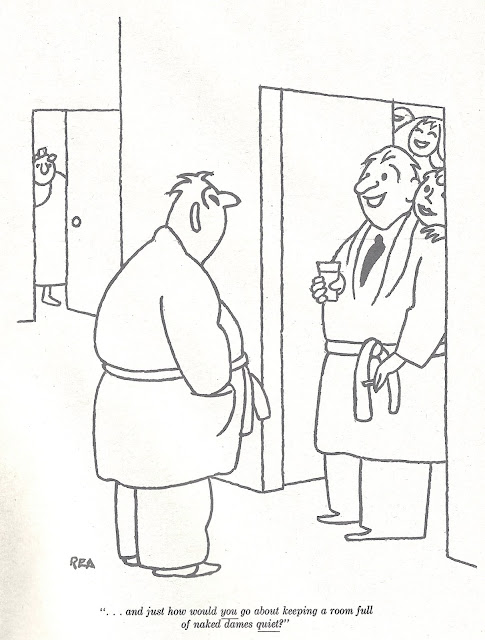
THE LOUD PARTY.
1. CLYDE LAMB. 1000 Jokes Magazine August-October, 1954.

2. ELMER ATKINS. Collier’s April 16, 1954.

3. GARDNER REA. 1000 Jokes Magazine March-May, 1964.
NOAH’S ARK.
1. ORLANDO BUSINO. Boys’ Life November, 1968.

2. CLYDE LAMB. American Legion Magazine December, 1953.

3. A.F. WILES. Punch July 2, 1958.

HUSBANDS COMING HOME LATE.
1. BILL YATES. American Legion Magazine January, 1956.

2. GEORGE CRENSHAW. 1000 Jokes Magazine Winter, 1950.

3. ROBERT CHURCHILL. The Saturday Evening Post February 24, 1951.

BEDTIME STORIES.
1. PERRY BARLOW. Collier’s June 2, 1937.

2. SALO ROTH. The Saturday Evening Post July 30, 1949.

3. ROLAND COE. Collier’s August 1, 1942.

PERFUME COUNTER.
1. REAMER KELLER. Judge March, 1947.

2. GEORGE DOLE. The Saturday Evening Post August 28, 1965.

3. BOB WEBER. True August, 1962.

Need more?
Gag Cartoon Clichés Part 1
Gag Cartoon Clichés Part 2
Gag Cartoon Clichés Part 3
Gag Cartoon Clichés Part 4
Gag Cartoon Clichés Part 5
Gag Cartoon Clichés Part 6
Gag Cartoon Clichés Part 7
Gag Cartoon Clichés Part 8
---
GAG CARTOON CLICHES Part Nine
(1937 - 1968)
The Cartoon Clip File continues the task of surveying gag cartoon clichés prevalent during the mid-20th Century. We began compiling this illustrated list when confronted with a list of 100 Gag Cartoon clichés more than a year ago. Over time we have used this list as a guide, finding typical examples of gag cartoons from the great magazines of the era. Our research also uncovered several examples of clichés which were not on the list so we have added them to this accounting, creating the Cartoon Clip File Cliché Compendium. Here is the latest installment . . .
THE LOUD PARTY.
1. CLYDE LAMB. 1000 Jokes Magazine August-October, 1954.

2. ELMER ATKINS. Collier’s April 16, 1954.

3. GARDNER REA. 1000 Jokes Magazine March-May, 1964.

NOAH’S ARK.
1. ORLANDO BUSINO. Boys’ Life November, 1968.

2. CLYDE LAMB. American Legion Magazine December, 1953.

3. A.F. WILES. Punch July 2, 1958.

HUSBANDS COMING HOME LATE.
1. BILL YATES. American Legion Magazine January, 1956.

2. GEORGE CRENSHAW. 1000 Jokes Magazine Winter, 1950.

3. ROBERT CHURCHILL. The Saturday Evening Post February 24, 1951.

BEDTIME STORIES.
1. PERRY BARLOW. Collier’s June 2, 1937.

2. SALO ROTH. The Saturday Evening Post July 30, 1949.

3. ROLAND COE. Collier’s August 1, 1942.

PERFUME COUNTER.
1. REAMER KELLER. Judge March, 1947.

2. GEORGE DOLE. The Saturday Evening Post August 28, 1965.

3. BOB WEBER. True August, 1962.

Need more?
Gag Cartoon Clichés Part 1
Gag Cartoon Clichés Part 2
Gag Cartoon Clichés Part 3
Gag Cartoon Clichés Part 4
Gag Cartoon Clichés Part 5
Gag Cartoon Clichés Part 6
Gag Cartoon Clichés Part 7
Gag Cartoon Clichés Part 8
Subscribe to:
Posts (Atom)


 Posts
Posts

