Friday, December 17, 2021

DON'T LOOK NOW BUT IT'S CHRISTMAS AGAIN by Fritz Wegner


DON'T LOOK NOW BUT IT'S CHRISTMAS AGAIN is a small paperback by Fritz Wegner and is copyright 1983 by same. Published by Patrick Hardy Books, this wonderfully rendered volume shows us 

  • Santa, 
  • angels, 
  • shepherds, 
  • flocks, 
  • Botticelli 
  • and pretty much anything related to ye olde tyme Chistmases.


Before coming across this little book, I had never heard of Fritz Wegner. Heck, I couldn't find his site. Windriver Studios has a short bio here.  [Edit: site is down as of this writing.]


Fritz Wegner was born in Vienna, Austria, in 1924, but was naturalized as a British subject. He studied at St. Martins School of Art from 1939 to 1942, and later became a guest lecturer. He eventually began doing freelance work, which included exhibition design for the Ministry of Agriculture royal shows.

Wegner's professional career has encompassed stamp design, advertising for English and American clients, and illustrations in books, magazines and periodicals. He is ardent about illustrating children's books and has enjoyed collaborating on the production of religious advent cards. Collecting prints, books and musical instruments and painting for pleasure are a few of the activities that occupy his spare time.
I like his cartoon style, with its almost painterly pen noodling. Some of the gags are great. These are just a few samples.


-- Edited from an original blog entry of December 23, 2011.

Thursday, December 16, 2021

George Price Cartoons from We Buy Old Gold (1951)


New Yorker cartoonist George Price (1901-1995) contributed to The New Yorker for seven decades. Despite this, he may not be as well remembered as, say, a James Thurber or a Charles Addams. I don't know why. His gags were always a lot of fun. Some remind me of crazy Far Side kinda jokes. His ink line work was impeccable. There is a breeziness in his lines, particularly in the first couple of decades. 


The absurdity is what makes these still vibrant cartoons. These are all from We Buy Old Gold, one of his many book collections. (Others include titles like: Good Humor Man, It's Smart To Be People, Who's In Charge Here?, Is It Anyone We Know?, George Price's Ice Cold War.) The cartoons are copyright 1951 by Mr. Price. 


The interesting thing about this collection is how many of his cartoons deal with water, and flooding in particular. What with Climate Change, these seem like an even more vital cartoon genre today. 


So, I thought I would just put up the cartoons that dealt with floods, but I found I got distracted. First, by other water cartoons (plumbing, flooded basements) and then just by ones that struck me as funny/well drawn. 


So here's a small selection from We Buy Old Gold (1951). You will see why Mr. Price should be better remembered! 


Wednesday, December 15, 2021

From the Dick Buchanan Files: Hank Ketcham Roughs

I have been lucky to have been in the studios of some great cartoonists, but not Hank Ketcham's. Today's blog entry is as close as we can come today to seeing the inner workings of the Dennis the Menace creator's drawing board from 1949 to 1951. My friend Dick Buchanan has generously put these Ketcham roughs together. Thanks, Dick!

---


HANK KETCHAM ROUGHS

1949-1951


Here are some marvelous roughs by Hank Ketcham, which were published in 1000 Jokes Magazine. 
When young Mort Walker became the magazine’s editor in 1949 he was able to acquire a few Hank Ketcham roughs that, naturally, he happily published. By the end of 1950 cartoonist Bill Yates replaced Walker as 1000 Jokes Magazine’s editor.  Whether Yates acquired these roughs or Walker left them is open to question. Yates would remain editor until 1960. 

Thanks to Walker and Yates, we are offered a rare glimpse  of Ketcham’s work--some of Ketcham’s great free-style drawings from 1000 Jokes Magazine. 


1.  1000 Jokes Magazine Summer, 1949.


2.  1000 Jokes Magazine Summer, 1949.


3.  1000 Jokes Magazine Fall, 1949.


4.  1000 Jokes Magazine Fall, 1949.


5.  1000 Jokes Magazine Spring, 1950.


6.  1000 Jokes Magazine Spring, 1950.


7.  1000 Jokes Magazine Summer, 1950.


8.  1000 Jokes Magazine Winter, 1950.


9.  1000 Jokes Magazine Winter, 1950.


10. 1000 Jokes Magazine Winter, 1951.


-- This has been an edited version of a blog entry originally published December 15, 2017.

Tuesday, December 14, 2021

Chad Frye: Storyboarding Rudolph the Red-Nosed Reindeer


Chad Frye has had a long and varied career in animation. He's professional and he's good! He's the guy you can call on to get the work done. Even if there are only three days to draw a storyboard that needs hundreds of drawings. 

Here's his latest in his own words (with a link to the finished YouTube video product):


"Back in August, I was hired to storyboard a Christmas music video for Capitol Records' recording of 'Rudolph the Red-Nosed Reindeer' as sung by Burl Ives. Production was accomplished by the Fantoons Studio using computer graphics, but they did a great job making it look like stop-motion puppet animation. 
 
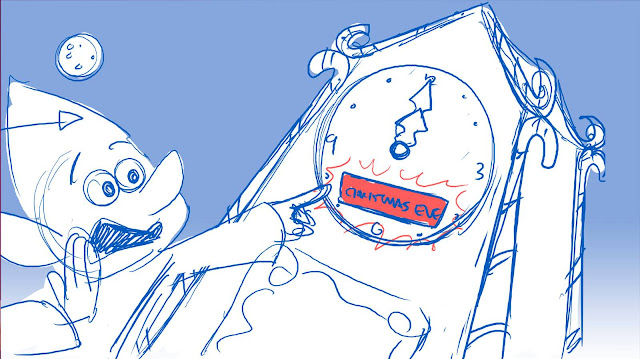
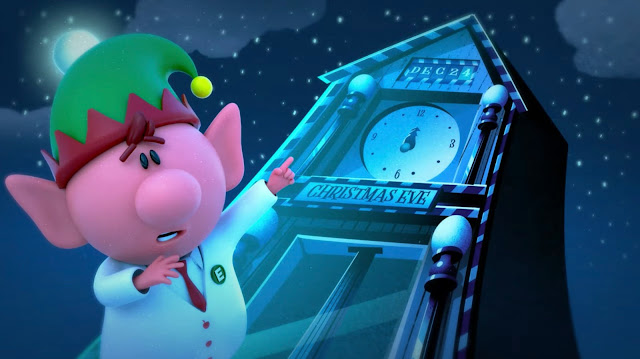
"Storyboarding is not always a very glamorous art form. My drawings for this were fairly simple sketches due to only having about three days to board the whole thing, but in that time I whipped out about 260 drawings. What IS important is what those drawings communicate: composition, camera angles and movements, transitions, indications of lighting, acting - basically all those aspects of filmmaking that you see when you watch a movie or TV show.
 
"Thought I'd share with you a few of my storyboard panels, followed by the corresponding final frames from the video. 
 
 
Much more at Chad's blog here.  


Oh, and if you saw the video, you may have noticed something about Rudolph's red nose. Here's Chad from his blog:

"Okay, I know you are all wondering, so let me set the story straight – why doesn’t Rudolph have a red nose in the cartoon? Well, despite Capitol Records having the ownership of that recording, they don’t own the rights to the visual of a reindeer with a red nose. That right is likely owned by whoever owns the actual song, thus my director’s invention of the floating red orb."
 
Thanks for the peek behind the scenes, Chad!

Monday, December 13, 2021

Video: Far Out Isn't Far Enough: The Tomi Ungerer Story (2013)

Here's one of the best documentaries about a person who makes his living from drawing: "Far Out Isn't Far Enough: The Tomi Ungerer Story."

The entire film is (as of today) on YouTube here. A preview is below. (This preview is NSFW due to language, so you are duly warned.)


Friday, December 10, 2021

Ever Happen To You? by Bud Blake


Bud Blake (1918 - 2005) dropped out of high school, sold some cartoons to Judge Magazine and enrolled in the National Academy of Design. He worked his way up from paste-up boy, a job he acquired at the age of 18, to Executive Art Director at New York City's Kudner Advertising Agency.

"Even though he was surrounded by what he called 'good men and good pay,' Blake realized that all the time he spent commuting and traveling meant less and less time at the drawing board, where he was happiest. 

"After a three-month sojourn to Spain, Blake returned to his drawing board as a freelance cartoonist for a variety of advertising clients and magazines, such as Business Week and Family Circle. He created a series of one-panel cartoons, which he brought to King Features Syndicate. The syndicate signed him to do a daily panel called, 'Ever Happen to You?'" - King Features

Best known for his long-running Tiger comic strip (1965 - 2003), this panel is its predecessor.

Here are some cartoons from Bud Blake's (1918 - 2005) Ever Happen To You? newspaper comic panel.

"King Features was looking for a cartoonist to do a cartoon similar to H. T. Webster's panel series, as Webster had recently died. Blake was hired to draw this series, which ran from 1954 to 1965 under a variety of titles ('Home Sweet Home,' 'Growing Pains,' 'Ever Happen to You?''). - Wikipedia

These are copyright 1958 - 1963 by King Features.

Sure, these are some typical-of-its-time upper-middle-class sitcom-style jokes about white suburbanites. Take a look at the cartooning -- the master line work: full of energy, yet controlled. The black spotting that draws your eye to the element that's essential to see to get the gag. And by looking at the over, you can see how his panels took reduction well. More than well! 


Related:

Ger Apeldoorn has a huge trove of Bud Blake's work here