Guild Files Notice of Appeal in Dismissal of Defamation Lawsuit
On April 26, the Guild filed a notice of appeal in the dismissal of the defamation lawsuit filed in the Fall of 2008. The Guild strongly disagrees with the judge's ruling in this case. For clarification purposes, the lawsuit is a defamation lawsuit regarding statements made by the defendants named in the lawsuit. It has no connection to the Orphan Works bill of 2008, or the Google class action lawsuit. Our statement on the notice of appeal can be downloaded here. An informational article on reprographic royalties can be read in our archived news.

Showing posts with label Creators' Rights. Show all posts
Showing posts with label Creators' Rights. Show all posts
Friday, April 29, 2011
Graphic Artists Guild Files Appeal Against Illustrators' Partnership
The Graphic Artists Guild has appealed the appellate judge's decision this week to dismiss the defamation lawsuit against The Illustrators' Partnership. Here's the press release:

Thursday, April 28, 2011
Illustrators' Partnership: Graphic Artists Guild Lawsuit Dismissed
A message from The Illustrators' Partnership of America:
Graphic Artists Guild Lawsuit Dismissed
| Last week the New York State Supreme Court, New York County, dismissed all claims in a million dollar lawsuit brought by the Graphic Artists Guild (GAG) against the Illustrators' Partnership of America (IPA) and five named individuals. In the lawsuit, GAG asserted claims for defamation and interference with contractual relations, alleging that IPA had interfered with a "business relationship" GAG had entered into that enabled GAG to collect orphaned reprographic royalties derived from the licensing of illustrators' work. GAG alleged that efforts by IPA to create a collecting society to return lost royalties to artists "interfered" with GAG's "business" of appropriating these orphaned fees. In her decision, Judge Debra James ruled that statements made by the Illustrators' Partnership and the other defendants were true; that true statements cannot be defamatory; that illustrators have a "common interest" in orphaned income; and that a "common-interest privilege" may arise from both a right and a duty to convey relevant information, however contentious, to others who share that interest or duty. Regarding a key statement at issue in the lawsuit: that GAG had taken over one and a half million dollars of illustrators' royalties "surreptitiously," the judge wrote: "Inasmuch as the statement [by IPA] was true, [GAG]'s claim cannot rest on allegations of a reckless disregard of whether it was false or not. Truthful and accurate statements do not give rise to defamation liability concerns." (Emphasis added.) And she noted: "The plaintiff Guild has conceded that it received foreign reproductive royalties and that it does not distribute any of the money to artists." Labor Department filings provided as evidence to the court document that between 2000 and 2007, GAG collected at least $1,581,667 in illustrators' reprographic royalties. GAG admitted to having collected similar royalties since 1996. GAG's officers have repeatedly refused to disclose how much money their organization has received to date or how the money has been spent. DUTY AND COMMON INTEREST The judge concluded that this situation justified an assertion of common interest by IPA. This means that "the party communicating [relevant information] has an interest or has a duty" to convey that information truthfully to others "having a corresponding interest or duty": "The duty need not be a legal one, but only a moral or social duty. The parties need only have such a relation to each other as would support a reasonable ground for supposing an innocent motive for imparting the information. Here the plaintiff Guild's factual allegations demonstrate that the defendants' statements were both true, and fall within the parameters of the common-interest privilege." (Emphasis added.) We hope this decision will end the two and a half years of litigation during which GAG pursued its claims against IPA and artists Brad Holland, Cynthia Turner and Ken Dubrowski of IPA, as well as attorney Bruce Lehman, former Commissioner of the US Patent Office and Terry Brown, Director Emeritus of the Society of Illustrators. All defendants were participants in a public presentation sponsored February 21, 2008 by 12 illustrators organizations. The presentation was disrupted by GAG's officers and their attorney. A videotape of the event proves that statements which GAG alleged to be defamatory were made only in response to GAG's intervention, and that until that time, no speakers had mentioned GAG or GAG's longstanding appropriation of illustrators' royalties. Last year, on January 12, 2010, Judge James issued a prior ruling dismissing nearly all of GAG's causes of action. This left only a claim asserted by GAG against Brad Holland. But in a response filed with the court February 4, 2010, attorney Jason Casero, serving as counsel for IPA, pointed out that GAG's remaining claim rested on an allegedly defamatory statement that Holland never made. When confronted with evidence, GAG was forced to admit it had "inadvertently attributed" the statement to Holland. GAG subsequently filed new motions in an effort to revive its claims against IPA and the other defendants. Last summer the judge consolidated GAG's multiple motions and on April 18, 2011, she dismissed all ten causes of action against IPA and all the defendants. REPROGRAPHIC RIGHTS AND ORPHAN WORKS GAG served the lawsuit on IPA October 10, 2008, seven days after Congress failed to pass the Orphan Works Act of 2008. The Illustrators' Partnership and 84 other creators' organizations opposed that legislation. GAG had lobbied for passage of the House version of the Orphan Works bill. Mandatory lobbying disclosures document that GAG spent nearly $200,000 in Orphan Works lobbying fees. In our opinion, the issues behind the lawsuit are greater than whether an organization should be allowed to benefit from the millions of dollars that, collectively, illustrators are losing. We believe the reprographic rights issue is linked to both orphan works legislation and the Google Book Settlement, which Federal Judge Denny Chin dismissed on March 22, 2011. Each of these developments involves an effort by third parties to define artists' work and/or royalties as orphaned property, and to assert the right, in the name of the public interest or class representation, to exploit that work commercially or to appropriate the royalties for use at their sole discretion. So far, judges have affirmed that copyright is an individual, not a collective right, and that unless one explicitly transfers that right, no business or organization can automatically acquire it by invoking an orphaned property premise. Now the challenge for artists will be to see that Congress does not pass legislation to permit what the courts have so far denied. We'll have more to say about this issue in the future. For now we'd like to conclude by thanking our attorney Jason Casero, who provided us with a strong, incisive and heartfelt defense; his law firm, McDermott Will & Emery, which provided us with his services; the Volunteer Lawyers for the Arts of New York and its Director Elena Paul. We'd also like to thank Dan Vasconcellos, Richard Goldberg, and the over 700 artists and illustrators who in 2008 signed a petition asking GAG (unsuccessfully as it turned out) to drop the lawsuit; the support of so many colleagues was a great tonic at a low time. Finally we'd like to thank the representatives of the 12 organizations that comprise the American Society of Illustrators' Partnership (ASIP). ASIP is the coalition organization IPA incorporated in 2007 to act as a collecting society to return royalties to artists. - Brad Holland and Cynthia Turner for the Board of the Illustrators' Partnership This message may be reposted or emailed in its entirety to any interested party. |
The Illustrators Partnership Orphan Works Blog
Sunday, March 27, 2011
Court Rejects Google Book Settlement

A news release from The Illustrators Partnership:
FROM THE ILLUSTRATORS' PARTNERSHIP
Court Rejects Google Book Settlement
3.23.2011
| Yesterday, U.S. Circuit Judge Denny Chin rejected the Book Rights Registry settlement between Google and the US Authors Guild. The $125 million commercial agreement would have rewarded both parties for the largest mass infringement of authors' copyrights in history. Instead, the judge ruled it a business deal "too far."
"A Reversal of Copyright Law" is what we called this agreement in our warning to illustrators September 29, 2009. Like the visual arts "databases" we opposed during the Orphan Works fight, we wrote:
"this agreement would allow both Google and a yet-to-be-created Book Rights Registry to commercially profit from an author's work whenever they say they can't locate the author.
"Both schemes would force authors to opt out of commercial operations that infringe their work or to 'protect' their work by opting-in to privately owned databases run by infringers. This Hobson's Choice for authors reverses the principle of copyright law."
Judge Chin held this to be the case. "A copyright owner's right to exclude others from using his property is fundamental and beyond dispute," he ruled. "[I]t is incongruous with the purpose of the copyright laws to place the onus on copyright owners to come forward to protect their rights when Google copied their works without first seeking their permission."
The judge also noted objections to the "Adequacy of Class Representation." In short, this holds that neither Google, nor any organizations claiming to represent authors, nor the university libraries that gave Google "permission" to digitize their holdings, own the copyrights to the works this agreement would have allowed them to exploit.
Therefore, they have no standing to broker deals based on claims that they represent the "class" of authors.
The judge held this to be the case even where organizations asserted the right to "expropriate" "orphaned" royalties belonging to rightsholders. Noting that "After ten years, unclaimed funds may be distributed to literary-based charities," the judge concluded:
"[A]t a minimum a fair question exists as to whether this Court or the Registry or the Fiduciary would be expropriating copyright interests belonging to authors who have not voluntarily transferred them. As Professor Nimmer has written: 'By its terms Section 201(e) is not limited to acts by governmental bodies and officials. It includes acts of seizure, etc., by any 'organization' as well.' 3 Melville B. Nimmer & David Nimmer, Nimmer on Copyright §10.04 (Rev. Ed. 2010) (footnote omitted)." [Page 31 of the judge's ruling, emphasis added.]
In rejecting the settlement, Judge Chin also echoed the US Justice Department's antitrust objections: The deal, he wrote, "would give Google a significant advantage over competitors, rewarding it for engaging in wholesale copying of copyrighted works without permission..." He suggested the settlement might win approval if it were revised to cover only those who opt into the agreement.
|
| Please post or forward this message to any interested party. |
Wednesday, March 02, 2011
Video: Rebels of the Ninth Art
African editorial cartoonists ask,
This is part of a longer documentary titled "Résistants du 9ème Art,” available on DVD or VOD formats.
"Why are cartoonists in Africa assaulted, jailed, sacked, banned and even assassinated? And some even forced to flee into exile? Can cartooning be part of a democratization process?"
This is part of a longer documentary titled "Résistants du 9ème Art,” available on DVD or VOD formats.
Friday, February 11, 2011
The Value of Your Creativity

Should you give away your work for free?
If you do, then "free" is your price.
Hey, even if you do not want to work for free, there are people out there who have no problem asking you.
For instance: Here's a person who placed an ad on the Web for a cartoonist. It's from one of those services where people post job listings and then the lowest bidder wins. You don't have to read the whole screed , but the point is he isn't shy about telling you why he will only pay 5 cents for a drawing. So, here's the whole thing, as it was posted on a job board, a few weeks back:
Title: 2000 Simple Line Drawings
Project ID: 686564
Budget: Under $250
Category: Illustration & Art
Description: Hi there, I'm working on an education project, and I need around 2000 simple line drawings of a variety of subjects: a dog, a cat, a house, etc. My budget is rather limited, so I am looking for a talented artist in the Philippines, India, or somewhere else where they won't mind working for about $3.00 per hour. When I say simple line drawings, I mean a simple vector drawing like this: http://www.artbyrichardmoore.com/files/2_dog.jpg orhttp://www.artbyrichardmoore.com/files/21_house.jpg. For a talented artist, with a drawing pad, I am sure you could complete each drawing in about a minute, so it works out to about $0.05 a picture. The reason I am asking for one person to complete the drawings is that I would like them to be consistent in style. I realise this is not a lot of money, but I am on a very limited budget and this is the best I can do. The ideal candidate is a natural artist who is super speedy and can plow through many drawings in a row. Working on this for 2 hours a day, it probably would take about 20 days to complete, so I am not going to propose an arbitrary deadline. If you are interested in applying, please respond to this image and include a few sample sketches. If you're quick, this should take less than 10 minutes. - a dog - a tree - a house - a simple landscape with a clock in the foreground showing a specific time (day) - a simple landscape with a clock in the foreground showing a specific time (night) (the final project will probably have about 10 of these, the purpose is showing different times) - a grandmother - a father - a washing machine - a $20 bill and other change - a car - breakfast I'll leave it at that. I'm just looking for super speedy line drawings in white, on a clear background. Obviously you can watermark the samples and I will not use them for any purpose other than evaluating you as a candidate. If you are selected and we come to an agreement, I would like full ownership of the works and a promise that you will not use them for any other purpose. If you think any of this is unreasonable, please get back to me with your thoughts and I will try to work something out that you think is fair. Thank you so much for your time, (I am traveling at the end of this week, so I will leave this posting open until I return on Monday 7 Feb)
You can't make a living (at least in the US and Western Europe) by making 5 cents a drawing.
But, let's say that just once you are going to give away your work. If you do, then you may be stuck "Free" becomes your price.
And that's what we are seeing with the HuffPo/AOL merger.
The Huffington Post, based on a business model of writers working for free, has been bought by AOL for $315 million. The unpaid content providers, the writers, want a piece of that. Ariana Huffington, who started the site, will not share the payday. A memo went out telling the writers that the only change will be that there may be more people reading their work than ever before:
"Your posts will have an even bigger impact on the national and global conversation. That's the only real change you'll notice - more people reading what you wrote."
You know the old saying: But people DIE from exposure!
What's the difference between the person who wants 2000 drawings and Ariana Huffington? Not much. They are both looking for something for nothing.
It's up to you whether your say yes or no to a potential client who asks you to work for free. If the client is from a money-making operation, then they are able to pay you. More than that: they should recognize the value of your work.
If they do not, smile and move on.
Unless you have a day job and can afford to work for free.

Related: If You Give Away Your Cartoons for Free, You Won't Make a Living as a Cartoonist
Related: Working for Free Business Model
And Ted Rall has a good cartoon today about the merger.
So does Matt Bors.
A hat tip to my pal David Jacobson for cutting and pasting that appalling job offer from a job board. I wish it was unique, but those kinda request are out there every day.
Sunday, December 12, 2010
The Wire Wants All Creators' Rights
One of the great things about drawing is that you can take a piece of paper and fill it with a scene out of your imagination. When I teach cartooning, sometimes someone will draw something really interesting and I'll ask,
And then I pick it up and hold it for the class to see. I talk about the choices that they made when drawing and why it's significant. And then I give the drawing back to the person.
Now, why do I do that?
Because that person made the drawing, they own the drawing.
Which brings me to a free weekly newspaper called The Wire. The Wire is a small tabloid that lists concerts, art exhibits and happenings around the NH seacoast area.
The Wire likes to showcase work by locals.
The Wire is asking for free content and it wants to own all rights too. Here's the latest, a quarter page house ad that now appears in every issue:
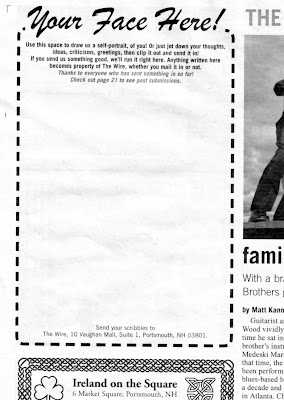
Like me showing something someone else draws in class, The Wire wants to share.
But then it wants to grab it, take it away ... and along with that, all the creator's rights.
Why do they do that? Shame on The Wire.
ADDENDUM: What I don't get is that "whether you mail it in or not" bit. So, I doodle something in that box there, and then toss the thing in the trash. Does that mean if a Wire employee goes through my garbage and finds it, then it's theirs? Weird.
Related: Harlan Ellison: Pay the Writer
Related: Signing Your Rights Away
Related: Cartoon Contests and Creators' Rights
"Can I show this to the class?"
"Okay."
And then I pick it up and hold it for the class to see. I talk about the choices that they made when drawing and why it's significant. And then I give the drawing back to the person.
Now, why do I do that?
Because that person made the drawing, they own the drawing.
Which brings me to a free weekly newspaper called The Wire. The Wire is a small tabloid that lists concerts, art exhibits and happenings around the NH seacoast area.
The Wire likes to showcase work by locals.
The Wire is asking for free content and it wants to own all rights too. Here's the latest, a quarter page house ad that now appears in every issue:

"Use this space as as self-portrait of you! Or just jot down your thoughts, ideas, criticisms, greetings, then clip it out and sent it in! If you send in something good, we'll run it right here. Anything written here becomes property of The Wire, whether you mail it in or not."
Like me showing something someone else draws in class, The Wire wants to share.
But then it wants to grab it, take it away ... and along with that, all the creator's rights.
Why do they do that? Shame on The Wire.
ADDENDUM: What I don't get is that "whether you mail it in or not" bit. So, I doodle something in that box there, and then toss the thing in the trash. Does that mean if a Wire employee goes through my garbage and finds it, then it's theirs? Weird.
Related: Harlan Ellison: Pay the Writer
Related: Signing Your Rights Away
Related: Cartoon Contests and Creators' Rights
Wednesday, June 23, 2010
Content That Is Not Suitable for Printing

I have no right to sell the above Baltimore Oriole t-shirt, which I had put up for sale a couple of weeks ago thru my Zazzle store.
"Unfortunately, it appears that your product, Baltimore Oriole, contains content that is not suitable for printing at Zazzle.com."I got the above note in my email in box last week.
Sure, as you may remember, I drew my own color sketch of the Baltimore Oriole that I had seen in my very own yard. The bird drawings drew a lot of comments and so I put some of those images on t-shirts for sale via Zazzle. Why not?
Well, that was NOT a good idea according to the Zazzle on-line store:
"Design contains an image or text that infringes on intellectual property rights. We have been contacted by the intellectual property right holder and at their request we will be removing your product from Zazzle’s Marketplace due to intellectual property claims."
You can still buy it, now renamed as No Name Bird.
Wear it in protest to an Orioles game.
Note to the lawyers: the Baltimore Oriole bird had the name FIRST, dang it!
Thursday, April 22, 2010
Video: Cartoonist Gregorius Nekschot On the Impact of Islam on Free Speech in Dutch Society
This is a 3 minute video from Dutch Danish television of Cartoonist Gregorius Nekschot and researcher Ajiedj Bakas talking about the impact of Islam on free speech in Dutch society. There is a short intro in Dutch Danish, and then most of the piece is in English.
Translation of Danish introduction:
Translation and more information here.
Translation of Danish introduction:
Not only in Denmark do we have an on going discussion about the limits of free speech.
In Holland many artists censor them selves, simply because of fear of the muslims.
But here you can meet an artist who found a solution to that problem; he works under cover using a pseudonym.
But that doesn't stop Gregorius Nekschot
The artist has received death treats just like Jyllands Posten's Kurt Westergaard, which is why he works anonymously.
But he continues, unlike many others.
Translation and more information here.
Friday, October 23, 2009
Friday, October 02, 2009
Orphan Works and the Google Book Settlement Part 3
FROM THE ILLUSTRATORS' PARTNERSHIP
Orphan Works and the Google Book Settlement / Part III 10.2.09 Compelling Arguments On September 10, 2009, Marybeth Peters, Register of the US Copyright Office, testified before Congress in opposition to the Google Book Search Settlement. Her arguments on behalf of creators rights are compelling and we support them. However, we note with some irony that they are nearly identical to the arguments we made in opposing the Orphan Works bill last year. We don't know what conclusions to draw from this fact, but we think it's fair to draw attention to it. We've picked several examples below and matched them with quotes from our own writings and testimony. In every case, the emphasis is ours. Marybeth Peters on the Google Book Settlement: "The [Google] settlement is not merely a compromise of existing claims, or an agreement to compensate past copying and snippet display. Rather, it could affect the exclusive rights of millions of copyright owners, in the United States and abroad, with respect to their abilities to control new products and new markets, for years and years to come." IPA on the Orphan Works Bill: The bill's sponsors say it's merely a small adjustment to copyright law. In fact...its provisions have been drafted so broadly it will orphan the work of working artists. Its consequences will be far reaching, long lasting, perhaps irreversible and will strike at the heart of art itself." * * * * * Marybeth Peters on the Google Book Settlement: "[The Book Rights Registry] is likely to have the unfortunate effect of creating a false database of orphan works, because in practice any work that is not claimed will be deemed an orphan." IPA on the Orphan Works Bill: "As clients come to rely on these [visual arts] registries as one-stop shopping centers for rights clearance, any works not found in the registries could be infringed as orphans." * * * * * Marybeth Peters on the Google Book Settlement: "Compulsory licenses... are scrutinized very strictly because by their nature they impinge upon the exclusive rights of copyright holders...By its nature, a compulsory license 'is a limited exception to the copyright holder's exclusive right . . . As such, it must be construed narrowly.'"IPA on the Orphan Works Bill: "[The Orphan Works bill] radically abridges the fundamental principal of exclusive rights granted to creators under the copyright law, and creates a sweeping compulsory license permitting large scale unauthorized use of not only older works, the provenance of which may be difficult to determine, but also of the valuable contemporary works that are the economic life blood of those in our profession." * * * * * Marybeth Peters on the Google Book Settlement: "Compulsory licenses are generally adopted by Congress only reluctantly, in the face of a marketplace failure."IPA on the Orphan Works Bill: "The Copyright Office only received about 215 relevant letters to their Orphan Works Study. From this they deduced a claim of widespread market failure in commercial markets..." " But the Copyright Office studied the specific subject of orphaned work. They did not inquire about the workings of commercial markets and there is no evidence in their report that business clients are unable to find the living authors they wish to work with. No evidence whatsoever." * * * * * Marybeth Peters on the Google Book Settlement: "In summary, the out-of-print default rules would allow Google to operate under reverse principles of copyright law..." IPA on the Orphan Works Bill: "[The Orphan Works bill] creates the public's right to use private property as a default position, available to anyone whenever the property owner fails to make himself sufficiently available." "[I]ts logic reverses copyright law." * * * * * Marybeth Peters on the Google Book Settlement: "In essence, the proposed settlement would give Google a license to infringe first and ask questions later..." IPA on the Orphan Works Bill: "Since orphan works transactions would occur only after infringement, the rights holder would have no leverage to bargain for more than the infringer is willing or able to pay." * * * * * Marybeth Peters on the Google Book Settlement: "[C]opyright law has always left it to the copyright owner to determine whether and how an out-of-print work should be exploited." IPA on the Orphan Works Bill: "Under copyright law, no author can be compelled to publish his or her work. So by what right of eminent domain can Congress give strangers the right to publish our work without our knowledge, consent or payment?" * * * * * Marybeth Peters on the Google Book Settlement: "The broad scope of the out-of-print provisions and the large class of copyright owners they would affect will dramatically impinge on the exclusive rights of authors, publishers, their heirs and successors." IPA on the Orphan Works Bill: "The fundamental problem with the Orphan Works Act is that it's been drafted so broadly its use cannot be confined to real orphaned work situations." "To redefine an orphaned work as "a work by an unlocatable author" is to radically re-define the ownership of private property...Since everybody can be hard for somebody to find, this voids a rights holder's exclusive right to his or her own property." * * * * * Marybeth Peters on the Google Book Settlement: "Some foreign governments have raised questions about the compatibility of the proposed settlement with Article 5 of the Berne convention, which requires that copyright be made available to foreign authors on a no less favorable basis than to domestic authors, and that the "enjoyment and exercise of these rights shall not be subject to any formality." IPA on the Orphan Works Bill: "[P]utting pressure on creators to subsidize the creation of privately-owned registries violates the intent of international copyright law, specifically Article 5(2) of the Berne Convention: "The enjoyment and the exercise of these rights shall not be subject to any formality." * * * * * Marybeth Peters on the Google Book Settlement: "The ability of copyright owners and technology companies to share advertising revenue and other potential income streams is a worthy and symbiotic business goal that makes a lot of sense when the terms are mutually determined. And the increased abilities of libraries to offer on-line access to books and other copyrighted works is a development that is both necessary and possible in the digital age. However, none of these possibilities should require Google to have immediate, unfettered, and risk-free access to the copyrighted works of other people. They are not a reason to throw out fundamental copyright principles; they are a pretext to do so." IPA on the Orphan Works Bill: "The internet has created a culture of appropriation; and immediate global access to artistic works has facilitated piracy, unintentional infringement and plagiary. But instant and unrestricted access to work should not be construed as a necessity just because technology has made it a possibility. That an artist's work now can be instantly transmitted around the world without the artist's permission or control does not justify a user's 'right' to take the work." * * * * * Marybeth Peters on the Google Book Settlement: "[T]he settlement would inappropriately interfere with the on-going efforts of Congress to enact orphan works legislation in a manner that takes into account the concerns of all stakeholders as well as the United States' international obligations." IPA on the Orphan Works Bill: "This bill has been drafted behind closed doors, without a needs-assessment study, an economic impact analysis, or an evaluation of how the public would be affected by this transfer of private property from individuals to giant commercial databases...For artists, the most troubling part has been our near-total exclusion from the legislative process." "On July 11th [2008], on behalf of all those who oppose this bill, [we] submitted Amendments to the Subcommittee on Courts, the Internet and Intellectual Property. Those Amendments would make this bill a true orphan works bill. The Amendments have never been considered...This is no way to re-write U.S. copyright law." Q.E.D. The Register's full testimony from September 10, 2009 can be found here. Our comments have been excerpted from various articles posted in 2008 on the IPA Orphan Works blog. - Brad Holland and Cynthia Turner for the Board of the Illustrators' Partnership ______________________________ For news and information, and an archive of these messages: Illustrators' Partnership Orphan Works Blog Over 85 organizations opposed the last Orphan Works bills, representing over half a million creators. Illustrators, photographers, fine artists, songwriters, musicians, and countless licensing firms all believe this bill will harm their small businesses. If you received our mail as a forwarded message and wish to subscribe to the IPA mailing alerts, click on the link below, "Join Our Mailing List" and follow the simple directions on the webpage. |
| Please post or forward this message to any interested party. |
Wednesday, September 30, 2009
Orphan Works and the Google Book Settlement Part 2
Here is the second part of the Orphan Works and the Google Book Settlement from Brad Holland and Cynthia Turner at The Illustrators' Partnership.
Part 1 is here.
FROM THE ILLUSTRATORS' PARTNERSHIP
Orphan Works and the Google Book Settlement / Part II
9.29.09
A Reversal of Copyright Law
Last Friday we summarized the basic details of the Google Book Search Settlement. Like the visual arts "databases" we opposed last year, this agreement would allow both Google and a yet-to-be-created Book Rights Registry to commercially profit from an author's work whenever they say they can't locate the author.
Both schemes would force authors to opt out of commercial operations that infringe their work - or to "protect" their work by opting-in to privately owned databases run by infringers. This Hobson's Choice for authors reverses the principle of copyright law.
The by-product of the Google settlement (again like the Orphan Works bill) would be to establish public access to private property as the default position in copyright law. In other words, it presumes:
If you're an author and you wish to keep the book you write from becoming a potential orphan, you'd therefore have to register it with the Book Rights Registry run by the parties that settled with Google (and who will receive an award of $30 million for cutting themselves in).
Advocates of the deal try to justify it by saying it will make more books available to more people than at any other time in history - a claim that's no doubt true - but therefore they say, as Andrew Albanese writes in Publishers Weekly, "the massive public good of the deal far outweigh[s] the individual greivances [sic] of rightsholders."
Yet it's in this very argument that the danger lies.
Once the Copy Left has established a legal precedent that the property rights of authors can be subordinated to the assertion of public interest, they can build on that principle to enact further statute and case laws to benefit commercial interests. To do this, they'll have to chip away further at the inherent property rights of individuals.
Orphan Works: "Half a Loaf"
An example of the agenda that underlies both the Google book search settlement and the Orphan Works bill came in May, 2008, at a time when the Orphan Works bill looked to be a shoo-in by early summer. Anticipating a quick mopping up operation, the bill's advocates were high-fiving one another. But as James V. DeLong of the Convergence Law Institute reminded them, there was still much work ahead.
Calling the Orphan Works bill just "half a loaf," he hinted at what it would take to permit commercial interests to take the whole loaf:
Of course he acknowledged that the new reverse copyright law should not deprive intellectual property owners of their "legitimate rights." But he reaffirmed the Copy Left's fundamental premise that intellectual property owners should not be entitled to legitimate rights except in situations where they've registered their works:
Again, this is the same premise we see at work in the Google book settlement. As Lynn Chu, a principal at Writers Representatives LLC, wrote in the Wall Street Journal, March 28, 2009:
This is identical to our warning last year about the Orphan Works bill:
The War on Authors
Both the Google Book settlement and the Orphan Works bill have their intellectual rationale in the war on authors that began decades ago in the obscure theories of Postmodern literary critics. Their fundamental premise is that all creativity is communal and that authors are only the agents through which the community creates. This has led a handful of activist legal scholars to demand changes in the law requiring artists, writers and others to affirm and reaffirm the rights to use their own work by, in effect, licensing it from the public "commons."
This argument, Marxist in its origins, has found its unlikely champion in those large commercial Internet interests that hope to build Information Age empires supplying businesses and the public with creative "content." By defining millions of works as orphans on the premise that some might be, both the Google Book settlement and the Orphan Works bill would allow these opportunists to profit by harvesting the work of others, providing their databases with content they could never afford to create themselves nor license from authors.
Next: Orphan Works and the Google Book Settlement /Part III: Compelling Arguments
The Register of the US Copyright Office has condemned the Google settlement in terms nearly identical to our condemnation last year of the Orphan Works bill. In Part III, we'll examine those similarities to see the patterns that are emerging from this insidious effort to change copyright law.
- Brad Holland and Cynthia Turner for the Board of the Illustrators' Partnership
______________________________________
For news and information, and an archive of these messages:
Illustrators' Partnership Orphan Works Blog
Over 85 organizations opposed the last Orphan Works bills, representing over half a million creators. Illustrators, photographers, fine artists, songwriters, musicians, and countless licensing firms all believe this bill will harm their small businesses.
Part 1 is here.
FROM THE ILLUSTRATORS' PARTNERSHIP
Orphan Works and the Google Book Settlement / Part II
9.29.09
A Reversal of Copyright Law
Last Friday we summarized the basic details of the Google Book Search Settlement. Like the visual arts "databases" we opposed last year, this agreement would allow both Google and a yet-to-be-created Book Rights Registry to commercially profit from an author's work whenever they say they can't locate the author.
Both schemes would force authors to opt out of commercial operations that infringe their work - or to "protect" their work by opting-in to privately owned databases run by infringers. This Hobson's Choice for authors reverses the principle of copyright law.
The by-product of the Google settlement (again like the Orphan Works bill) would be to establish public access to private property as the default position in copyright law. In other words, it presumes:
a.) that the public is entitled to use your work as a primary right,
b.) that it's your legal obligation to make your work available, and
c.) that if you fail to do so, you forfeit your exclusive right to control access to your work.
If you're an author and you wish to keep the book you write from becoming a potential orphan, you'd therefore have to register it with the Book Rights Registry run by the parties that settled with Google (and who will receive an award of $30 million for cutting themselves in).
Advocates of the deal try to justify it by saying it will make more books available to more people than at any other time in history - a claim that's no doubt true - but therefore they say, as Andrew Albanese writes in Publishers Weekly, "the massive public good of the deal far outweigh[s] the individual greivances [sic] of rightsholders."
Yet it's in this very argument that the danger lies.
Once the Copy Left has established a legal precedent that the property rights of authors can be subordinated to the assertion of public interest, they can build on that principle to enact further statute and case laws to benefit commercial interests. To do this, they'll have to chip away further at the inherent property rights of individuals.
Orphan Works: "Half a Loaf"
An example of the agenda that underlies both the Google book search settlement and the Orphan Works bill came in May, 2008, at a time when the Orphan Works bill looked to be a shoo-in by early summer. Anticipating a quick mopping up operation, the bill's advocates were high-fiving one another. But as James V. DeLong of the Convergence Law Institute reminded them, there was still much work ahead.
Calling the Orphan Works bill just "half a loaf," he hinted at what it would take to permit commercial interests to take the whole loaf:
"These possibly-orphan, sort-of-orphan, and gray literature works simply cannot be made available if the digitizers are required to make one-by-one judgments and seek permission before copying. If they are to be retrieved in useful form, then sooner or later Google, Amazon, Microsoft, and some others must be permitted to digitize on a massive scale."
Of course he acknowledged that the new reverse copyright law should not deprive intellectual property owners of their "legitimate rights." But he reaffirmed the Copy Left's fundamental premise that intellectual property owners should not be entitled to legitimate rights except in situations where they've registered their works:
"At some point, some kind of grand grandfathering proceeding will probably be required, a window in which holders of existing rights must reaffirm them or lose them." (Italics added)
Again, this is the same premise we see at work in the Google book settlement. As Lynn Chu, a principal at Writers Representatives LLC, wrote in the Wall Street Journal, March 28, 2009:
"Under the settlement, every rights-owner in America is supposed to hand over all their private contract data, on every edition of every work they ever wrote -- and every excerpt permission ever granted to others -- at the peril of losing the money Google will be making on their backs. This is a massive burden on everyone in the book industry, making us all, in effect, Google's data-entry slaves. Indeed, in most cases such information about every permission ever granted is unlocatable. It opens a Pandora's box of disputes and mistaken claims about who actually owns what." (Italics added)
This is identical to our warning last year about the Orphan Works bill:
"[The Orphan Works bill] would force artists either to entrust their entire life's work to privately owned commercial databases or see it exposed to widespread infringement. It would let giant image banks access our commercial inventory and metadata - and enter our commercial markets as clearinghouses to compete with us for our own clients. I can think of no other field where small business owners can be pressured to supply potential competitors with their content, business data and client contact information."
- Brad Holland, Small Business Administration Roundtable, August 8, 2008
The War on Authors
Both the Google Book settlement and the Orphan Works bill have their intellectual rationale in the war on authors that began decades ago in the obscure theories of Postmodern literary critics. Their fundamental premise is that all creativity is communal and that authors are only the agents through which the community creates. This has led a handful of activist legal scholars to demand changes in the law requiring artists, writers and others to affirm and reaffirm the rights to use their own work by, in effect, licensing it from the public "commons."
This argument, Marxist in its origins, has found its unlikely champion in those large commercial Internet interests that hope to build Information Age empires supplying businesses and the public with creative "content." By defining millions of works as orphans on the premise that some might be, both the Google Book settlement and the Orphan Works bill would allow these opportunists to profit by harvesting the work of others, providing their databases with content they could never afford to create themselves nor license from authors.
Next: Orphan Works and the Google Book Settlement /Part III: Compelling Arguments
The Register of the US Copyright Office has condemned the Google settlement in terms nearly identical to our condemnation last year of the Orphan Works bill. In Part III, we'll examine those similarities to see the patterns that are emerging from this insidious effort to change copyright law.
- Brad Holland and Cynthia Turner for the Board of the Illustrators' Partnership
______________________________________
For news and information, and an archive of these messages:
Illustrators' Partnership Orphan Works Blog
Over 85 organizations opposed the last Orphan Works bills, representing over half a million creators. Illustrators, photographers, fine artists, songwriters, musicians, and countless licensing firms all believe this bill will harm their small businesses.
Friday, September 25, 2009
Orphan Works and the Google Book Settlement Part 1
From Brad Holland and Cynthia Turner at The Illustrators' Partnership:
Orphan Works and the Google Book Settlement / Part I
9.25.09
We've been asked for news about the Orphan Works bill. Last June Intellectual Property Watch warned that it would be back during the summer. And on June 11th, Senator Orrin Hatch confirmed his intent to reintroduce the bill. We immediately put out a notice to artists. But summer's over and we've had no further news. So far, so good.
Of course Congress has had other priorities: the ongoing financial mess, the health care debate and - on the copyright front - the Google book search controversy. For those who haven't followed the news about this Google assault on copyright, we'll try to summarize it.
The World's Largest Library (Or is it Bookstore?) In 2004, Google announced its intent to digitize all of the world's 80-100 million books - and to make most of them commercially available as orphaned works. The plan has been controversial since its inception.
Google began with the cooperation of several major libraries. The libraries gave Google access to their holdings. The problem is that libraries are libraries; they don't own the copyrights to the books they hold. In short, they gave Google the rights to other people's work. So far, Google has scanned over 10 million books.
In 2004, the Authors Guild and Association of American Publishers sued Google for copyright infringement. Last October the parties settled. The resulting agreement is 141 pages long, with 15 appendices of 179 pages. The implications for copyright holders are not clear, but what the litigants would get is breathtaking. As Lynn Chu, a principal at Writers Representatives LLC, wrote in the Wall Street Journal, March 28, 2009:
"[I]f approved by the federal court, [it would] permit Google to post out-of-print books for reading, sales, institutional licensing, ad sales, and other publishing exploitations, by Google, online. The settlement gives the class-action attorneys $30 million; a new, quasi-judicial bureaucracy called the Book Rights Registry $35 million...and $45 million for owners infringed up to now -- about $60 a title."
http://online.wsj.com/article/SB123819841868261921.html
Google would keep just over a third of the profits generated by selling these books online. The rest would go to the Book Rights Registry run by publishers' and authors' representatives. In other words, 63% would go to the parties that sued Google. In theory, the Registry would attempt to locate the authors of orphaned works and pay them royalties. But as Ms. Chu points out, the parties that sued Google - and would therefore benefit from Google's infringement - have themselves traded away other people's rights in the bargain:
"No one elected these 'class representatives' to represent America's tens of thousands of authors and publishers to convey their digital rights to Google. Nor are the interests of this so-called class identical."
The US Department of Justice apparently agrees. Last Friday, it filed an objection to the settlement and advised the court to reject the settlement as written. On page 9 of their brief, the DOJ attorneys write:
"The structure of the Proposed Settlement itself, therefore, pits the interests of one part of the class (known rightsholders) against the interests of another part of the class (orphan works rightsholders). Google's commercial use of orphan works will generate revenues, which will be deposited with the Registry. Any unclaimed revenues, however, will inure to the benefit of the Registry and its registered rightsholders. Thus, the Registry and its registered rightsholders will benefit at the expense of every rightsholder who fails to come forward to claim profits from Google's commercial use of his or her work...
"The greater the economic exploitation of the works of unknown rightsholders by Google and the Registry, the stronger the incentive for known rightsholders to retain the unclaimed revenues for themselves." [Emphasis added]
The Department of Justice also warns that the settlement fails to comply with copyright, antitrust laws and the rules of class action litigation.
http://www.usdoj.gov/opa/pr/2009/September/09-opa-1001.html
The US federal court was scheduled to hold a fairness hearing October 7. But over 400 objections from around the world have been filed by rightsholders, competitors to Google and (in addition to the US government) the governments of France and Germany. Yesterday we received news that the fairness hearing has been delayed.
The Google settlement has also been condemned by Marybeth Peters, Register of the US Copyright Office. Testifying before the House Judiciary Committee last Wednesday, Ms. Peters stated that it would allow Google to "operate under reverse principles of copyright law," adding "it could affect the exclusive rights of millions of copyright owners, in the United States and abroad, with respect to their abilities to control new products and new markets, for years and years to come." http://www.copyright.gov/docs/regstat091009.html
We haven't had much to say about this agreement because, with the notable exception of childrens' book illustrations (which for purposes of the settlement are considered part of the text) the agreement doesn't include visual art. Yet like the Orphan Works bill itself, the Google Book Settlement would be a radical change to copyright law.
Tomorrow we'll examine some of the ways in which this settlement parallels the Orphan Works bill.
- Brad Holland and Cynthia Turner for the Board of the Illustrators' Partnership
______________________________________________________________
For news and information, and an archive of these messages:Illustrators' Partnership Orphan Works Blog: http://ipaorphanworks.blogspot.com/
Over 85 organizations opposed the last Orphan Works bills, representing over half a million creators. Illustrators, photographers, fine artists, songwriters, musicians, and countless licensing firms all believe this bill will harm their small businesses.
Orphan Works and the Google Book Settlement / Part I
9.25.09
We've been asked for news about the Orphan Works bill. Last June Intellectual Property Watch warned that it would be back during the summer. And on June 11th, Senator Orrin Hatch confirmed his intent to reintroduce the bill. We immediately put out a notice to artists. But summer's over and we've had no further news. So far, so good.
Of course Congress has had other priorities: the ongoing financial mess, the health care debate and - on the copyright front - the Google book search controversy. For those who haven't followed the news about this Google assault on copyright, we'll try to summarize it.
The World's Largest Library (Or is it Bookstore?) In 2004, Google announced its intent to digitize all of the world's 80-100 million books - and to make most of them commercially available as orphaned works. The plan has been controversial since its inception.
Google began with the cooperation of several major libraries. The libraries gave Google access to their holdings. The problem is that libraries are libraries; they don't own the copyrights to the books they hold. In short, they gave Google the rights to other people's work. So far, Google has scanned over 10 million books.
In 2004, the Authors Guild and Association of American Publishers sued Google for copyright infringement. Last October the parties settled. The resulting agreement is 141 pages long, with 15 appendices of 179 pages. The implications for copyright holders are not clear, but what the litigants would get is breathtaking. As Lynn Chu, a principal at Writers Representatives LLC, wrote in the Wall Street Journal, March 28, 2009:
"[I]f approved by the federal court, [it would] permit Google to post out-of-print books for reading, sales, institutional licensing, ad sales, and other publishing exploitations, by Google, online. The settlement gives the class-action attorneys $30 million; a new, quasi-judicial bureaucracy called the Book Rights Registry $35 million...and $45 million for owners infringed up to now -- about $60 a title."
http://online.wsj.com/article/SB123819841868261921.html
Google would keep just over a third of the profits generated by selling these books online. The rest would go to the Book Rights Registry run by publishers' and authors' representatives. In other words, 63% would go to the parties that sued Google. In theory, the Registry would attempt to locate the authors of orphaned works and pay them royalties. But as Ms. Chu points out, the parties that sued Google - and would therefore benefit from Google's infringement - have themselves traded away other people's rights in the bargain:
"No one elected these 'class representatives' to represent America's tens of thousands of authors and publishers to convey their digital rights to Google. Nor are the interests of this so-called class identical."
The US Department of Justice apparently agrees. Last Friday, it filed an objection to the settlement and advised the court to reject the settlement as written. On page 9 of their brief, the DOJ attorneys write:
"The structure of the Proposed Settlement itself, therefore, pits the interests of one part of the class (known rightsholders) against the interests of another part of the class (orphan works rightsholders). Google's commercial use of orphan works will generate revenues, which will be deposited with the Registry. Any unclaimed revenues, however, will inure to the benefit of the Registry and its registered rightsholders. Thus, the Registry and its registered rightsholders will benefit at the expense of every rightsholder who fails to come forward to claim profits from Google's commercial use of his or her work...
"The greater the economic exploitation of the works of unknown rightsholders by Google and the Registry, the stronger the incentive for known rightsholders to retain the unclaimed revenues for themselves." [Emphasis added]
The Department of Justice also warns that the settlement fails to comply with copyright, antitrust laws and the rules of class action litigation.
http://www.usdoj.gov/opa/pr/2009/September/09-opa-1001.html
The US federal court was scheduled to hold a fairness hearing October 7. But over 400 objections from around the world have been filed by rightsholders, competitors to Google and (in addition to the US government) the governments of France and Germany. Yesterday we received news that the fairness hearing has been delayed.
The Google settlement has also been condemned by Marybeth Peters, Register of the US Copyright Office. Testifying before the House Judiciary Committee last Wednesday, Ms. Peters stated that it would allow Google to "operate under reverse principles of copyright law," adding "it could affect the exclusive rights of millions of copyright owners, in the United States and abroad, with respect to their abilities to control new products and new markets, for years and years to come." http://www.copyright.gov/docs/regstat091009.html
We haven't had much to say about this agreement because, with the notable exception of childrens' book illustrations (which for purposes of the settlement are considered part of the text) the agreement doesn't include visual art. Yet like the Orphan Works bill itself, the Google Book Settlement would be a radical change to copyright law.
Tomorrow we'll examine some of the ways in which this settlement parallels the Orphan Works bill.
- Brad Holland and Cynthia Turner for the Board of the Illustrators' Partnership
______________________________________________________________
For news and information, and an archive of these messages:Illustrators' Partnership Orphan Works Blog: http://ipaorphanworks.blogspot.com/
Over 85 organizations opposed the last Orphan Works bills, representing over half a million creators. Illustrators, photographers, fine artists, songwriters, musicians, and countless licensing firms all believe this bill will harm their small businesses.
Wednesday, June 17, 2009
Orphan Works: Back Again
The Orphan Works Bill is back. Below is an email from Brad Holland and Cynthia Turner for the Board of the Illustrators' Partnership to tell you what is going on.
| |||||
| | |||||
| | ||||
| | |||||
Monday, June 15, 2009
Post #2000: Don't Work for Exposure
 This is my 2000th post at the Mike Lynch Cartoons blog on Blogger.
For something that I started on a whim in 2006, I had no idea until recently how much this thing is part of peoples' routines. My thanks to you for reading, for making your comments.
I write a lot about how you sell cartoons, why you need to keep your rights, and why it's important to persist, in spite of the odds.
Which brings me to the Google story that some of you may already know about.
And keep in mind that this company made $1.42 billion in the first quarter if 2009 (an 8% increase over the same quarter in 2008).
This New York Times article by Andrew Adam Newman shares the good news that some illustrators received from Google:
Google wants your artwork for its new browser.
And then, the other shoe is dropped:
Google will not compensate you.
Please keep in mind that the call went out to established, paid professionals.
I'm glad that some artists said no to this working for exposure proposal. After all, many print illustrators are seeing their fees cut. In the meantime, a Google spokesperson says,
" ... we are currently working with dozens of artists who are excited about the opportunity to be involved in this project."And, Google adds, it isn't releasing the names of these excited artists.
I am frustrated that those dozen of artists agreed to this. They are wrong.
I continue to write and draw my own cartoons full-time. But I'm also making choices to cut my overhead in as many ways possible (no Reubens convention for me this year, no MoCCA, no vacation, etc.).
Yoshihiro Tatsumi says in his huge autobiography A DRIFTING LIFE, that being a cartoonist is "like a traveler in the desert, searching for an elusive oasis."
While there is no guide, there is common sense. Keep walking. Keep moving.
Keep moving -- especially when a corporate giant like Google, that as we all know pays a decent wage to many of its employees like programmers, executives, media consultants, secretaries, etc., asks for your hard work for free.
I'll be here tomorrow, ever insanely optimistic that cartooning will work out for me and for all of us.
Hat tip to Tom Tomorrow.
Thursday, February 26, 2009
Dead to Rights UPDATED
Starting my day reading 2 stories of rights going down the dumper. And, along with that, an artist's ability to be be compensated.
Amazon's new Kindle 2, which is that electronic tablet wherein one may download books -- many books -- may not pay an author for audio rights. Kindle DOES pay authors when a consumer downloads a book.
"But there’s another thing about Kindle 2 — its heavily marketed text-to-speech function. Kindle 2 can read books aloud. And Kindle 2 is not paying anyone for audio rights," writes Roy Blount in the NY Times.
Musician Richard Gibbs, profiled in the Christian Science Monitor, who has seen the trafficking of free, illegal downloads escalate in the past 10 years, suggests a day of sharing for all:
Amazon's new Kindle 2, which is that electronic tablet wherein one may download books -- many books -- may not pay an author for audio rights. Kindle DOES pay authors when a consumer downloads a book.
"But there’s another thing about Kindle 2 — its heavily marketed text-to-speech function. Kindle 2 can read books aloud. And Kindle 2 is not paying anyone for audio rights," writes Roy Blount in the NY Times.
Musician Richard Gibbs, profiled in the Christian Science Monitor, who has seen the trafficking of free, illegal downloads escalate in the past 10 years, suggests a day of sharing for all:
"Richard Gibbs argues that holding an international 'Day of Sharing' would be a radical gesture on behalf of the beleaguered music industry."How would it work? 'Order your favorite meal, eat it, and walk out,' he cites as an example. 'Test drive a car and simply keep driving. Fill your pockets with candy from the 7-Eleven.'"
In the future, you'll get your music and cartoons and movies for free, but it'll be created on the side, part-time; by people who have to work in another industry. And, to quote my pal Brian Fies, there won't be anything good left to steal.
Hat tip to Dad for the CSM link. Thanks, Dad!
UPDATE: a bright spot from today's NY Times: iPhone users are willing to spend money in ways that Web users are not by Saul Hansell.
Friday, February 13, 2009
He's Just Not That Into Your Income

"Sanders, I just sold your soul. You weren't using it were you?"
I get email. Some of them ask for cartoons. Like this one:
I wish to add your cartoon to a Powerpoint presentation.
OK. I write back:
Hey, that's great that you would like to use my cartoon. My fee is $20 per image, per presentation. I accept Paypal and credit cards.
Oops. That's not at all what this person had in mind:
Unfortunately I shall not use your cartoon if it means paying for it. I thought I would just try and do things by the copyright book. Thanks anyway.
And I respond:
No hard feelings. I'm sure neither one of us can afford to give away his/her professional work.
Is taking a cartoon stealing?
Yes. A cartoon has value. A cartoon is called "intellectual property."
Composer Tom Green, writing for First Drafts - The Prospect Magazine Blog, writes about the "Music industry in crisis: you gets what you pays for:"
Fans at my gigs offer home-copied CDRs of my albums for me to sign, not real ones, and think nothing of it. MySpace “friends” send me emails praising my music to the skies, and then say that they’ve sent multiple copies of it to all their friends, and then they expect me to thank them for this unsolicited “promotional activity.”People who like Tom's music are just not that into his wallet concerns.
I was just reading this morning about how so many of those free alt-weekly papers are scrubbing ALL of their comics. At the City Paper, they got rid all of them except one: a cartoon titled Dirtfarm by Ben Claassen. How did it escape the fate of the others?
Dirtfarm survives because Claassen said he’d do it for nothing. “City Paper feels like family to me,” Claassen explains. “I called the publisher and told her that I would rather have it run for free than to not have it run at all.”Well, it's sweet to have those feelings for a business --but family should not let you starve, Ben.
When fans who like your work, and the companies that buy your work, all ask you to work for free. What do you do?
For more and more people-- it means you produce the work for free, in your spare time. You can no longer afford to do it full-time.
When I get an email telling me "I shall not use your cartoon if it means paying for it," I remind myself that I'm fortunate that, for now, I have corporate clients who do pay. I'm also fortunate that I do not have children, a big house, 2 cars or outstanding medical bills (for now).
My plan: I will continue to persist in finding new markets, and proactively getting my work out there (and not doing business with people who want me to work for exposure).
Consumers will continue to have art and music to consume, but more and more, it will be produced part-time; by people with day jobs.
NOTE: As of this time, the Prospect blog is down. I've sent am email to a Prospect Magazine editor about it. Hopefully, it's getting fixed.
Related: NYCC 2009: Intellectual Property Primer by Dennis McCunney. (Hat tip to Journalista!)
Also related: If you Give Away Your Cartoons for Free, You Won't Make a Living as a Cartoonist.
Wednesday, February 04, 2009
Larson Not Laughing
I wrote the below piece on January 3, 2007, and it's become one of the most clicked-on single entries at the Mike Lynch Cartoons blog. I wrote about fair use and creators' rights. Here it is:

Blogger/Motivational Speaker Graeme Codrington (bio here) has a problem with Gary Larson. Gary Larson has asked him to not post Far Side cartoons on his (Codrington's) Web site. Graem responded online:

Blogger/Motivational Speaker Graeme Codrington (bio here) has a problem with Gary Larson. Gary Larson has asked him to not post Far Side cartoons on his (Codrington's) Web site. Graem responded online:
"Now, Gary Larson, in a nice enough way, has asked us to remove the page. What I don’t get is his logic. His argument is all about his emotional attachment to his cartoons, his desire to exercise control over their usage and the fact that they are 'his children.' Sure. But what about the 20 Larson books I have in my library? Why isn’t he concerned about them? I’ll be honest and say I don’t think I’ve dusted them in over a year, and one or two may have torn pages. Does that make him sad?
"Why can’t he just be honest and say, 'Hey punk, if you didn’t pay for the pictures, you can’t use them.' I did actually pay for them - the pics on the site were all scanned from legal copies of his books that I own."
Link here.
There are some comments from readers on his blog. Some are on Graeme's side. And, although the blog entry is from October 2006, I only recently saw it, and I wanted to talk about getting cartoons for free on the Web, and the rights of cartoonists.
Graeme feels he's entitled to take the work from Larson becuase he's bought a lot of Far Side merchandise over the years, and "contributed to what I assume is a fairly wealthy man’s fortune." And he assumes that having bought the book entitles him to using the man's work to his own ends.
OK, a lot of people clip out a cartoon and put it up in their office or school locker.
Taking cartoons is one thing. Taking them for profit is another.
"A website I own hosts a number of talks that can be used in youth groups. ... One of the talks was about how to use Gary Larson’s cartoons to teach young people about God. It was a fun talk, and it included some examples of his cartoons."And Graeme has stumbled on the whole key: fair use.

At the Carnegie Museum, in one of the back rooms, there's a cartoon of mine (the one above) that someone taped to the door. My dad's a docent there, and when I saw it, I thanked him. He told me that he didn't put it there.
Someone else -- someone not related to me -- saw it in WSJ and liked it enough to bother to clip it and tape it up to cheer up the messy Museum break room.
Now, if someone was, for instance, using the cartoon to sell something -- that would not be OK with me.
This person would be using my cartoon as a tool to help them personally profit.
"As an author and presenter myself, I accept that people use my work," Graeme writes. " ... I don’t pursue the copyright I own and am entitled to. Is that just me? I’d like your opinion."
Well, that's his business. But as far as cartoonists are concerned ....
A cartoonist giving away his or her cartoons is a hot topic and has lit up some pro and/or amateur cartooning boards. But some do offer their cartoons for free to Web sites. How do you make a living giving away your cartoons?
One side of this debate says EXPOSURE IS GOOD and the other says YOU KNOW, PEOPLE CAN DIE FROM EXPOSURE.
And then there's the YOU'RE RUINING THE MARKET BY GIVING AWAY YOUR CARTOONS!
If someone's taping up a cartoon of mine in their school locker or their MySpace page, then that's fine with me. That's personal use. But if someone is using another person's creation without permission for business purposes, then that's wrong.
I don't think it's wrong to a cartoonist give away their cartoons. It's their business. And most of the gag cartoonists who do give away their work are only giving away a portion of their output. (I can't speak for Web cartoonists who tend to put 100% of their product out there for free.) A lot of businesses give away stuff (free t-shirts, pens, 2-for1 coupons). It's a way to drum up business and remind people you're out there. But I also believe that it's up to the creator to choose which way to go on this issue.
But it's flat out wrong to use cartoons for a commercial purpose without making an agreement with the cartoonist.
Tuesday, December 02, 2008
Orphan Works: A Lame Duck Countdown Part 2
FROM THE ILLUSTRATORS' PARTNERSHIP
Orphan Works: A Lame Duck Countdown: Part II. The Legislative Blueprint 12.02.08 The "legislative blueprint" for the Orphan Works Act was not drafted by the Copyright Office after their year-long Orphan Works study, but before it, by law students at the Glushko-Samuelson Intellectual Property Law Clinic. Their Copyright Clearance Initiative (CCI) is the document that first proposed the "limitation on remedies" that would radically change international copyright law. From page 5 of the CCI proposal: "Under no circumstances will Sec. 504(c) statutory damages, attorney's fees, damages based on the user's profits or injunctive relief relating to the challenged use be available against a qualified user." http://copyright.gov/orphan/comments/OW0595-Glushko-Samuelson.pdf This is the premise the Copyright Office adopted with only slight modifications: where the law students had proposed capping infringement fees at $100, the Copyright Office proposals changed that to an ambiguous "reasonable fee." And how did the student authors describe their study of the orphan works issue? "On April 11, 2003, the Clinic held a symposium with scholars, academics and other interested parties to discuss this issue. Since then, the work of CCI has focused its efforts on devising the blueprint for a legislative solution to the 'orphan works' problem...and has been in close contact with various non-profit organizations, intellectual practitioners and academics..." A footnote names the eight "clinic students" who contributed to the "legislative solution." And among the "interested parties," the authors cite Public Knowledge, a group now actively promoting the Orphan works bill. Copyright holders were apparently not considered interested parties, as none are listed among those invited to participate. The Clinic authors submitted their blueprint to the Copyright Office March 24, 2005. They cited no effort to survey the potential impact of their legislative solution on commercial markets - nor did the Copyright Office three years later, when they adopted the "limitation on remedies" and proposed it to Congress in their 2006 Report on Orphan Works. The Director of the Glushko-Samuelson Law Clinic is a long-standing critic of existing copyright protections. In 1994, legal scholar Peter Jaszi wrote that in the new "information environment" created by the internet, authors, artists and others "may not need the long, intense protection afforded by conventional copyright -- no matter how much they would like to have it." Copyright, he wrote, is rooted in outdated concepts of "possessive individualism." The "romantic myth of authorship," he argued, is a vestige of the 18th and 19th centuries "in which entrepreneurial publishers...[and] entrepreneurial writers...played out their shared conviction that the "individual [is] essentially the proprietor of his own person or capacities -- and thus of whatever can be made of them." Professor Jaszi has criticized the US for joining the international Berne Copyright Convention, calling it "an international agreement grounded in thoroughly Romantic assumptions about creativity." And he noted with disapproval: "The first Act of this preeminent 'authors' rights' treaty in 1886 represented the culmination of a process which got underway in the mid-nineteenth-century with Victor Hugo's vigorous campaign for the rights of European writers and artists. Other famous 'authors' rallied to the cause: Gerhard Joseph suggests that the manic energy with which Charles Dickens championed international copyright stemmed from the novelist's private insecurities about his own 'originality.'"* Note the scare quotes around "authors rights" and "originality." The Professor appears to subscribe to the postmodern cliché that all art is a form of collage and that authorship and originality are merely covers for one writers "vigor" or another's "manic energy" and "insecurities." Maybe so, but a working author might guess that Dickens and Hugo were merely protecting their copyrights because that's how they made a living. Citing the authority of postmodern critics, Professor Jaszi laments that their "critique of authorship" "has gone unheard by intellectual property lawyers." "However enthusiastically legal scholars may have thrown themselves into 'deconstructing' other bodies of legal doctrine, copyright has remained untouched by the implications of the Derridean proposition that the inherent instability of meaning derives not from authorial subjectivity but from intertextuality. Above all, the questions posed by Michel Foucault in 'What Is an Author?' about the causes and consequences of the persistent, overdetermined power of the author construct -- with their immediate significance for law -- have gone largely unattended by theorists of copyright law, to say nothing of practitioners or, most critically, judges and legislators." -Page 12 The Construction of Authorship* Or to put it in plain English: why hasn't Congress harkened to some collectivist literary critics and written their debatable theories into US copyright law? With the Orphan Works bill, maybe they will. Yet if this were one's goal - to impose a collectivist agenda on US copyright law, wouldn't forthrightness be the better policy? Shouldn't you say "we want to change the laws governing a citizen's ownership of his or her intellectual property" - then present the case frankly and debate it publicly and transparently? Wouldn't that serve the public interest better than concealing the agenda behind a claim that you're only amending the law to "find homes for the poor orphan works" or making the world safe for folks to duplicate pictures of grandma? Tomorrow: How many letters did it take to trigger the Orphan Works Bill? Would you believe 215? *Quotes from the Introduction to The Construction of Authorship: Textual Appropriation in Law and Literature by Martha Woodmansee, Peter Jaszi, Editors, Duke University Press, 1994 http://books.google.com/books?id=dpRKltgJYYwC - Brad Holland and Cynthia Turner, for the Board of the Illustrators' Partnership ______________________________________________________________ Over 80 organizations oppose this bill, representing over half a million creators. |
Subscribe to:
Comments (Atom)


 Posts
Posts

