Wednesday, August 07, 2019

"Lifesaver" AROUND THE BLOCK WITH DUNC AND LOO by John Stanley


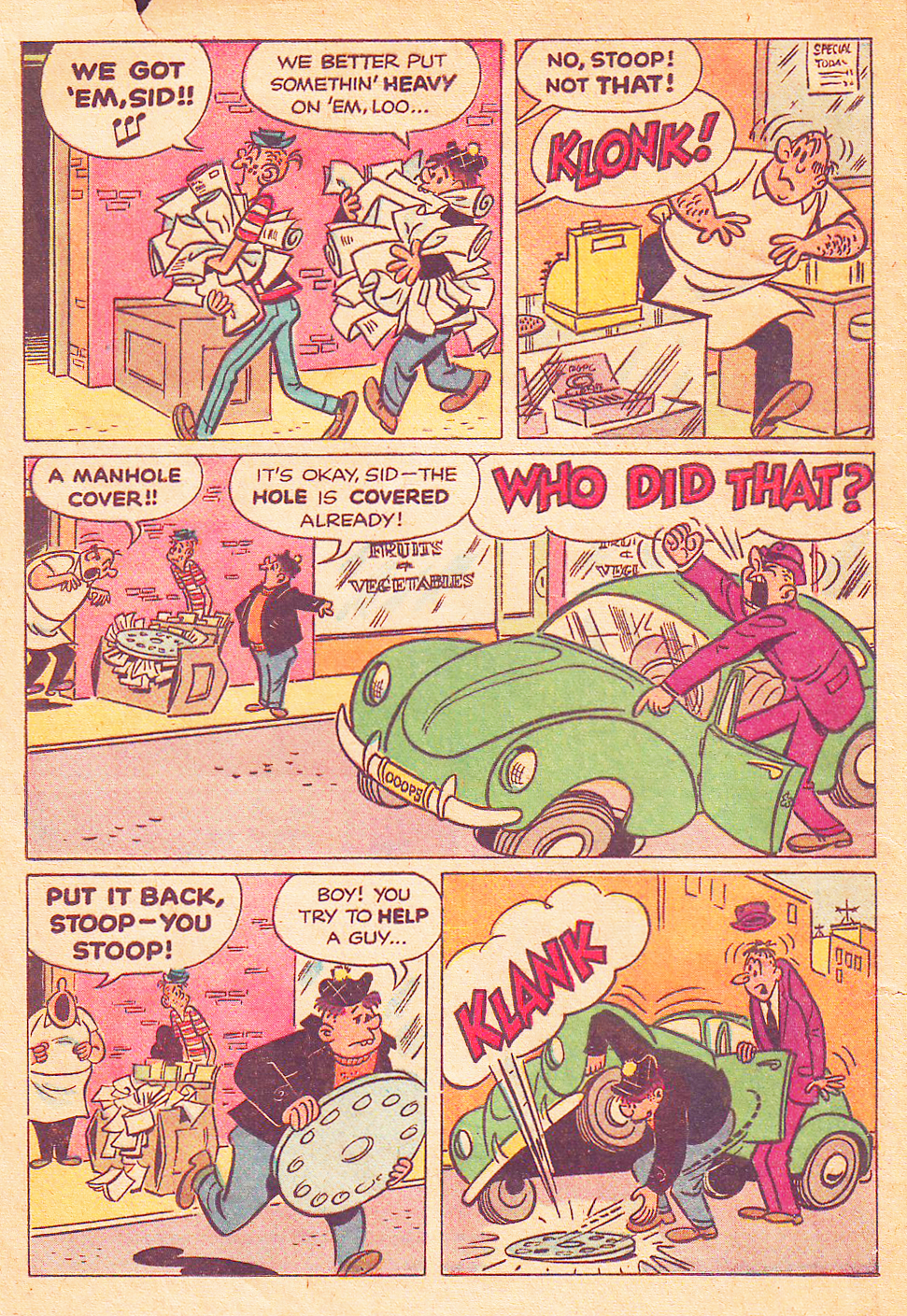
Here is a four page story by John Stanley, with art finished by Bill Williams, from the short-lived AROUND THE BLOCK WITH DUNC AND LOO Dell comic book series. (It was later shortened to DUNC AND LOO.) This has to be the most action-filled, hilarious four pages of fun comics I have seen in a long time. And the whole series is pretty much forgotten, except among us comics nerds.

The reason I wanted to post this was to show just how much story with character motivation you could stuff into such a short story. This is comics at its kinetic best by the master, John Stanley. And just look at the issue that I bought: its spine is rolled and there are tears along the staples. This is one well-read comic book!

Who are Dunc and Loo? Don Markstein puts it best:


Dunc was "classically handsome", with regular features and neatly-combed black hair, and always well dressed, with a coat and tie. He focused on girls, practically to the exclusion of everything else. His main lust object was Beth O'Bunnion, whom he met in the first issue (Oct-Dec 1961). Much of the action involved him trying to avoid Beth's protective father or appease her hulking, brutish brother, Buddy. 
Loo was Dunc's best pal. He was also obsessed with girls, but not so monomaniacally. He had unkempt red hair and usually dressed sloppily, in jeans and T-shirts. Loo had a kid brother, Joey, who sometimes had separate adventures, opening the comic to young kid humor as well as the teenage variety. All of the regulars lived in the same New York City apartment building. 
Readers seem unanimous in their opinion that every page of every issue of Around the Block with Dunc & Loo was hilarious. Still, it lasted only eight issues. The final one was dated Oct-Dec 1963.


Here's "Lifesaver," the four page opening story from DUNC AND LOO No. 5. September November 1962. It's copyright Dell Publishing.



Related: CartoonSnap has more DUNC AND LOO

Tuesday, August 06, 2019

The Anniversary of Snoopy's Friend "Woodstock"

From CBS Sunday Morning:

The Charles M. Schulz Museum, in Santa Rosa, Calif., is celebrating one of the most popular "Peanuts" characters with an exhibition devoted to Woodstock, the little "hippie bird" who became a valued friend of Snoopy's. Luke Burbank talks with the comic strip artist's widow, Jean Schulz, exhibition curator Benjamin Clark, and cartoonist Paige Braddock, about the important role Woodstock played in the Peanuts universe.


More:

Jane Pauley Interviews Her Husband Garry Trudeau for CBS Sunday Morning

Monday, August 05, 2019

George Price: Early Years


A few cartoons from THE GOOD HUMOR MAN, "A happy array of Cartoons, Sketched and a gay Diary compiled and edited by Richard McAllister." Farrar and Rinehart, Inc., Publisher, New York. Copyright 1940 by George Price.


"Some of the drawings in this book originally appeared in The New Yorker, Collier's, The Saturday Evening Post and the original Life.

"The description of Mr. Price in the title of this book is used with the co-operation of the Good Humor Corporation."


From the book's INTRODUCTION:

"When we first planned this book we asked Mr. Price if he would write up a few of his experiences.

"... When we finished reading the diary we asked Mr. Price whom he thought he was ribbing. Certainly, we stated, there was not the least truth in all this.

"Mr. Price was indignant. 'Every word is absolute gospel,' he said stiffly. 'If you knew anything at all about the cartoon business you wouldn't question that for a moment.'"


Below are some excerpts from Mr. Price's "gay Diary:"

June 22nd

"Made out very well at Collier's today. Gurney Williams held five of my roughs for the art meeting.

"When submitting drawings to Gurney I strike quickly, like a cobra. On top of my batch, I place my strongest idea. Get him in into a good humor from the very start, I find, and he will okay ideas like mad.

"More times than I like to think of, though, I have no 'strong' idea to place on top (on top, or anywhere) and the whole session has dissolved into a fiasco.

"Cleveland Amory at the Saturday Evening Post I approach differently. In his case it his best use a 'build up.'

"On top of the batch, instead of my best, I place one of my sourest ideas. Beneath that I place the worst, the very worst, of the lot. Usually, it is so bad as to bring from Clip a quiet moan. After an introduction like that the remaining ideas, no matter how mediocre, appear like so many nuggets."


June 25th

"Another milestone passes! I sold a cartoon to Life* today!

"For a long time now I have struggled to make this magazine. It was a tough one to crack. Not that I hadn't received encouragement. It wasn't eight months before the elevator operator was calling me by my first name. Never had I been able to get past the receptionist, however, and my drawings had always come back with a plain rejection slip.

"Life, of course, has long been know for the odd manner in which it is edited. Since its inception the magazine has used its famous 'passerby' system. The publisher's reason, with no little logic, that since the man-in-the-street reads the magazine, the man-in-the-street should have some say in the editing of it.

"The cartoons are selected entirely on this basis. A few days before an issue goes to press, the editors lean out the office windows, show the cartoons to anyone who happens to be passing by and ask for a frank opinion.

"Until a few years ago this system worked without a hitch. Life's offices were located on the first floor, and passerby were in easy access.

"Then complications arose. The offices were moved up to the twenty-third floor. In spite of the apparent difficulty of employing the passerby system under these conditions, the owners demanded that this traditional style of editing be adhered to.

"People who happen to be passing the twenty-third floor windows, of course, are few and far between. There remains, in fact, but one type of passerby on whom Life can now try out their cartoons -- the occasional human fly who happens to be scaling the building.

"It is a familiar sight along Bleecker Street (and to me a somewhat amusing one) to see the editors of Life, each clutching a handful of cartoons, anxiously peering from their windows hoping a human fly will begin an ascent in time for them to make a deadline.

"With a set-up like that, if I ever expected to sell a cartoon to Life, my course was clear. The plan was a risky one, but I was willing to gamble. I made up my mind to climb the building, pretending to be a human fly.

"*Mr. Price, of course, refers to the humorous magazine of that name. It has since been discontinued."


"At ten o'clock this morning I began my ascent. I had never before scaled a building and there were several fearful moments during the first stages of the journey when I was tempted to quit. The sight of Life's editors poking their heads out the window spurred me on, however, and I manfully stuck to my task.

"By noon I had reached the eighth floor. Here a little Gypsy Tea Room was located. I lunched leisurely and had my tea leaves read.

"Resuming my climb I passed the twentieth floor two hours later, and fortified by a shot of bourbon from a stenographer with a southern drawl, I started on the home stretch.

"By this time Life's editors, informed of my approach, lined the windows shouting encouragement.

"' ... Er -- young man,' one of them said, 'we would like to ask a favor of you.' He then explained the passerby system and I listened with interest as if hearing about the whole thing for the first time. I agreed, naturally, to look at their cartoons.

" ... Each I rejected. I would shake my head regretfully and hand the cartoon back with some remark like: 'I'm sorry, it just doesn't make seem funny to me,' or, 'Don't get it,' or, at a particularly bad one, 'Ugh.'

"One hour passed. Another. The editors, as the stack of drawings decreased without an approval, became alarmed. 'I do hope he likes one of them,' I heard a layout man say nervously. 'We still have that half-page open in the next issue, you know.'

"Finally, I had looked at all of them. I shrugged. 'Sorry,' I said, 'but none of these hit me.'

"There was an embarrassed pause. Then, as if it were a random thought, I asked if they had any cartoons about camels around. I didn't know why, I said, but cartoons about camels always struck me funny.

"After a hurried conference one of the assistants was dispatched to the mailing room. He rushed back with a cartoon showing two large camels and one baby camel. They handed the drawing to me and anxiously watched my reaction.

"I roared with laughter. I guffawed so heartily that for one breathless moment I almost lost my grip on the gargoyle.

"'It's in!' the editor-in-chief shouted 'Set it up for a half-page!' He handed the cartoon to an assistant. 'By the way,' he said, ' who drew it?' The assistant told him the artist was named George Price.

"'Send him a check,' the editor-in-chief said.

"We exchanged farewells. I continued on my way up to the roof, came down in the elevator and rushed back to my studio glowing with triumph."


Friday, August 02, 2019

Cartoon Illustrations from Woman's Day, July 1951


Here are some great illustrations for stories and ads from the July 1951 Woman's Day magazine. It's copyright 1951 by Woman's Day, Inc. in New York City. It cost 20 cents and, oddly, you could not subscribe to it.

When it comes to midcentury cartoonist/illustrators, one of my favorites is Roy Doty:


There are a good number of cartoon illustrations that are uncredited. Here's some great art, but no signature or attribution:


Indulge me here while I read about the new "What's My Line" TV quiz show. 


Some illustrations by Richard Scarry:


The great gag cartoonist Sam Cobean:


Cartoon drawings were usual for a lot of ads. I would guess this one is by Roy Doty, but I'm not sure. 


New Yorker cartoonist Mary Gibson draws for Drano:


More Richard Scarry:

More art with no name attached. Most were done by a staff illustrator at the ad agency:


More great Roy Doty spots:


More anonymous cartoon art. I enjoyed this ad, especially the women's clothing and hairstyles! Talk about high maintenance!


Thursday, August 01, 2019

The Garden As of August 1, 2019

Well, honestly, I can't remember the name of a lot of these flowers (even these beautiful purple ones), but aren't these pretty?


Wednesday, July 31, 2019

Wally Wood: 22 Panels That Always Work

Here's a decent, hi-res version of Wally Wood's legendary "22 Panels That Always Work ... or some interesting ways to get some variety into those boring panels where some dumb writer has a bunch of lame characters sitting around and talking for page after page!"


Tuesday, July 30, 2019

1955 TV Show: Confidential File: Horror Comic Books

Here is "Confidential File," a 1955 news program. This episode talks about lurid comic books that were believed to be the root of juvenile delinquency.

A report by Paul Coates. Produced by Jim Peck. Directed by Irvin Kershner (the guy who would go on to direct "the Empire Strikes Back"). Aired October 9, 1955. A KTTV Production, Los Angeles, for Times-Mirror.

In 1954 the Senate Subcommittee on Juvenile Delinquency conducted an investigation into how the comic book industry was supposedly contributing to the moral decay of a nation's youth. The investigations were spurred on by a number of articles that blamed comics for the rise in juvenile delinquency in post-war America. Chief among the critics was Doctor Frederic Wertham, whose book, "Seduction of The Innocent" has been blamed for nearly single-handedly crippling the entire comics industry.

In 1955, the comic book publishers formed the self-regulating organization, The Comics Code Authority, which great impacted on how comic books were perceived by the public and what kind of stories were told in the comics for decades. The effects of the virtual witch-hunt from this period in American history still has effect on the comic book industry to this day.

"Confidential File" was aired in 1955, after the senate hearings and the formation of the Comics Code, but it serves as a good example of how the media reacted to the comic book industry, and sought a scapegoat by blaming the comic book publications for society's own lack of responsibility in raising its children. This was a "whipping boy" blame game that would continue on, blaming TV cartoons, rock and roll music, Dungeons & Dragons, videogames, and so on.


Friday, July 26, 2019

Chuck Jones Animated Short: "90 Day Wondering" (1956)

Via 8thManDVD: Here is "90 Day Wondering" (1956), a jointly produced Warner Brothers/United States Army animated short, directed by Chuck Jones. It's aimed at encouraging discharged soldiers to re-enlist. It is neither a Looney Tune nor a Merrie Melody.


Thursday, July 25, 2019

CBS News Live "As It Happened:" Apollo 11 Moon Landing

From the CBS archives, here is five hours of the July 20, 1969 live broadcast of the Eagle descending and landing (about 43 minutes in).


1965 Documentary Short: MIT Science Reporter—"Computer for Apollo"

This 1965 MIT Science Reporter television program features the Apollo guidance computer and navigation equipment, which involve less than 60 lbs of microcircuits and memory cores.

Scientists and engineers Eldon Hall, Ramon Alonzo and Albert Hopkins (of the MIT Instrumentation Laboratory) and Jack Poundstone (Raytheon Space Division in Waltham MA) explain and demonstrate key features of the instruments, and detail project challenges such as controlling the trajectory of the spacecraft, the operation of the onboard telescope, and the computer construction and its memory.

The program was presented by MIT in association with WGBH-TV Boston, and hosted by MIT reporter John Fitch. It was produced for NASA and is from the MIT Museum Collections.

Wednesday, July 24, 2019

Trailer: Mister Rogers Movie Starring Tom Hanks "A Beautiful Day In the Neighborhood"

Umm ... I was not looking forward to this. When I first heard that Hanks was going to play Fred Rogers, I thought it was a horrible idea. So many ways to screw this up. Leave Mister Rogers alone.

Actually, for a minute I thought it was a joke. But, NO JOKE. This is a real movie and it's out this fall and it looks good (too good) and the timing couldn't be better.

Tuesday, July 23, 2019

Video: San Diego Comicon: Patrick Stewart, Brent Spiner and Cast of New "Star Trek: Picard" Series

From the recent San Diego Comicon: Here's Patrick Stewart and the cast of the new "Star Trek: Picard" show talking about the new CBS All Access channel series. It debuts Fall 2019.


And, in case you missed it, here's the official trailer for the new series which picks up the character of Captain Picard from Star Trek: The Next Generation:


Video: Bill Sienkiewicz Interview

From HeroesCon 2019:

Cartoonist Kayfabe Spotlight: Bill Sienkiewicz

Ed Pisko and Jim Rugg talk to the legendary and influential creator about Elektra: Assassin, Big Numbers, New Mutants, Frank Miller, Alan Moore, NYC in the 80s, multimedia, commercial art, indie comics, and more! Sienkiewicz expanded the comics landscape with his experimental and unique approach to the form. We discuss his experiences, inspiration, and how comics have evolved! https://billsienkiewiczart.com/