Thursday, March 07, 2019

Cartoonist Rights Network International Files Friend of the Court Letter in Support of Ted Rall

The Cartoonists Rights Network International, a nonprofit organization that fights for freedom of speech for cartoonists, has 

"written to the Supreme Court of the State of California as cartoonist Ted Rall, formerly of the LA Times, seeks to overturn an “anti-SLAPP” ruling that prevents him from pursuing legal action against his former employer for defamation and unfair dismissal in 2015.
"As we reported at the time, Rall was fired after a poor-quality audio recording of his being ticketed for jaywalking fourteen years prior was apparently taken from LAPD evidence and passed to his editors as a pretext for disciplinary action. Rall went on to contend that the Los Angeles Police Protective League, which welcomed his firing, influenced the paper’s decision.  The LAPPL was at that time heavily invested in a private equity fund that was the major shareholder in the LA Times‘ publisher, Tribune Media.

"The letter reads:

"Cartoonists Rights Network International (CRNI) is a human rights organization working in defense of editorial, political and other cartoonists whose work leads to direct threats against their life, limb or livelihood. Often this involves cartoonists from oppressive theocracies where blasphemy or mere disrespect is a matter of grave consequence. Far more common, however, are instances where cartoonists suffer abuse inflicted with the instruments of authoritarian regimes: the military or police, party loyalists, unduly censorious statutes or heavy-handed legal action. In recent years the cases we champion have been largely in Africa, Asia, the Middle East and Central & South America.

"However, it is not unheard of to find a cartoonist in trouble in Australasia, Europe or North America, especially in an era when fewer and fewer professionals cartoonists have the backing of a newspaper or other large media player. Even in the USA, where First Amendment rights are regarded as inviolate, we have seen cartoons being withdrawn from circulation or cartoonists dismissed due to pressure applied from the ground up (organized displays of “offense” on social media) or top down (corporate interests or political cronyism).

"Our organization is small, but whenever possible we seek to intervene on behalf of the cartoonist in trouble, which may mean assisting in their legal defense, relocation, or simply making representations to the relevant authorities. This year Index on Censorship recognized our work, nominating us for their Freedom of Expression Award in the “campaigning” category.

"[This case] alarms us first and foremost because of how similar certain aspects appear to those of others we have followed in locations such as Turkey, Malaysia or Equatorial Guinea. In each of these places a cartoonist has been the recipient of our annual Courage in Editorial Cartooning Award after being subjected to campaigns of intimidation and harassment from police, generally based on fabricated or exaggerated evidence.

"Of course we recognize that Mr Rall’s case differs in the scale and gravity of the alleged criminality at its heart, (neither jaywalking nor the allegedly exaggerated blog post are acts of sedition) but the intent and effect of the ensuing events have produced alarmingly similar results. That a freelance cartoonist could be expected to pay the legal fees of one of the country’s largest and most powerful news outlets seems an injustice so skewed as to be clearly intimidating to other writers and artists. That the incident involves the police could be construed as a further warning against challenging the authorities. Those in positions of power have seized upon an opportunity to silence a critic and serious, perhaps irreparable, damage has been done to the career of a popular and acclaimed cartoonist.

"CRNI understands the court’s solemn legal obligations. We also understand that all media accounts, from sporting events to complex legal cases, involve some degree of subjectivity, and that different parties will inevitably interpret the same situation in differing manners. It is especially within those gray areas that we seek to ensure fair treatment. Mr Rall did not misrepresent the basic fact of his arrest for jaywalking. His cartoon and blog were based upon facts and, predictably, infused with opinion. If they were overly acerbic or emphatic in the expression or interpretation of those facts and opinions then, to some degree, that is only what Mr Rall was, or any editorial cartoonist is, employed to do. He is entitled to mount a rigorous legal defense of his reputation.

"In our view the role of the political cartoonist today remains unchanged; they are a societal safety-valve, expressing dissatisfaction about political ineptitude, corporate malfeasance, international strife, all the various injustices and irritants of the world in a fashion that is at times blunt, even vulgar, but ultimately harmless. The cartoonist should provide the opportunity for the reader to have a rueful chuckle about the state of affairs as they stand, communicating an idea in a direct fashion that is consumed and processed in a matter of seconds. It is this immediacy that gives the cartoon its sensation of impudence. To read an essay takes time and its line of argument can be picked over. A cartoon arrives in the mind’s eye too fast for analysis and can feel like a blow, particularly if it belittles a cow we happen to hold sacred.

"An editorial cartoon is not a bald statement of fact; it is an opinion piece. Nonetheless humor falls flat without veracity. Thus we look to cartoonists not for nuanced analysis of any particular policy but to reveal greater truths. It is for this reason that those in power have cause to fear them. Like virtually no other profession, the cartoonist makes it their business to remind the citizenry that the emperor is wearing no clothes.

"We humbly ask the court to take these points into consideration as it deliberates upon the petition for review before it.

"The letter is signed by President Joel Pett and Executive Director Robert Russell on behalf of our board of directors and regional representatives.

"We note the efforts of other freedom of expression and cartoonists’ organizations in this regard – such as our colleagues at AAEC – and join in their sincere trepidation regarding the precedent that could be set should Rall’s petition fail to convince the Californian Supreme Court."

Wednesday, March 06, 2019

Tuesday, March 05, 2019

Video: "Mort Gerberg Cartoons: A New Yorker's Perspective"

Mort Gerberg talks about drawing cartoons for 50 years and his new exhibit at the New-York Historical Society on NY1 with Pat Kiernan.

"Mort Gerberg Cartoons: A New Yorker's Perspective" is on display from February 15 thru May 5, 2019 on the second floor of the New-York Historical Society.

The AP has a video of Mort at the exhibition here:


CUNY TV has this January 9, 2019 interview with Mort from "Tony Guida's New York" show:


Related:

New Yorker Cartoon Editor Emma Allen interviews Mort

Gil Roth's "Virtual Memories" podcast

Monday, March 04, 2019

Help Gahan Wilson


Very sad news about the state of Gahan Wilson's health. Please consider helping this great cartoonist at this time.

Paul Winters has the details:

Sad news. Gahan's wife of 53 years, Nancy Winters, passed away March 2, 2019.

More sad news is that Gahan is suffering from advanced dementia. We were keeping his condition private for many reasons.

My mother, his wife, was his rock and his guide through the world. With her passing, he is lost and devastated.

We must raise some immediate funds to find him some memory care until we can set him up at our new place in New Mexico.

We have set up a gofundme for Gahan if any one wants to help out. Memory care is crazy expensive and if we could pay for it ourselves, we would do so.

https://www.gofundme.com/gahan-wilson-team-effort

Over the years, Gahan gave me a big collection of his cartoons. I will sell the whole collection as one, or piece by piece if anyone wants to help out in that way. We have pieces ranging from $125.00 for a print on up to the thousands. My interest is to help Gahan live the rest of his life in as wonderful a fashion as possible.

They had a wonderful life together. It is this last turn that is so sad.

Please contact me at paulwinters@gahanwilson.net if you wish to buy an original cartoon.

Thank you,

Paul Winters

Friday, March 01, 2019

John Gallagher Part Two: 1000 Jokes! - Gag Cartoons 1954 - 1965

Want to see some great cartoons by one of the most prolific gag cartoonists ever? Here's "John Gallagher Part Two: 1000 Jokes! - Gag Cartoons 1954 - 1965" written by Dick Buchanan. Part one is here. Thank you, and take it away, Dick:

 ---

JOHN GALLAGHER
   Part Two: 1000 Jokes!

  (Gag Cartoons 1954 – 1965)


Laughing Out Loud #5 October-December, 1957. One of the six covers Gallagher rendered between 1956 to 1958.


John Gallagher received the National Cartoonist Society’s Gag Cartoon Award for 1957 and 1971. His brother George Gately created the comic strips, Hapless Harry and Heathcliff.

An avid baseball fan, sports was one of his favorite subjects--baseball, boxing, horse racing, hunting and fishing. These cartoons found a happy home in Sport Magazine, True Magazine and Golf Magazine as well as The Saturday Evening Post. Animals were another subject Gallagher portrayed in countless gags. His lions, parrots, giraffes and dogs were portrayed with his unique humorous touch.

Like many cartoonists before and since, John Gallagher had a healthy disdain for editors. Shortly after he abandoned freelancing, he shared his thoughts in an interview by Jim and Gerry Ruth in Cartoonists Profiles (December, 1971):
“One of the most discouraging things about the gag field was the part that the editors played. No one wants to be accused of not having a sense of humor, but the buying of professional humor requires more background and knowledge than many editors had. There was constant interference and control of visual humor by people who were more at home with writing than humor. I always felt that gag selection should have been in the hands of a person involved in the field.”
Gallagher said he sold his best gags not to the major magazines but to 1000 Jokes Magazine. “I always felt I sold my best stuff to 1000 Jokes. Bill Yates, the editor over there, got some of my best gags. Both he and John Norment, who was editor after him, had good backgrounds in the business. They knew humor and they knew how to pick gags.”

In that spirit, here is a selection of John Gallagher’s cartoons from the pages of 1000 Jokes Magazine and its sister publication, For Laughing Out Loud . . .


1. 1000 Jokes Magazine August-October, 1954.


2. 1000 Jokes Magazine May-July, 1955.


3. 1000 Jokes Magazine November, 1955-December, 1956.


4. For Laughing Out Loud February-April, 1957.


5. For Laughing Out Loud February-April, 1957.

6. For Laughing Out Loud February-April, 1957.


7. 1000 Jokes Magazine September-November, 1958.


8. 1000 Jokes Magazine June-August, 1958.


9. For Laughing Out Loud October-December, 1958.


10. 1000 Jokes Magazine June-August, 1959.


11. For Laughing Out Loud January-March, 1960.

". . . . Being of sound mind and body. . . ."


12. For Laughing Out Loud October-December, 1961.


13. For Laughing Out Loud January-March, 1962.


14. 1000 Jokes Magazine September-November, 1963.


15. 1000 Jokes Magazine September-November, 1964.


16. 1000 Jokes Magazine March-May, 1965.


Thursday, February 28, 2019

John Gallagher Gag Cartoons 1951 - 1970

INTRO: John Gallagher gets a great write up about his life and his cartooning career by Dick Buchanan. Dick did a lot of research into this, and I'm grateful that the Gallagher family was happy to help. The rest of this is written by Dick, who will show and tell you the story of the amazing cartoonist John Gallagher:


---


Occasionally the Cartoon Clip File spotlights an important cartoonist from the Golden Age of Gag Cartooning. This time we take a look at the work of cartoonist John Gallagher, one of the most prolific and funniest gag cartoonists of the era—or any era, for that matter. Our thanks go to John Gallagher’s son, Michael and his nephew, Peter Gallagher for providing a huge amount of biographical material


JOHN GALLAGHER
(Gag cartoons 1951-1970)

John Gallagher was born in Englewood, New Jersey in 1926. He received the National Cartoonist Society’s Gag Cartoonist Award for 1957 and 1971. His brother George Gately created the comic strips Hapless Harry and the incomparable Heathcliff.

Gallagher’s father, renowned for his sense of humor, was a longshoreman who had always wished to be a cartoonist. He and his wife encouraged John’s and George’s artwork. John Gallagher began drawing Mickey Mouse and Popeye at the age of three. After John and George became professional cartoonists, their father clipped hundreds of cartoons from magazines and glued them in spiral bound notebooks for their reference. He also took over the bookkeeping aspects of his sons’ cartooning activities.

During World War II, Gallagher served as a Navy Signalman. After the war he attended Syracuse University School of Art on the G.I. Bill. It was there he met cartoonist Brad (Marmaduke) Anderson, who became his lifelong friend. Anderson showed him how to put together cartoons for submission to magazines. After two years, John transferred to Pratt Institute, majoring in Illustration.

In 1951, his senior year at Pratt, John Gallagher sold his first cartoon to The Saturday Evening Post—submitted by mail. He married Dorothy “Dot” Lotter and moved to New York City where he became a staff artist for the Howell-Rojin Agency, which helped pioneer TV “green screen” technology still used today by TV news weathermen. At this time, he began submitting cartoons on a regular basis. When his freelance career began to take off, he and Dot moved to Bergenfield, New Jersey.

For the next 20 years, Gallagher enjoyed an immensely successful gag cartoon freelancing career. He was one of the greatest “Big Foot” style cartoonists and a superlative gagman. Readers and editors alike found his cartoons to be just plain funny. They appeared in magazines such as The Saturday Evening Post, Collier’s, Look, American Legion, Sport, Military Life, True, Golf, Argosy, Parade, Saga and Boys’ Life. In the late 1960’s he penned “The Cartoon Bug,” an advice column for aspiring cartoonists which was later syndicated to newspapers in the United States and Canada.

In the 1960’s, Gallagher attempted to crack the syndicated comic strip market with projects which never sold but nonetheless remain memorable to many in the industry. One was Joe Bucket, a tiny robot who lived with the wacky scientist who accidently created him, a stereotypical hobo, a dog and his flea, etc. (the ‘joe bucket” was Navy slang a ship’s coffee pot) When cartoonist Johnny Hart was making the rounds attempting to sell his comic strip B.C., one editor was discussing with him how he needed to make it better. As Hart was asking for guidance, the editor opened his drawer and pulled out Gallagher’s Joe Bucket strip and said “Take a look at this. This is funny.” Johnny Hart was already a huge Gallagher fan. He corresponded with Gallagher in the 1980’s asking about “the little robot strip.”

The magazine cartoon market began to dry up in the late 1960’s, prompting John to leave freelancing to become Art Director for American Kitchen Foods. He designed packaging and promotional material for their new frozen French fry products, including “Tasti Fries.” During this period, he also began a long association with fellow cartoonist Bob Weber, supplying gags for his syndicated comic strip, Moose.

When his brother, George Gately, launched his syndicated panel, Heathcliff (McNaught/Creator’s Syndicate) in 1973 John became Heathcliff’s primary gagwriter and layout penciler until shortly before his death in 2005. Today Heathcliff is drawn by their nephew, Peter Gallagher.

Here is a selection of gag cartoons by John Gallagher . . .


1. The Saturday Evening Post December 6, 1951.


2. Here! March, 1952.


3. Collier’s August, 1952.


4. Collier’s February 7, 1953.


5. American Legion Magazine June, 1954.


6. American Magazine April, 1954.


7. Collier’s January 21, 1955.


8. Sport Magazine May, 1955.


9. The Saturday Evening Post July 20, 1957.


10. American Legion Magazine August, 1958.


11. The Saturday Evening Post February 8, 1958.


12. Sport Magazine February, 1959.


13. American Legion Magazine November, 1960.


14. The Saturday Evening Post October 22, 1960.


15. True Magazine August, 1961.


16. The Saturday Evening Post October 6, 1962.


17. True Magazine March, 1962.


18. Boys’ Life July, 1965.


19. True Magazine January, 1967


20. True Magazine February, 1970.


Wednesday, February 27, 2019

From the Dick Buchanan Files: Caption-less, Wordless Gag Cartoons 1946 – 1963

My friend Dick Buchanan has dug deep into his clip file of golden age magazine panel cartoons to come up with 15 caption-less gems. Ten of them don't even have a sign or written words as part of the art. Here are some great ones by some cartooning legends. Thank you, Dick!

---

Caption-less, Wordless Gag Cartoons
(1946 – 1963)
 
Here is yet another installment of vintage gag cartoons which are caption-less, wordless or, if you will, sight gags.

As usual, minimal reading required to appreciate these classic cartoons by some of the best cartoonists of the mid-century era, haphazardly plucked from Cartoon Clip File . . .

1.  ROY WILLIAMS. American Legion Magazine  January, 1947.


2.  BO BROWN. The Saturday Evening Post  October 1, 1960.


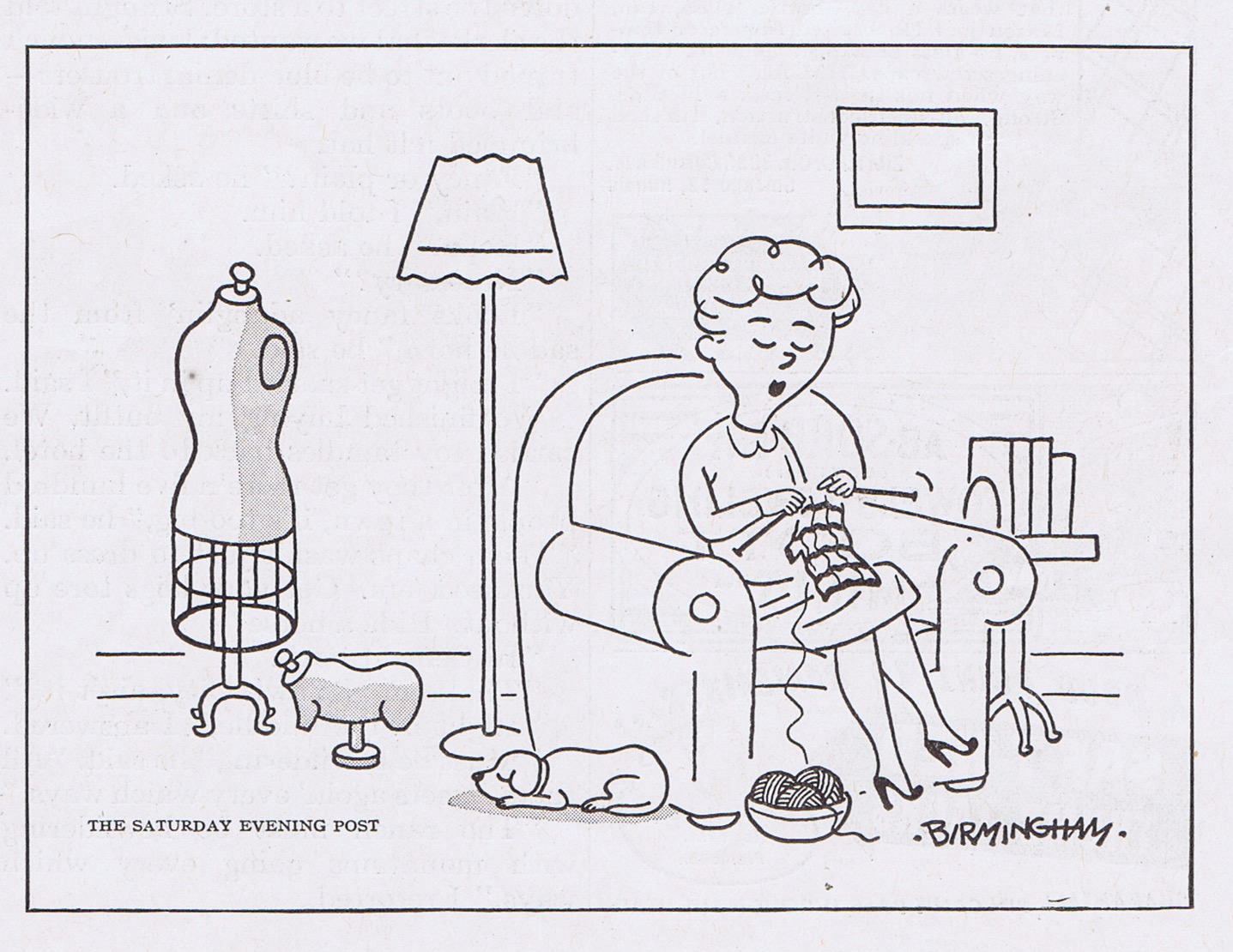
3.  LLOYD BIRMINGHAM.  The Saturday Evening Post  December 13, 1947


4.  CHARLES E. MARTIN (CEM).  The Saturday Evening Post  May 8, 1948.


5.  IRWIN CAPLAN.  The Saturday Evening Post  May 8, 1948.


6.  LARRY HARRIS.  1000 Jokes Magazine  Spring, 1951.


7.  HARRY LYONS. True Magazine  October, 1958.


8.  LEE PURCELL.  The Saturday Evening Post  February 11, 1950.


9.  SALO ROTH.  Judge  October 26, 1953.


 10. GAHAN WILSON.  Collier’s  March 4, 1955.


11.  JIM WHITING. Collier’s, circa 1950’s.


12.  GEORGE SMITH.  The Saturday Evening Post.  November 29, 1949.


13.  MARTIN FLICHOCK.  Collier’s March 2, 1946.


14.  STAN HUNT.  The Saturday Evening Post  May 8, 1948.


15.  DAVID PASCAL.  The Saturday Evening Post  November 2, 1963.