Wednesday, July 15, 2020

The Garden As of July 15, 2020


Here it is, bushy and green and ... SUDDEN REALIZATION! I'm going to be overrun with vegetables. (Ha ha. I just noticed you can see my neighbor's garden in the background to the left, with its scarecrow. My neighbor asked his girlfriend what they should name it, and she said, "Mike." Yeah. Really. And what did I ever do to them? No respect, I tell ya.)


Baby Roma tomatoes. 


Zucchini.


Tiny cucumbers.

Not shown: carrots, radishes and peppers.

Here's a parade of dill, basil, parsley, flowers:


Related:

The Garden As of Mid-May 2020
The Garden As of Early June 2020
The Garden As of June 15, 2020
The Garden As of July 1, 2020


Tuesday, July 14, 2020

Video: "John Nesbitt's Passing Parade: 'People on Paper'" 1945

Here's a 1945 MGM one-reeler documentary short featuring classic syndicated newspaper cartoonists.

This edition of John Nesbitt's "Passing Parade" series, released to theaters on November 17th, 1945 by MGM Studios, features classic newspaper cartoonists in action:

H.H. Knerr (Katzenjammer Kids),

Bud Fisher (Mutt and Jeff),

Fred Lasswell (Barney Google and Snuffy Smith),

Frank King (Gasoline Alley),

Chester Gould (Dick Tracy),

Dick Calkins (Buck Rogers in the 25th Century),

Milton Caniff (Terry and the Pirates),

Chic Young (Blondie),

Raeburn Van Buren (Abbie an' Slats),

Ham Fisher (Joe Palooka),

Hal Foster (Prince Valiant),

Harold Gray (Little Orphan Annie),

and Al Capp (Li'l Abner).


"North American Comic Book Sales Have Hit New Record High in 2019"


Hit!

Smack!

Spank!

Get it? Ha ha ha!

Seriously, last year was the best year for comics sales. Comic books (and graphic novels, etc.) tallied up $1.21 billion in sales last year, an 11% increase over 2018. Heaven knows how things will sort out for this COVID-19, Second Great Depression year, but I'm ever hopeful.

Monday, July 13, 2020

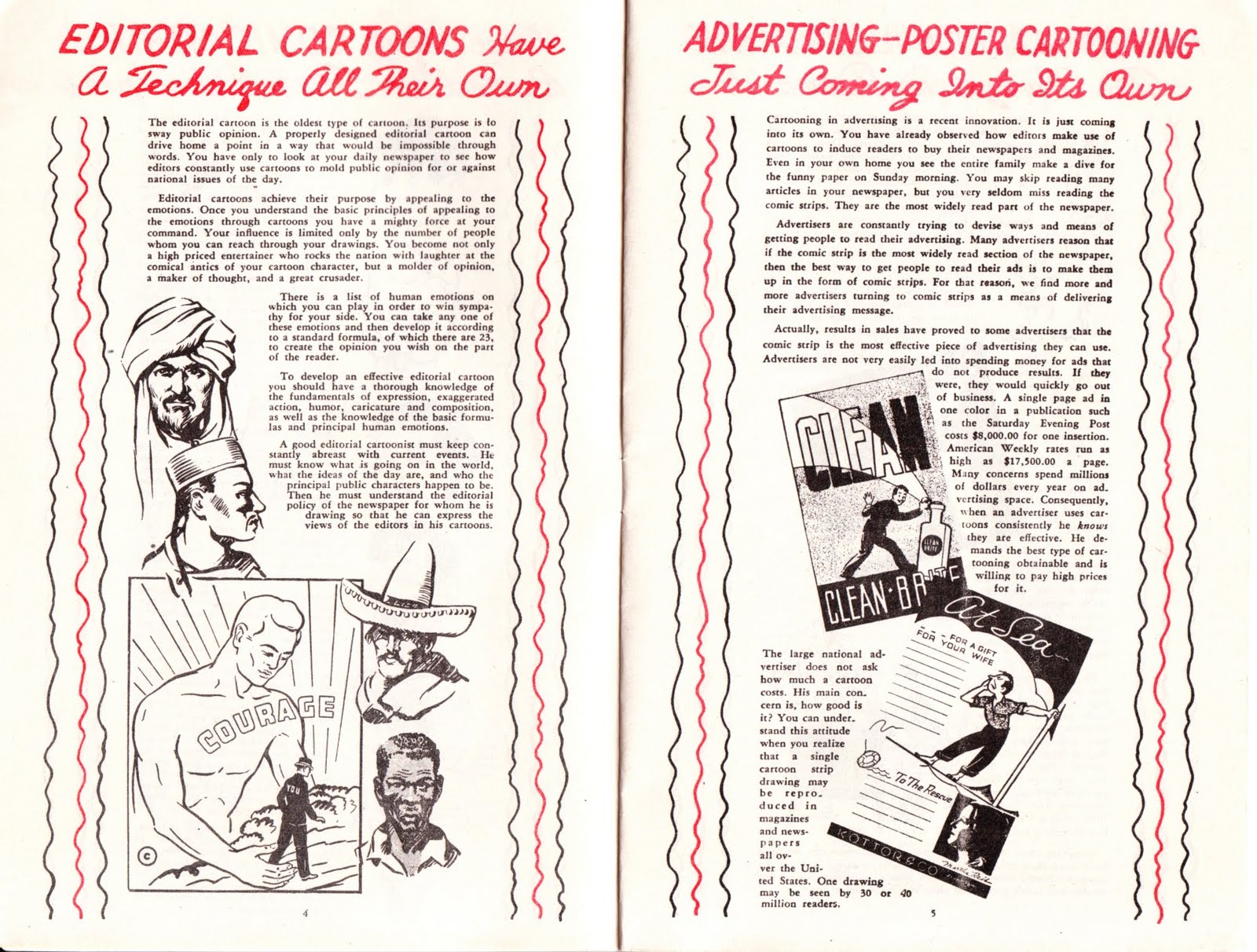
Cartoonists' Exchange: HOW TO MAKE MONEY WITH SIMPLE CARTOONS (1949)


There's big money in cartooning and enormous markets, so says the Cartoonists' Exchange booklet titled HOW TO MAKE MONEY WITH SIMPLE CARTOONS.

This booklet was part of a plethora of Ohio-based correspondence course learn-to-cartoon material that the Cartoonists' Exchange produced for several decades.

Here are the principles that all successful comic strips are based on, editorial cartoon techniques, chalk talk information, caricature, proportions, realistic figure drawing, the "three steps in developing a cartoon sketch" and so much more. This is copyright 1949 The Cartoonists' Exchange, Pleasant Hill, OH.


Friday, July 10, 2020

Video: Keith Knight


Lamorne Morris plays "Keef" Knight in a new streaming Hulu series based on the cartoonist's life.


Cartoonist Keith Knight is known for his comic strips including The Knight Life, th(ink) and The K Chronicles. "Woke", a new live-action/animated comedy based on Knight's life, will premiere on Hulu in June. Warren Bernard, executive director of the Small Press Expo, interviews Knight about his life and career.


Thursday, July 09, 2020

Video: Barry Blitt of The New Yorker

2020 Pulitzer Prize winner Barry Blitt is interviewed by Françoise Mouly, The New Yorker’s long-time art editor, about his career and art.

Wednesday, July 08, 2020

Video: James Thurber Unsold Pilot "Christabel"


Here's a rare half hour of TV from June 8, 1959. From Alcoa-Goodyear Theater, this is "Christabel;" an unsold pilot for a series that was to be titled "the Secret Life of John Monroe." It's based on a James Thurber story, and there's animated segments created by the UPA Studio.

UPA had animated Thurber before, for the animated short "The Unicorn in the Garden."


From Betagems:

"'Christabel' was written by Mel Shavelson, who ten years later created (and sometimes wrote and directed) the James Thurber-inspired series My World and Welcome to It, with a fourth episode called "Christabel" (10-6-69) that was very similar to the Alcoa-Goodyear version, right down to the cartoon dog in the credits. Directed by James Sheldon and also starring Georgeann Johnson, Susan Gordon, Charles Herbert, and Dabbs Greer. Music by Joseph Liebling. Alcoa Theatre was a half-hour anthology series that ran from September 30, 1957 through May 23, 1960. You can find more episodes of this and other vintage TV anthologies in the BetaGems playlist 'Anthology Television 1950s-1960s.'"


Hat tip to Steve Thompson!

Tuesday, July 07, 2020

Former Marvel Comics Letterer Rick Parker: Notes for Aspriring Comics Artists Regarding Lettering


Photo of Rick Parker in the Marvel Bullpen, ca.1979 by Eliot R. Brown.


If you know comics, you know Rick Parker. He first went to work for Marvel Comics as a letterer in the late 1970s. Lettering ma be how he got his start, but he's also known as a writer and cartoonist. His work has appeared in The New York Times, The Village Voice, Time Magazine and various comics. He's best known as the artist of MTV's Beavis and Butthead comic book, which was published by Marvel from 1994 to 1996. He wrote and drew his own graphic novel, Deadboy, in 2010. His work also appeared under the Papercutz imprint.

Here's his advice on lettering, from Rick Parker's Facebook page:


PANDEMIC PRACTICE

NOTES FOR ASPIRING COMICS

ARTISTS REGARDING LETTERING:


Lately, so many people have messaged me asking about lettering, I thought perhaps I would make a few public comments in the hope that they might help aspiring comic artists with their lettering.

It's my opinion that cartoonists and the people who look at their work would all be better off if we all hand-lettered our work.

Fonts are really cold and have no soul. At best, comics is an artform done by a human hand. There is almost no lettering in comics today that is as good as the hand lettering on comics in the good old days by artists like Ben Oda, Sam Rosen, Joe Rosen, Gaspar Saladino.

Look around. All the great cartoonists working today letter their own work. Crumb, Dan Clowes, The Hernandez Brothers, Chris Ware, Noah Van Sciver and many others.

There is a good reason for this. They want their lettering to be a perfect match with their artwork stylistically. And for other reasons. It's more enjoyable to look at.

In my experience, and to be as brief and possible, the most important thing is that the lettering has to be EASY TO READ. One of the most important ways to accomplish this is to avoid having any letters touching and to leave ample white space around the lettering in the balloons.

I put together this sample with you in mind. Look at each letter and copy it a few times. Don't worry about your work looking like mine. After a while your own style will develop.

Each letter is composed of a variety of strokes. The vertical mark, the horizontal mark, the diagonal mark and several variations of circles. There are not that many strokes. Practice making them. The entire alphabet can be written down in only 62 simple strokes.

Finally, please keep in mind that the "I" with the serifs on it is a personal pronoun and should not be used in a words like "ship, thin, crisp or little".

It should be used in a case such as , "I went out for a walk."

Good Luck.


Monday, July 06, 2020

From the Dick Buchanan Files: The Search for Happiness Part Two: Here Comes the Bride! 1942 - 1964

Dick Buchanan has another 25 gag cartoons regarding the journey toward happiness that we all are on -- successfully or not!

Part one is here.

Thanks and take it away, Dick!


---


THE SEARCH FOR HAPPINESS
Part Two: Here Comes the Bride!
(1942 – 1964)


This is the second part of The Search for Happiness—the Wedding.

DISCLAIMER: The actions portrayed in these cartoons were intended to show the humorous side of the wedding experience. They bear no resemblance to actual persons or behavior which may, or may not, have been common practice then or now.


1. CEM (Charles E. Martin). Liberty Magazine August 10, 1946.


2. BILL KING. 1000 Jokes Magazine Winter, 1944.


3. DAVE GERARD. The Saturday Evening Post July 19, 1947.


4. GEORGE WOLFE. True Magazine 1940’s.


5. DICK CAVALLI. American Legion Magazine February, 1953.


6. MARTHA BLANCHARD. 1000 Jokes Magazine December, 1962 – February, 1963.


7. SALO ROTH. Liberty Magazine January 12, 1946.


8. SYD HOFF. True Magazine March, 1952.


9. JEFF KEATE. Liberty Magazine March 1, 1947.


10. JERRY MARCUS. The Saturday Evening Post May 7, 1949.


11. JACK TIPPIT. The Saturday Evening. October 15, 1960.


12. JACK TYRELL. The Saturday Evening Post July 26, 1958.


13. BOB SCHROETER. American Legion Magazine March, 1954.


14. LARRY FRICK. American Magazine June, 1951.


15. CLYDE LAMB. For Laughing Out Loud October – December, 1961.


16. BILL YATES. The Saturday Evening Post November 22, 1952.


17. JOE ZEIS. The Saturday Evening Post October 10, 1959.


18. JEFF KEATE. American Magazine June, 1950.


19. BOB SCHROETER. American Magazine February, 1951.


20. JOHN DEMPSEY. Collier’s July 8, 1955.


21. IRWIN CAPLAN. For Laughing Out Loud October – December, 1956.


22. CLYDE LAMB. Judge Magazine October 26, 1953.


23. GEORGE GATELY. 1000 Jokes Magazine March – May, 1964.


24. HERB MIDDLECAMP. The Saturday Evening Post August 8, 1942.


25. GEORGE SHELLHASE. Collier’s October 23, 1943.