Monday, May 11, 2020

Richard Sala 1959 - 2020


Graphic novelist and illustrator Richard Sala, known for inky images of spooky whimsy, passed away on May 9, 2020 according to an announcement by Fantagraphics Publishing. He was 61. No cause of death has been announced.

this was a shock to all. Fantagraphics comments, "It is with great sadness that we share the news that our dear friend, the cartoonist Richard Sala, has passed away at the age of 61. We are still processing, and will say more soon, but our hearts are with his close friends and family who are grieving this insurmountable loss."

Via his Wikipedia page:

"Richard Sala was born in Oakland, California in 1955. He spent his childhood in West Chicago, Illinois and his teenage years in Scottsdale, Arizona. In interviews, Sala has mentioned the influence of his childhood years on his work, particularly his visits to museums and antique shops. He has stated that his love of reading and his interest in comic books and horror films helped him deal with real life fears. He attended college as an art major, finally earning a Master of Fine Arts Degree in painting from Mills College. He then worked as a freelance illustrator, something he had begun doing while in college, and a cartoonist, publishing his first comic book, Night Drive, in 1984.

"More of a reflection of his art school education than a typical comic book, Night Drive nevertheless ended up opening doors for Sala that would eventually lead to his rediscovering and embracing his childhood love of comics and monsters. The book came to the attention of several individuals who contacted Sala to request work. These included Art Spiegelman, Monte Beauchamp and Colossal Pictures and resulted in his appearances in two highly regarded comic anthologies – Spiegelman's RAW and Beauchamp's BLAB!. Colossal Pictures hired Sala to animate one of the stories from Night Drive called Invisible Hands. This was eventually expanded by Sala and director Denis Morella into a 12-minute story about a psychic detective, a hooded criminal, taxidermy, a costume party and a secret society of one-handed killers, all done in Sala's usual tongue-in-cheek style. Divided into 2-minute chapters so it could be shown as a serial, Invisible Hands, debuted on the first season of Liquid Television Show, which also featured the television debuts of Beavis and Butthead and Æon Flux.

"Sala has continued to be a prolific illustrator and comic book artist. Two of his books, The Chuckling Whatsit and Mad Night began as serials. They are epic thrillers with labyrinthine plots and black humor. The Chuckling Whatsit first appeared in the anthology Zero Zero. Mad Night, which features the girl detective, Judy Drood, was initially serialized in Sala's 12-issue comic book series Evil Eye, published by Fantagraphics Books. Evil Eye also introduced Peculia, a mysterious black-haired waif whose fairy tale-inspired adventures include encounters with murderous children, necrophiles, cat-women and zombies. Evil Eye ran for twelve issues, between 1998 and 2001.

"Sala has also worked on projects with Lemony Snicket, Steve Niles and The Residents and illustrated Doctor Sax and The Great World Snake, a script written in the 1960s by Jack Kerouac, which, like Sala's own work, makes use of pulp genre conventions such as vampires and shadowy avengers."


Friday, May 08, 2020

From the Dick Buchanan Files: Puck Magazine Cartoons 1879 - 1890

From the deep, dark mists of time comes a number of great old vintage cartoons/covers from the very first successful humor magazine, Puck! Named after the Shakespearean "Midsummer's Night Dream" character, with the motto "What Fools These Mortals Be" on each and every cover, Puck magazine skewered the powerful from 1871 to 1918. The lush lithographic techniques are still, today, full of vibrant colors and pinpoint reproduction of details. Dick Buchanan has ventured into his deep, dark cartoon clip files to share these gems from the 19th century. He's also added quite a bit of background into the gags and the men who drew them. So, sit up straight and pay attention. This is cartoon history! Thanks, and take it away, Professor Buchanan!

---


Long ago, when your friendly crackpot Cartoon Clip file curator was merely a young eccentric, he leisurely explored the many bookstores which have proliferated in Greenwich Village ever since the days when Walt Whitman and Mark Twain exchanged barbs at the Hotel Albert. One afternoon we stumbled across a bunch of Puck magazines in a printer’s loft. After all, Greenwich Village lies beneath the shadow of the historic Puck Building so this was an area where such treasures were to be found. We are happy to share the cartoons and illustrations from the first great American humor magazine.


PUCK
(1879 – 1890)


Puck. March 22, 1882. Cover by Bernhard Gillam


Puck was the first successful humor magazine published in the United States. It was also the first magazine to carry illustrated advertising and the first to successfully adopt full color lithography printing for a weekly publication.

A typical 16-page issue contained a vivid full-color political cartoon on the front cover and another one the back page. The back-page cartoon sometimes was political in nature but sometimes was one commenting on the social fabric of the day. Each issue contained a double-page color centerfold on a political topic. The magazine’s interior contained black-and-white cartoons dealing with issues like New York City’s Tammany Hall, presidential politics, and social issues of late 19th century to the early 20th century. Cartoons were also used to illustrate humorous anecdotes and poetry. The last few pages were devoted to advertisements.

Puck was created by Austrian-born cartoonist Joseph Kepler, a classically trained artist who immigrated to the United States in 1869. While living in St. Louis, Missouri he helped to publish German-American cartoon weekly magazines without success. After two failures, he launched a final effort, Puck, but it lasted only a year and a half.

In 1874 he moved to New York City where he worked for Frank Leslie’s Publishing House, contributing political cartoons to Frank Leslie’s Illustrated Newspaper, one of the elite magazines of the time. In September 1876 he and fellow Frank Leslie employee Adolph Schwarzmann left Leslie’s and resurrected Puck for the New York German-American audience. A year later an English-language version was added.

Puck continued in operation for more than 40 years under several owners and editors, until it was bought by the William Randolph Hearst Company in 1916. The publication lasted only two more years. The final edition was distributed September 5, 1918. In 1931, the "Puck" name and slogan were revived as part of the Comic Weekly Sunday comic section that ran on Hearst's newspaper chain until 1989, when the Los Angeles Herald-Examiner, the last paper running a comic section under that name, folded.

We delved into the farthest reaches of the Cartoon Clip and retrieved some cartoons by the pioneering cartoonists who made Americans laugh in the late 19th Century.

It is important to remember that these cartoons are part of history and therefore reveal the prejudice, stereotyping and injustice which was pervasive during this era.


JOSEPH KEPLER

Joseph Kepler’s cartoons were famous for their caustic wit, generating much publicity for Puck and pioneering the use of color lithography for caricature. Much of his success was due to a clever adaptation of classical and historical subjects to his criticisms of modern life. Initially Kepler drew all the Puck cartoons. But when the workload became too much, he made use of several talented artists who became the cornerstone of cartooning for decades.


1. JOSEPH KEPLER. Cover. Puck October 15, 1879.


2. JOSEPH KEPLER. Cover. Puck. January 5, 1887.


3. JOSEPH KEPLER. Cover Puck August 27, 1890.


 4. JOSEPH KEPLER. Back cover. Puck. circa 1882.


EUGENE (ZIM) ZIMMERMAN.

Eugene Zimmerman, who often signed with ZIM, was the developer of the grotesque school of caricature, sometimes credited as the originator of the “Big Foot” cartooning style. He was one of the nation's most respected and original cartoonists of the late 19th century. He was the founder and first president of the American Association of Cartoonists and Caricaturists.

5. EUGENE ZIMMERMAN. Cover. Puck October 28, 1885.


6. EUGENE ZIMMERMAN. Puck September 3, 1884.


7. EUGENE ZIMMERMAN. Puck October 8, 1884.


8. EUGENE ZIMMERMAN. Puck May 6, 1885


9. EUGENE ZIMMERMAN. Puck September 3, 1884.


FREDEICK BURR OPPER.

Frederick Burr Opper, who signed his work F. Opper, was born in Madison, Ohio. He attended public school, but dropped out when he was fourteen to work for the local newspaper, the Madison Gazette. At the age of sixteen he moved to New York City where he worked in a store by day and drew cartoons in the evenings. Opper's only formal art training was one term at Cooper Union followed by a few months as a pupil and assistant to illustrator Frank Beard.

Opper's first published cartoon appeared in Wild Oats in 1876, followed by cartoons and illustrations in Scribner's and St. Nicholas. In 1877 he joined the staff of magazine publisher Frank Leslie. Following Leslie's death in early 1880, the publishers of Puck, Joseph Keppler and Adolph Schwarzmann, were able to hire the twenty-three-year-old for their magazine. Opper remained on the staff of Puck for eighteen years, drawing everything from spot illustrations to exquisite color covers.

Opper is regarded as one of the pioneers of the American newspaper comic strip. He his best known for his comic strip Happy Hooligan. His comic characters were featured in magazine gag cartoons, covers, political cartoons, and comic strips for six decades,

10. FREDERICK BURR OPPER. Back cover Puck October 28, 1885.


11. FREDERICK BURR OPPER. Puck May 6, 1886.


12. FREDERICK BURR OPPER. Puck January 5, 1887


13. FREDERICK BURR OPPER. Puck October 8, 1884.


14. FREDERICK BURR OPPER. Back Cover Puck May 6, 1886.


LOUIS DALRYMPLE

Louis Dalrymple was best known for his caricatures. Born in on a farm in Cambridge, Illinois, he exhibited a talent for drawing at an early age and contributed to a local country newspaper. He was studying at the Pennsylvania Academy of Fine Arts when Judge brought him to New York as a member of its staff. There he studied at the Art Students League. In 1885 he became the chief cartoonist for the New York’s Daily Graphic. A year later he joined the staff of Puck. Eventually his restless disposition led him to leave New York. He subsequently held positions on newspapers in Chicago and Pittsburgh.

15. LOUIS DALRYMPLE. Cover. Puck January 21, 1891.


16. LOUIS DALRYMPLE. Puck January 21, 1891.


17. LOUIS DALRYMPLE. Puck January 5, 1887.


18. LOUIS DALRYMPLE. Puck January 5, 1887.


F. M. HOWARTH.

Franklin Morris Howarth was a bookkeeper who spent most of his early life “trying to find the easiest way to make a living.” He discovered that work to be the writing of jokes and the drawing of comic pictures. His drawings were bright and original, featuring characters which were drawn from one-half to one-fourth its correct size. These “sawed-off people,” as he called them, were a clever effort to save both time and money. He resolved to make his drawings, and jokes, as different from the ordinary as possible and he succeeded admirably. Howarth wrote all of his own jokes as well as writing jokes for others. He holds a special distinction in the art world as being the first artist to draw a free hand sketch of the scene of a murder for a newspaper.


19. F. M. HOWARTH. Puck January 5, 1893.


20. F. M. HOWARTH. Back Cover Puck January 5, 1893.


C. J. TAYLOR.

Illustrator Charles Jay Taylor was born in New York, studied law at Columbia University, then art at the Art Students League, the National Academy of Design and City College of New York, as well as in London and Paris.

21. C.J. TAYLOR. Cover. Puck April 14, 1886.


Thursday, May 07, 2020

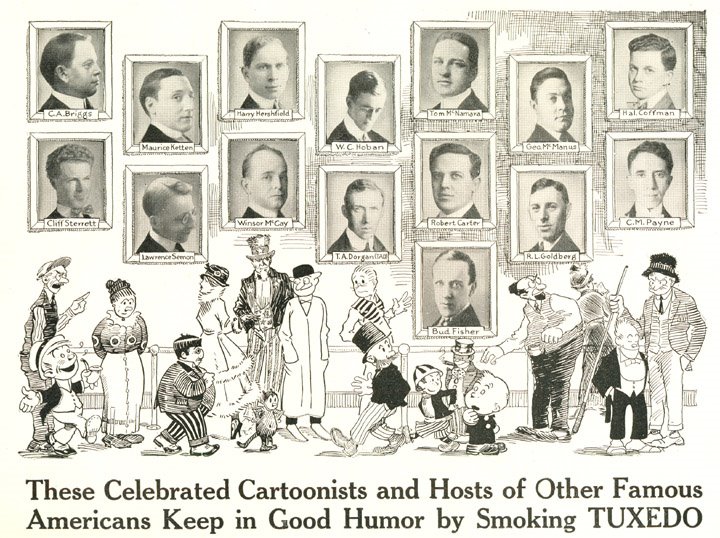
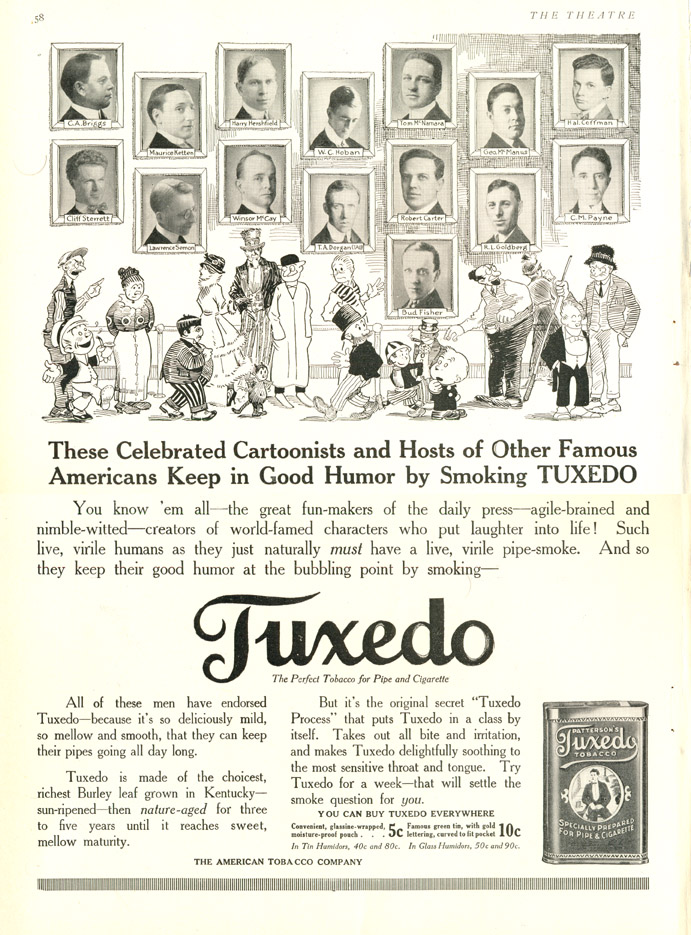
1916 Advertisement: Celebrated Cartoonists Keep In Good Humor by Smoking TUXEDO


This is a gorgeous jam ad of photos of cartoonists from the February 1916 issue of THE THEATRE Magazine. I believe, but am not quite sure, this may be the Evening Journal staff. The famous cartoonist roster includes a soon-to-be popular silent movie star who went from cartoonist to comedian. These giants of yesterday are:
Clare Briggs (1875 - 1930) created a dozens of strips, most famously "Mr. and Mrs."


Robert Carter (1875 - 1918) created a couple of early strips, drawing initially for Hearst's New York American paper. "Just Little Ones" and "Coffee and Sinkers" were two of his features. The Stripper's Guide has much more here.

The first cartooning job Hal Coffman (1883 - 1958) had was at the age of 15 for the San Francisco Post. He was paid $3 a week. He drew a series of then-well known depictions of the San Francisco earthquake. He continued cartooning, with better pay, and moved east. More here.

TAD Dorgan (1877 - 1929) was a cartoonist's cartoonist. He helped many cartoonists get their start, including Segar and Herriman and Walter Berndt, the Berndt Toast Gang's namesake. TAD had lost most of the fingers on his right hand in an accident and learned to draw with his left. A study in perseverance!


Bud Fisher (1885 - 1954), creator of "Mutt and Jeff," was the first cartoonist celebrity millionaire. He also owned his creation.


Rube Goldberg (1883 - 1970), a seminal name, was one of the guys who started the National Cartoonists Society. People who do not know who in the world Rube Goldberg was, know what a Goldberg kinda invention is.

Iowa-born Harry Hershfield (1885 - 1974) is best known for the Abie the Agent strip.

Walter Hoban (1890 - 1939) drew the popular "Jerry on the Job" strip, one of many office boy cartoons.

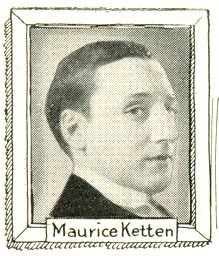
Maurice Ketten (AKA Prosper Fiorini, 1875 - 1965?) was originally born in Florence, Italy. Some samples of his strips here.

Winsor McCay (1869 - 1934), one of the giants. A prodigious illustrator who would in the next decade do thousands of drawings and break new ground in animation. The Norman Rockwell Museum has a page about him here. And there are, well, many, many more sites. Three's always some of his animation on YouTube.

One of my favorites, George McManus (1884 - 1954), creator of the long-running "Bringing Up Father." A gorgeous strip that's influenced Herge and Swarte.

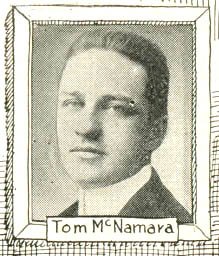
Tom McNamara (1886 - 1964) is a guy who left cartooning to work in the then-young movie business. He authored some Our Gang shorts, and worked with Mary Pickford.

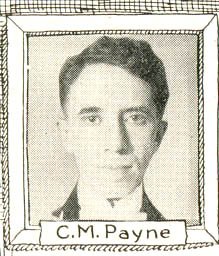
Charles M. Payne (1873 - 1964) drew "S'Matter Pop?" for 30 years.

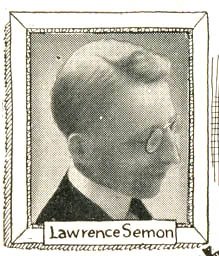
Larry Semon (1889 - 1928) was a cartoonist in this photo -- but he left for Hollywood within a couple years , pursuing a career in the new Hollywood film industry. He became a then-popular, now-forgotten silent screen comedian.

Cliff Sterrett (1883 - 1964), a cartoonist who sometimes utilized Cubist and Expressionistic art techniques in his "Polly and Her Pals" strip, continues to be rediscovered. More here.

And there you have a roster of greats.

The TUXEDO ad copy giddily blusters:

"You know 'em all -- the great fun-makers of the daily press -- agile brained and nimble-witted -- creators of world-famed characters who put laughter into life! Such live, virile humans as they just naturally must have a live, virile pipe-smoke. And so they keep their good humor at the bubbling point by smoking -- TUXEDO, 'The Perfect Tobacco for Pipe and Cigarette.'"

Here's the whole ad (right-click to put it on its own page so you can see it nice and big):


-- Extensively updated from a 2006 blog entry. I provided a scan of this ad for a "Polly and Her Pals" book some years ago, but I cannot recall which collection it was. I knew I should have asked for a free copy!

Wednesday, May 06, 2020

"Teen-Agers, Unite!" by Charles M. Schulz


 "The 'Peanuts' Gang Grows Up! A Great New Collection of Riotous Cartoons by Charles M. Schulz"
This 1967 Bantam paperback collects some of Schulz's teenager strips. This is what Nat Gertler was talking about in Friday's blog entry: a new definitive collection of all teenager panels that Schulz drew. So, here are a few scans from this earlier collection to whet your appetite.


"It's my big brother's sweatshirt .... I thought for sure it would fit me if I rolled up the sleeves!"


It's fun to see these cartoons -- but these are not "the PEANUTS gang grown up," despite the cover blurb. Well, okay, this girl looks a heckuva lot like Violet or Lucy.


"Elaine and I are sort of off and on. . . . One day she likes me and the next year she doesn't!" 

Hmm. That guy with the hat looks like Charlie Brown. And that girl; she looks like Frieda sans the naturally curly hair.


"Sure, I know all about that beautiful coat that Jacob gave Joseph, but I'll bet you that Joseph didn't already have seven sport coats at home!"


OK, so the guy looks and talks like Linus. But these are gags about teenagers that Schulz did for a church publication. The cartoons are not related to the Peanuts gang.
Here's Peanuts authority Nat Gertler from the essential Aaugh.com site:
"... the non-Peanuts work of Schulz that has been most reprinted is the series of single-panel gags that he did for the Church Of God, appearing primarily in their magazine Youth. These panels, occasionally referred to by the horrible name Teen-nuts, have been collected in a number of books over the years. I heartily recommend reading any of these you can lay your hands on."


"I'm convinced that the telephone is an instrument of the devil.... I haven't had anyone call me for a date all week!"

Yeah, she looks a little like Peppermint Patty. What Schulz always is playing on is the lankiness of the teenager -- just like Zits does now. All the teenagers (or "teen-agers" as the title of the book spells it) are tall drinks of water.


"I appreciate being nominated as president of our youth group, but I am afraid that I must decline on grounds that I am too stupid."


Some typical self-deprecating humor. Interesting how easily these couple of horizontal lines read as pews. That's economy!


"So how can I kneel in front of my bed to say my prayers? I sleep in the upper bunk!"

The little kinds in this panel do not look like Peanuts kids; smaller bodies and large, bulbous heads. Poor little guys. If they had an itch on the top of their head, they couldn't reach up to scratch it now, could they?


"I really have nothing against your saving string, Son, but couldn't you at least keep it rolled in a ball?"

This must've been one of those "fun to draw" gags. One of the things I like to see is detail, and this one has some great details: a shoe (Where is the other one?), the teenager wearing the frilly female apron to run the sweeper, the argyle socks, the string wrapped around the light fixture. And note that all the cartoons are signed "CSM."


"I do too like to walk in the rain. . . . I just like to see who I'm walking with, that's all!" 

I always liked the way Schulz drew rain. Those inky lines really looked like a downpour.


More:

Barry's Pearls of Comic Book Wisdom: Charles M. Schulz: Cartoons Without Peanuts 


Charles Schulz's Letter About Democracy, Discovered 50 Years Later

-- Edited from a August 4, 2006 blog entry. 

Tuesday, May 05, 2020

Video: Art in Action Exhibition at the Library of Congress: Herb Block Foundation's Marcela Brane and Sarah Alex

There's an exhibition of Herblock political cartoon art at the Library of Congress, and here's two of the political cartoonist's assistants to talk about it.

Drawings by the renowned cartoonist provided vital inspiration for the Library of Congress exhibition "Art in Action: Herblock and Fellow Artists Respond to Their Times." The show thematically paired his political cartoons with artists' prints, drawings and posters as a powerful way of exploring the role of artists in reflecting history, culture and society. Marcela Brane and Sarah Alex, dedicated assistants to the cartoonist late in his career, now head the Herb Block Foundation. Together they visited the Library's Graphic Arts Galleries where they vividly recalled what it was like to work for him. While sharing their memories of him as a cartoonist and a human being, they also offered special insights into his work and career.


For transcript and more information, visit https://www.loc.gov/item/webcast-9154

Friday, May 01, 2020