Wednesday, July 14, 2021

PETER PLANTS A POCKETFUL by Aaron Fine


Some selected drawings from the children's book PETER PLANTS A POCKETFUL, written and drawn by Aaron Fine. It's copyright 1955 by the Oxford University Press. As you can see, this is from an old, discarded well-loved library book. I bought it for a dollar at a thrift store in Maine. What an old kids book from a San Bernadino, CA elementary school is doing at the other end of the country some sixty years later, I don’t know. But I was glad to discover it.

STORY: Peter and his family, for reasons not spelled out in the story, has to move three blocks away from his old house. (It could be eminent domain, but I am just supposing.) Now, before that happens, he plants the title “pocketful of seeds.” His old house is demolished. The seasons pass. Winter comes and goes. A concrete playground is poured on the grounds of Peter’s former house. And, workmanship being what it is in a contract-goes-to-the-lowest-bidder public works matter (Perhaps a topic for another book in the Peter series.), a crack appears. You can see it right there next to the teeter totter.

Turns out it’s a sunflower, left over from Peter’s planting of a year ago. Oh, and, “many, many weeds – a whole pocketful!”

Aaron Fine did a wonderful job on the look of this book, like I said. Each one of theses pages is an outstanding graphic, created in two tones. But, then I started looking for more about Aaron Fine. There is nothing on the Internet about him or about other books or other art that I could find.

I would be glad to discover that I am wrong, though!


My scans of the gatefold are incomplete. Sorry about that.


Tuesday, July 13, 2021

Pogo: Churchy La Femme Has a Thing About Friday the Thirteenth.


If you know your Pogo then you know that Churchy La Femme has a thing about Friday the thirteenth. Many Pogo strips have him worrying that "Friday the thirteenth is on a Tuesday this month!" (Which it is this month.) But, worse of all, is when it falls on an actual Friday.


Go look! Michael Bates collects a 1965 Friday the thirteenth sequence via Whirled of Kelly. 

In the Pogo comic strip, the superstition is always unfounded. Churchy expounds on bad things that could maybe happen, but the only thing he does is panic himself and spook the other Okefenokee swamp critters. The enemy, as Pogo observes, is ourselves.

And the superstition has a name which I found out about at this here web site run by a real estate agent:

"The fear of Friday the 13th is called paraskevidekatriaphobia, a word derived from the combination of the Greek words Paraskeví (meaning Friday), and dekatreís (meaning thirteen), attached to phobía (meaning fear)."

Monday, July 12, 2021

Documentary Film: American Caricature

Tom Richmond and C. F. Payne are among the caricaturists interviewed for "American Caricature," a 2020 feature documentary about drawing caricatures for a living.

"You’ve seen them in magazines, in cartoons, and at just about every densely populated tourist attraction in America. A professional caricature artist will manage not only to capture a person’s likeness, but amplify it - all while exaggerating, contorting, and stylizing the subject’s most prominent features. To some, they are souvenirs. Fleeting entertainment. To others, a powerful tool in their satirical arsenal. American Caricature showcases not only the art of caricature, but the subculture surrounding it. From animators, illustrators, cartoonists, and live sketch artists, you’ll hear in their own words what it is that brings them all together, both literally and figuratively. Drawing caricatures for a living is unconventional to say the least, and you’re invited to explore the the passion, the industry, and the community of caricature art in the United States. After all, drawing funny faces is a serious business! 

"Directors: Joe Ciomek and Tom Faraci 

"Starring: Joe Bluhm, Tom Richmond, Jason Seiler, C.F. Payne, Glenn Ferguson, Ali Thome, Len Hernandez, Rob Hren, Stacy Pierce, Dave Smith, Jared Stokes, Sean Evans, Mary Kay Williams, Ty Jones, Sean Gardner, Jeremy Townsend, Chris Chua, Natalie Hume, Emily Byrne, Kayla Archer, Nate Kapnicky, Tony Sobota, Beejay Hawn, and more!"


Friday, July 09, 2021

The First Desert Island Cartoon?

Desert Island Cartoons. I say it, and you know what I mean. It's been a popular gag cartoon trope for a long time. Heck, it was even a TV show (Gilligan's Island), right? Even though, as Bruce Handy notes in this 2012 Vanity Fair article,

"You’d think by now, in a world equipped with G.P.S. and Google Earth, cartoonists would have wrung every last drop of humor from the premise of castaways marooned on desert islands."

-- But desert island cartoons still persist.  

I remember selling my very first desert island cartoon. It was a thrill to be able to make a decent gag out of such an old idea. It first appeared in the magazine Legal Affairs, aimed at the legal profession. The tour guide in the boat (obscured by the watermark) has the line:


"And to port, the most sequestered jury in the world."

 (My cartoon is now available for licensing at Cartoonstock.)


OK, OK, but when was the FIRST desert island cartoon?  

Here's then-New Yorker cartoon editor Bob Mankoff on its history, from that same article:

"The desert-island cartoon originally comes out of desert-island literature—Robinson Crusoe. It’s the classic thing of tragedy plus time equals comedy. In the 17th and 18th centuries, shipwrecks were common and you could actually be stranded, and people were stranded, on desert islands. Our desert-island cartoons probably started in the 1930s.

"One of the interesting things about that is that originally the desert island in cartoons is quite large, and the ship is sinking in the background, so there’s a narrative. You sort of understand how they got on the island. Later, the island becomes an icon [i.e., the tiny island with a single palm tree].

"Probably there were desert-island cartoons in comic magazines that preceded The New Yorker. I don’t know specifically, but probably in Judge and Life, comic magazines that precede The New Yorker [which debuted in 1925] and that New Yorker cartoonists probably worked on in the early part of the century, and even in the 20s."


Desert islands, or as they're sometimes called "deserted islands," figure in popular literature like The Tempest, Swiss Family Robinson and Lord of the Flies. Perhaps the interest was originally in response to the rise of urban centers and a nostalgia for a simpler, agrarian times. Regardless, there is nothing approaching any scholarship examining the appeal and longevity of desert island gag cartoons. 

Let's see if we can add to the knowledge database of the desert island single panel motif. 


So far as the first desert island cartoon, my friend Dick Buchanan may have the answer. Here is a cartoon from the satirical magazine Judge, September 17, 1887, that Dick has unearthed:


The cartoon is by Michael Angelo Woolf (1837 -1899). He was London-born, but lived most of his life in Brooklyn, NY. He was known as an artist, satirist and actor.


From Michael Lund's biographical sketch "Another Other Half: A Look at Michael Angelo Woolf and His 'Waifs:'"

"'The father of the modern comic picture—the man who woke the laughter of a generation [...]
—died at 1 o’clock yesterday morning,' The New York Times declared on March 5, 1899. The deceased was Michael Angelo Woolf, a now largely-forgotten cartoonist who in his own time, as the obituary’s epithets for him suggest, was both well-known and well-liked. Born in London in 1837, Woolf moved to America at a young age and first pursued an acting career in Philadelphia. At the close of the Civil War, he turned his efforts instead to art and went to France for instruction. After returning to America, and beginning in the magazine Wild Oats in the 1870s, Woolf would focus much of his career in cartooning on drawing his then-famous illustrations of “waifs,” a character type that was inspired by New York City street urchins. Returning to the life of the city’s poor time and time again, in a career that spanned some thirty-odd years, Woolf, a generally liberal and sometimes conservative cartoonist, opened up a world of which many of Harper’s Weekly, Judge, and LIFE’s middle class readers had little first-hand knowledge."


I agree with Mr. Lund that while Woolf was popular in his day, describing him as the "father of the modern comic picture" is hyperbole. That honor should go to his contemporary, Thomas Nast. Woolf is best known now for his cartoons about children of the slums of New York, much like photojournalist Jacob Riis. 

Back to the point ....

But is this the FIRST desert island cartoon? I don't know for sure. It's the earliest I have ever seen, but without going through thousands of 19th century cartoons in Judge, Puck, Punch and other publications, I don't know. It's merely a possible contender.

My thanks to Dick Buchanan for spotting this cartoon and sending it on!

Thursday, July 08, 2021

Liza Donnelly: "Drawing Bits of New York"


Liza Donnelly shares her process in her latest blog post "Drawing Bits of New York:"


"Sometimes if a person that I am drawing moves away, I will either abort the drawing or make it up from memory. I have to say it’s a little odd showing you the photo, because you can see how I abbreviate, alter and leave things out in order to do it simply and get the feeling without stressing about details!"


Wednesday, July 07, 2021

Lynn Johnston "For Better or For Worse" Interview

Bryan Tobin talks to Lynn Johnston about her newspaper comic strip (and TV show) "For Better or For Worse" in this podcast far-ranging interview.

"She talks about her tough relationship with her mom, and the backlash she caused by creating a gay character and killing off the dog in the comic. It's really quite the episode."


Tuesday, July 06, 2021

Danny Shanahan 1957 - 2021


New Yorker cartoonist Danny Shanahan passed away on the morning of July 5th at the age of 64 following complications from surgery. He was 64 years old.

His friend and fellow New Yorker cartoonist Michael Maslin has a remembrance.

"Danny’s star rose quickly at The New Yorker, becoming a favorite contributor during editor Robert Gottlieb’s short tenure. Mr. Gottlieb was so fond of Danny’s work, he once huddled with then art editor, Lee Lorenz to develop a cover idea for Danny to execute (the cover, a businessman running along a city street, with New York City Taxi rates on his briefcase, was published August 12, 1991). Over his thirty-two years at the magazine Danny contributed approximately a thousand cartoons, numerous illustrations, and a dozen covers.

"Danny was born in Brooklyn, July 11, 1956, one of eleven children, and raised in Bethelhem, Connecticut. Before bursting onto the pages of The New Yorker, he tended bar at The Bottom Line in Manhattan’s Greenwich Village. He lived for a time in New Mexico with his family before moving to Rhinebeck, N.Y., where he became part of a small community of New Yorker cartoonists that included Michael Crawford, Liza Donnelly, and myself.

"Around Rhinebeck, Danny was often seen strolling the town’s main street, sometimes with a cigar in his hand (until he quit in later years). In a number of his New Yorker cartoons showing small town sidewalk scenes, shop windows contain names of actual stores in Rhinebeck."


From a 2015 interview:

Brent: Do you usually come up first with the visual or the words? 

Danny: I'm a word guy, primarily a comic writer, I suppose, so I nearly always work with the captions first, the drawings following. I write in a sketchpad because I like to immediately rough out the ideas I come up with. Sometimes these ideas are half-formed, but if I get them sketched out, they might eventually be more fully realized the following week, or the week after.


Via The Daily Cartoonist:

"Certainly his years at The New Yorker (1988 – 2020) sealed his cartooning fame, but he also contributed to other publications including: Time, Newsweek, New York Magazine, Fortune, Playboy, Esquire, The New York Times, the Wall Street Journal, the Chicago Tribune, and others.

"Danny’s last years had seen some troubles but he had hoped to regain his career when this tragedy struck."


Friday, July 02, 2021

Two Videos: Stephen Hess on "The Ungentlemanly Art" and "American Political Cartoons 1754-2010"

Iowa State University is digitizing its audio library, and this lecture by Stephen Hess has popped up. Hess is the co-author of The Ungentlemanly Art, a book first published in 1968 about the history of American political cartoons. The book has been revised a couple of times since then, and there are a number of new editions. The date for this Iowa State talk does not appear on the YouTube page, but it could be any time since then. I am hoping, since this was just recently posted by the Iowa State University Lecture Series Archive, that the missing information will be added soon.

Although it's audio only (The original lecture is on "reel to reel quarter inch" tape -- another reason to think it's probably an older lecture.), Hess does a good job here of describing the slides (yes, SLIDES) of the cartoons from The Ungentlemanly Art and, generally, squeezing in the history of political cartoons into about a half-hour.

From the dust jacket:

"'Stop them damn pictures,' demanded William Marcy Tweed of his henchmen. 'I don't care so much what the papers write about me. My constituents can't read. But, damn it, they can see pictures!' Since Boss Tweed's outburst, inspired by a cartoon in an 1871 issue of Harper's Weekly, political cartoonists have fearlessly continued to expose corruption and elicit wry laughter. The Ungentlemanly Art presents for the first time the fascinating history of American political cartoons from 1747, when a Philadelphia printer named Benjamin Franklin drew the first American political cartoon, right up to the work of such contemporary masters as Herblock and Mauldin. This lively and entertaining book reveals how Paul Revere's cartoons 'borrowed' freely from other artists and how Currier & Ives often produced election lithographs for both sides. Included are the famous War of 1812 cartoons by William Charles, who a latter-day cartoonist felt 'had not the least notion of what we call decency.' Illustrated with a selection of Thomas Nast's most powerful drawings, the book recounts the career of the man Lincoln called his 'best recruiting sergeant.' Nast invented the Republican Elephant and the Tammany Tiger: here are the stories behind these popular symbols, as well as John Q. Public, Uncle Sam, and the Democratic Donkey. The Ungentlemanly Art not only chronicles the careers of the statesmen, soldiers, and politicians who provided the cartoonists with cause for merriment or disdain,-but also gives a highly knowledgeable picture of the mass media through which the cartoonists have reached their audiences--the early broadsides; the nineteenth-century humor magazines, such as Judge, Life, and Joseph Keppler's Puck; and the rise of the newspaper cartoons during the era of Joseph Pulitzer and William Randolph Hearst. 'Caricatures,' Emerson said, 'are often the truest history of the times.' And through the over 300 brilliant cartoons that Stephen Hess and Milton Kaplan have chosen to illustrate this book, we see the political fads and foibles of the American past come alive before our eyes. In these pages we see how other generations of Americans viewed Prohibition and Woman's Suffrage, Theodore Roosevelt and William Jennings Bryan, the First World War and the Civil War. 'Americans not only have had the capacity to poke fun at their politics and their politicians, but they have often done it exceedingly well.' Considering such cartoonists as Jules Feiffer, David Levine, Patrick Oliphant of the Denver Post, and Paul Conrad of the Los Angeles Times, the book provides abundant evidence that the state of the art in the United States today is very healthy indeed."


By way of wanting to give you more visuals, here is Stephen Hess and Sandy Northrop talking at a  2011 Library of Congress event about their new book American Political Cartoons 1754-2010. This books supersedes the older Ungentlemanly Art.


Thursday, July 01, 2021

The Garden As of July 1, 2021


Big heat wave in New England with temperatures in the 90s these past three days. Then, a big storm blew through late afternoon, and the power went out for about 90 minutes. Exciting! Well, here's the scruffy garden after last night's deluge and high winds. 


Peppers and lettuce with grass that needs to be weeded in between.

Tomatoes! Three kinds! Which is why some are bigger than others.

Zucchini and yellow squash which, despite all looking nice and green, is being attacked by the squash borer and the squash bugs.

Zinnias and runner beans -- and the beginning of a makeshift trellis that got knocked over in the storm.


Wednesday, June 30, 2021

From the Dick Buchanan Files: Gag Cartoons From Oblivion to Here 1944 - 1970

My friend Dick Buchanan has taken a deep dive into his Olympic-sized collection of gag cartoons from the golden age of gag cartooning and surfaced with some classic gems from the past. Let me step aside and say thanks, Dick, and take it away:


---

FROM OBLIVION TO HERE
(1944 – 1970)


Here is another random assortment of mid-century gag cartoons, plucked from the clutches of oblivion, and emerge safe in the friendly confines of the Cartoon Clip File. These recently rescued cartoons are presented to amuse and dismay all those who enjoy such things and if you’ve read this far, that means you. Take a look . . .


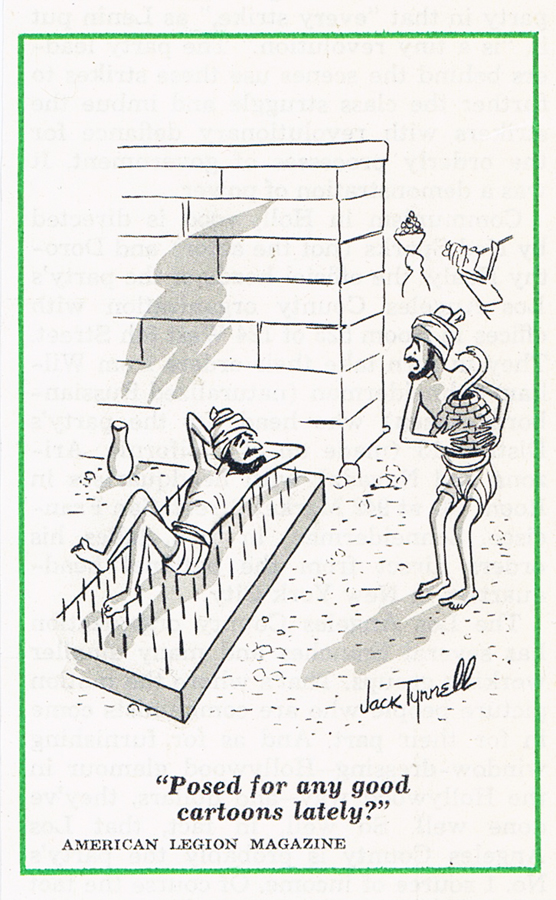
1. JACK TYRELL. American Legion Magazine May, 1949.


2. BOB BARNES. Collier’s June 25, 1955.


3. LESLIE STARKE. The Saturday Evening Post March 26, 1949.


4. HANK KETCHAM. The Saturday Evening Post July 15, 1950.


5. DICK ERICSON. American Magazine August, 1956.


6. TON SMITS. This Week Magazine June 16, 1957.


7. BILL HOEST. True Magazine May, 1970.


8. VIRGIL PARTCH. True Magazine June, 1952.


9. JEFF KEATE. American Legion Magazine July, 1948.


10. JOSEPH FARRIS. The Saturday Evening Post September 27, 1958.


11. CLYDE LAMB. American Legion Magazine July, 1948.


12. LARRY HARRIS. American Legion Magazine August, 1967.


13. ROY WILSON. The Saturday Evening Post October 23, 1954.


14. PERRY BARLOW. Look June 30, 1964.


15. ED NOFZIGER. The Saturday Evening Post July 15, 1950.


16. DAVID PASCAL. Colliers March 4, 1946.


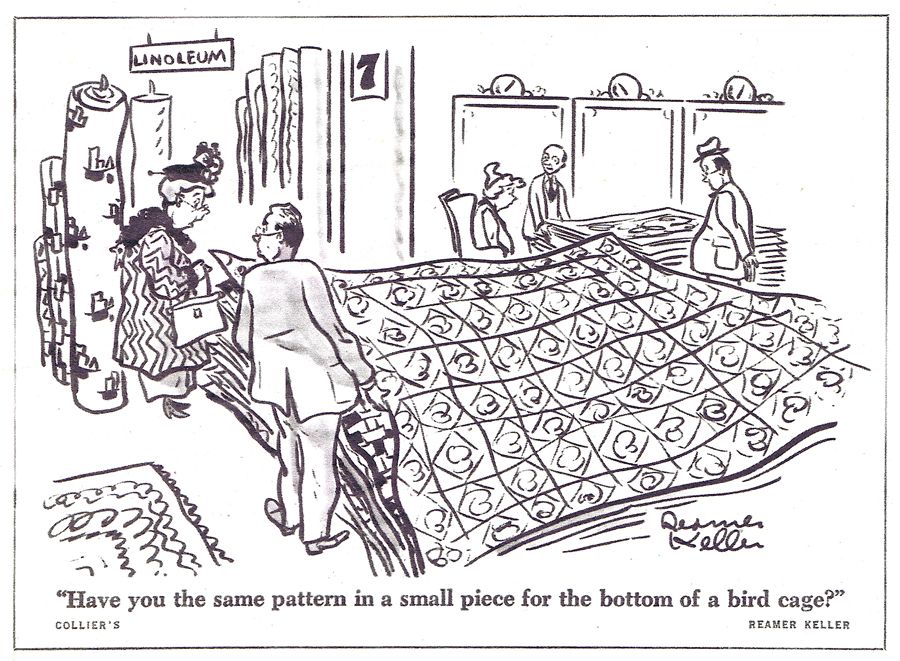
17. REAMER KELLER. Collier’s April 15, 1944.


18. PHIL INTERANDI. Look Magazine October 6, 1964.


19. WILLIAM von RIEGEN. Collier’s July 4, 1953.


20. ROBERT CENSORI. True Magazine May, 1970.