Friday, June 07, 2024

THE BETTER HALF by Bob Barnes


THE BETTER HALF was created by veteran cartoonist Bob Barnes in 1956 and syndicated by the Register and Hall Syndicate, and then by King Features until the panel ended in 2014. Two years into the feature, Barnes won Best Newspaper Panel from the National Cartoonists Society. The panel changed hands after Barnes' death in 1970

"His wife Ruth Barnes and illustrator Dick Rogers continued the strip until September 30, 1979. It then passed to Vinnie Vinson (October 1, 1979 to October 3, 1982) and Randy Glasbergen (October 10, 1982 to November 30, 2014).[1]

"Between 1982 and 1992, Glasbergen did the strip under the pseudonym "Jay Harris," so as not to confuse publishers who were familiar with his different style of humor and character design. ("Harris" was his wife's maiden name.) As he was able to transform the characters to his own style, he began using his own name. In the process, Stanley became much shorter than Harriet and lost his scruffy mustache.

"At the end of syndication, The Better Half was appearing seven days a week in approximately 150 print and online newspapers around the world. The strip ended on November 30, 2014, after a 58-year run" - Wikipedia


Stanley and Harriet Parker spar over middle class concerns. She stays home and irons and does the wash and is a bad woman driver. He smokes his pipe, mows the lawn, complains about the bills and occasionally ogles other ladies. If the spouses aren't trading zingers with another, they are combating the many butchers, paper boys, garbage men, store clerks and others that populate the suburbs.

James Coco and Lily Tomlin portrayed the couple in an unsold 1970s ABC TV pilot.

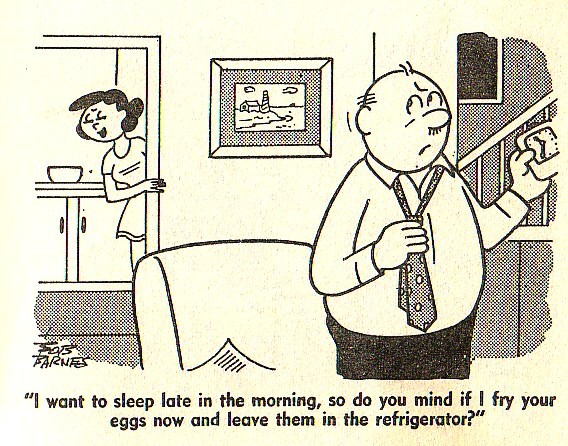
Here are two dozen from THE BETTER HALF book, a paperback collection published by Duell, Slean and Pearce, New York and is copyright 1963 by the Register and Hall Syndicate




Related:

From the Dick Buchanan Files: Bob Barnes 1913 - 1970


Edited from a January 12, 2012 blog entry. I wish I could fine video of that unsold TV pilot. 


Thursday, June 06, 2024

From the Dick Buchanan Files: Bill Mauldin's World War Three Cartoons

I'm handing things over to Dick Buchanan who reminds us about this fascinating "What If" story about a possible World War Three from a 1951 issue of Collier's Magazine. We were in the beginning of the cold war, and there was always the threat that the cold war would go HOT. This is that imagined scenario, just six years after the end of World War 2. Thank you and take it away, Dick:

----

BILL MAULDIN’S WORLD WAR THREE CARTOONS
  
        (Collier’s  October 27, 1951)


By October, 1951 World War Two was in the rearview mirror, the Korean Conflict was underway and the idea that World War Three was on the horizon was a commonly held fear.  With that in mind, the editors of Collier’s put together a special issue "Preview of the War We Do Not Want – an Imaginary Account of Russia’s Defeat and Occupation, 1952-1960."  The project, code-named "Operation Eggnog," was put together by Associate Editor Cornelius Ryan under considerable secrecy over a period of nine months. The 131-page issue appeared October 27, 1951.

Here’s the story in a nutshell. In May, 1952, after the Russian invasion of Yugoslavia, the principal United Nations countries and the United States declare war.  The United States uses atomic bombs against Russian industrial complexes.  Soviet forces invade West Germany, the Middle East and Alaska.  US forces, in disarray, have retreated on all fronts.  Korea and Japan are evacuated. London is hit by nuclear weapons, followed by Detroit, New York and Hanford. It should be noted their assessment of the harm caused by nuclear weapons was seriously deficient. Yes, things were grim, but never fear, all is not lost.

The following year more American cities are struck by nuclear weapons, but now better prepared, there are fewer casualties. Slowly but surely, UN forces manage to contain invading Soviet forces in several theaters. On May 22nd, B-36s drop nuclear weapons on Moscow, retaliating on Russia’s nuclear attack on Washington, DC.  UN forces are victorious in conflicts highlighted by a suicide task force of 10,000 US paratroopers dropped into the Ural Mountains to destroy the last remaining hidden Soviet nuclear stockpiles. The War ends in 1955 with the occupation of UN forces in Soviet Union.  In true storybook fashion Good prevails.  A Christian Science Monitor editor reports the rebirth of religion, unions, a free press and democracy in Russia.

These imaginary events of the Third World War were the covered by 20 leading writers of the day. Author Robert E. Sherwood provided the chilling narrative, Edward R. Murrow, as an embedded journalist, described the nuclear bombing of Moscow and Philip Wylie helped wind things up with a love story about a US Major who falls in love with a Russian girl who has been rendered infertile by radiation.  Other distinguished contributors included Senator Margaret Chase Smith, labor leader Walter Reuther, sports columnist Red Smith and world traveler and author Lowell Thomas. Leaving no stone unturned, Collier’s commissioned famed cartoonist Bill Mauldin to provide all of the cartoons in the issue.

Bill Mauldin was the preeminent cartoonist of World War Two. As an 18-year-old training with the 45th Infantry he cartooned part-time for the camp newspaper, The 45th Division News, in 1940.  These cartoons depicted the viewpoint of the war from the infantryman’s perspective, as experienced by bedraggled soldiers, Willie and Joe, the unshaven, listless, dull-eyed, cynical dogfaces who spent the war fighting the Germans, trying to keep dry and warm and flirting with insubordination. In 1943 his cartoons began appearing in Stars and Stripes and were syndicated by United Features in 1944.

Although Mauldin’s cartoons were wildly popular with enlisted men and with American audiences as well, they were not well received by some officers, notably General George Patton.  Patton summoned Mauldin to a meeting in 1945 and complained about the scruffiness of the characters and blamed Mauldin for disrespecting the army and "trying to incite a mutiny." Subsequently, General Eisenhower put an quick end to the campaign to ban Mauldin’s work by when he wrote an official letter to Deputy Theater Commander Lt. Gen. Ben Lear that said, in part, “A great deal of pressure has been brought on me in the past to abolish such things as Mauldin’s cartoons. . . . You will make sure that the responsible officer knows he is not to interfere in matters of this kind. If he believes that any specific violation of good sense or good judgment has occurred, he may bring it to my personal attention.”
 
  Here are all the cartoons Bill Mauldin created for Collier’s incredible project.


1.  BILL MAULDIN.  Collier’s  October 27, 1951.  Page 48.


2.  BILL MAULDIN.  Collier’s  October 27, 1951.  Page 59.


3.  BILL MAULDIN.  Collier’s  October 27, 1951.  Page 69.


4.  BILL MAULDIN.  Collier’s  October 27, 1951.  Page 74.


5.  BILL MAULDIN.  Collier’s  October 27, 1951.  Page 96.


6.  BILL MAULDIN.  Collier’s  October 27, 1951.  Page 106.


7.  BILL MAULDIN.  Collier’s  October 27, 1951.  Page 112.


8.  BILL MAULDIN.  Collier’s  October 27, 1951.  Page 125.


9.  BILL MAULDIN.  Collier’s  October 27, 1951.  Page 128.


- Edited from a December 5, 2019 blog entry.

Wednesday, June 05, 2024

June 6, 2024 Live Library of Congress Zoom Event: Censorship, the Comic Book, and "Seduction of the Innocent" at 70: A Roundtable Discussion


The Library of Congress will hold a free Zoom event at noon on June 6, 2024, "Censorship, the Comic Book, and 'Seduction of the Innocent' at 70: A Roundtable Discussion featuring:


• Margaret Galvan, Assistant Professor of visual rhetoric, Department of English, University of Florida

• Carol Tilley, Associate Professor, School of Information Sciences, University of Illinois at Urbana-Champaign

• Qiana J. Whitted, Professor of English and African American Studies, University of South Carolina


Zoom link here.


Description:


"In 1954, psychiatrist Fredric Wertham published 'Seduction of the Innocent: The Influence of Comic Books on Today’s Youth,' a book that cemented his role as America’s most prominent critic of comic books. At the time, comic books were near the peak of their popularity, with titles like Batman, Superman, and Captain Marvel selling as many as 1.5 million copies per month. The content of those comics was also entirely unregulated. Writing amid a moral panic that Wertham himself helped create, 'Seduction of the Innocent' almost immediately helped spur the formation of the Comics Code Authority, which dramatically reshaped the nation’s comic book industry.

"Join staff of the Manuscript and Serial & Government Publications divisions for a roundtable discussion with three comic studies scholars who will make brief presentations on current research, and discuss Wertham’s anti-comics legacy and its afterlives in more recent clashes over representations of race and sexuality in comics and graphic novels.


"The panel will be moderated by Josh Levy of the Library’s Manuscript Division and Megan Halsband of the Serial and Government Publications Division, who will briefly highlight the Fredric Wertham Papers and the Library’s vast collections of comic books and zines. Join us to reflect on race, gender and representation, visual culture and archives, and Wertham’s anti-comics crusade seven decades on."


Tuesday, June 04, 2024

From the Dick Buchanan Files: Bob Barnes 1913 - 1970

You can't control when you are born, and what the world you grow up in is like. Coming of age during a worldwide depression was not what anyone would want. Fortunately, Bob Barnes kept pressing on. But his professional cartooning career really didn't start to take off until he was well into his thirties. Dick Buchanan does a deep dive into Bob Barnes' life and career. 

Thanks and take it away, Dick!


---


BOB BARNES
(1913 – 1970)


Bob Barnes Self Portrait. Best Cartoons of The Year 1947. Crown Publishers, New York, New York 1947.


Robert L. “Bob” Barnes was born in Portland, Oregon in 1913. He was an illustrator and cartoonist whose drawings appeared many magazines and newspapers in the mid-20th century. Barnes attended a commercial art school in the 1930s. The Great Depression was underway so Barnes made a living by tackling a variety of jobs; he was a sign painter, a letterer and contributed advertising art to The Oregon Journal and Portland Telegraph. He also was a reporter and sold sewing machines. During WWII he worked at the California Shipbuilding Corp., doing public relations work and editing their weekly and monthly in-house publications.


After WWII Barnes’ gag cartooning career took off. His first major sale was to Collier’s. He was a regular contributor to Laff-A-Day, the daily panel syndicated by King Features and edited by fellow cartoonist Bob Schroeter. Although he sold but one cartoon to The New Yorker, he drew hundreds of them for the nation’s other leading magazines—Collier’s, The Saturday Evening Post, Look, True Magazine, This Week, Better Homes & Gardens, and 1000 Jokes Magazine. From 1953 to 1960, Bob Barnes was among the among the top ten sellers in magazine sales.


In 1956 Barnes created the syndicated panel, The Better Half, featuring the bickering, wisecracking married couple, Stanley and Harriet Parker. The Better Half debuted June 25, 1956, syndicated by the Register & Tribune Syndicate, appearing in over 200 newspapers. In 1958 he was awarded the Best Cartoon Panel from the National Cartoonists Society


The Better Half ran until Barnes’ death in 1971. His wife, Ruth Barnes and illustrator Dick Rogers continued the strip until September 30, 1979. Subsequently, the panel was illustrated by Vinnie Vinson (October 1, 1979 to October 3, 1982) and Randy Glasbergen (October 10, 1982 to November 30, 2014)
Here, neatly clipped from the pages of the great magazines of the 20th century, are some Bob Barnes magazine gag cartoons . . .


Judge July, 1946.

American Magazine July 1946.


Collier’s November 2, 1946.


American Legion Magazine March, 1948.


The Saturday Evening Post June 12, 1949.


American Magazine May, 1951.


Gags October, 1951.


Here! December, 1951.


Collier’s January 26. 1952.


American Magazine March, 1953.


The Saturday Evening Post October 17, 1953.


Collier’s April 18, 1953.


The Saturday Evening Post October 23, 1954.


American Magazine June, 1955.


American Magazine August. 1955.


1000 Jokes Magazine March-May, 1956.


The Saturday Evening Post April 27, 1957.


The Saturday Evening Post March 9, 1957.


1000 Jokes Magazine June-August, 1958,


The Saturday Evening Post April 18, 1959.


American Legion Magazine July, 1959.


American Legion Magazine March, 1960.


For Laughing Out Life October-December, 1961.


Look Magazine April 25, 1961.


The Saturday Evening Post February 25, 1961.


Monday, June 03, 2024

The Garden As of Early June 2024


This is the raised bed garden as of June 1st. As you can see, nothing to see here. The winter rye has been cut down and the soil turned. 

Some repairs are needed. 


The winter rye, once turned back into the soil, adds nutrients. 


I love lupins, but only one of the plants came back this year. They are all over the place in New England and Canada. They're practically a weed, blooming in fields all over the place, but I sure can't grow 'em in my darn garden. 


I planted carrots a couple of years ago and they have gone rogue, spouting up in other boxes and in the lawn.


Just a some branches from the birch that was taken down due to the ice storm a couple of months ago.


The hostos is growing an inch or two a day.


I decided it’ll be mostly zinnias in the raised beds. I’ll grow tomatoes and cucumbers on the side porch. I’m doing this so I don’t have to build a tall fence around the raised bed garden to ward off deer. For years, there were no deer here on the ridge. They were lazy and stayed down in the valley. But, now, no more they're not. Now there are many and they are hungry. I grew a raised bed of zinnias last year and they didn't eat it. Hopefully, they won’t figure out how to get up the porch steps to eat the produce. Sad thing is that there won't be as big a harvest.