Tuesday, October 12, 2021

Dick Buchanan's Cartoon File: Wordless Gag Cartoons 1944-1964

My thanks to Friend-of-this-blog Dick Buchanan. He has wandered the dusty piles of his old magazines and scanned in a selection of fifteen cartoons without words and shared them with us. Take it away, Dick!

----

At one time or another several magazines had a feature titled “Too Funny for Words” featuring cartoons without captions. Here are some cartoons that fall into that special category--some amusing if not necessarily “too funny” cartoons by some of the best cartoonists of their time.

1. AL ROSS. For Laughing Out Loud. July-September, 1963


2. GEORGE la MENDOLA (George Dole). 1000 Jokes Magazine. Fall, 1950


3. CORKA. (Jon Cornin & Zena Kavin) Liberty. August 10, 1946


4. CLYDE LAMB. Judge. October 1953


5. TOM HENDERSON. Collier’s. July 8,1955


6. VIRGIL PARTCH. Liberty. September 9, 1944


7. TON SMITS. 1000 Jokes Magazine. March-May, 1962


8. CEM (CHARLES E. MARTIN) The Saturday Evening Post. September 29, 1962


9. CHARLES ADDAMS. True Magazine. October 1949


10. BOB BARNES. 1000 Jokes Magazine. Fall, 1950


11. JOHN GALLAGHER. Collier’s. March 16, 1953


12. HENRY SYVERSON. Look Magazine. January 28, 1964


13. PETER PORGES. The Saturday Evening Post. September 29,1962


14. STAN HUNT. 1000 Jokes Magazine. May-July, 1955


15. CLYDE LAMB. 1000 Jokes Magazine. Summer, 1951


FYI: In May, 1955, The Gag Re-Cap (a publication for cartoonists and gag writers covering major magazines) reported that out of 94 magazines there were 924 cartoons published, of which 20% were no caption gags—194 to be exact..

---

Thanks, Dick, for this amazing selection.


Here are more of Dick's great gag cartoon finds:

1953 George Booth Drawings for American Legion Magazine

Dick Buchanan: Winter/Christmas/Holiday Gag Cartoons 1940s-60s

Dick Buchanan: Some PUNCH Magazine Cartoons 1948-1963

Dick Buchanan: Gag Cartoon Clip File 1946-64

Dick Buchanan: Gag Cartoon Clip File 1947-62

Dick Buchanan: Some Favorite Magazine Gag Cartoons 1940-60s

Dick Buchanan: Gag Cartoon Clip File 1931-64

- This has been a rerun from December 22, 2016.

Monday, October 11, 2021

TV Show Title Cards Part Three

This is part three of our look at some vintage hand-drawn TV Title Cards from the early 1950s. 

Part One is here.

Part Two is here. 

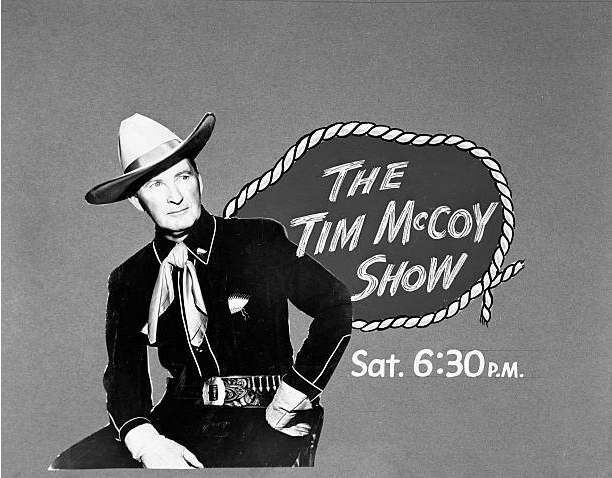
Tim McCoy's Wild West was a daily series (one of many of Tim McCoy's TV shows -- see the second title card) where he would talk about the history of the old west. More here.


Songs For Sale (1950-52) was hosted by Steve Allen and featured many musical acts.


Peter Potter hosted Jukebox Jury, first on radio and then, beginning in 1948, on television. 

"On 'Jukebox Jury', six young, glamorous late-Forties' B-movie stars and minor recording artists were on-hand to judge the latest record company releases. Celebrities like Barry Sullivan, Maureen O'Sullivan, Phyllis Winger, and Jane Powell form a six pack of stars who line up on either side of the host. Their job: to sit still and look cool while the three-minute single played and the TV camera probed them - then offer an opinion of the record." - TV Party


The Garry Moore Show was a chat/variety show that ran for eight years from 1950 to 1958. With his co-host Durwood Kirby, the program then moved to prime time where it ran for another four years.

I believe this Late Show title card to correspond with a late night movie series on a West Coast station.


If this was The Walt Disney Christmas Show of 1951, then it was essentially a promo for the company's new Peter Pan movie as well as the Snow White rerelease.

The Patricia Bowman Show was a one-season wonder. A musical variety program, the show was a "[L]ive variety series showcasing the dancing abilities of ballerina Patricia Bowman." - CTV

The Sammy Kaye Show was a mainstay for the the 1950s, running from 1950 to 1959. 

From Nostalgia Central:

"Bandleader Sammy Kaye first brought his swing-and-sway music to television in 1949, with two specials. He later appeared in several series during the 1950s, on various networks.

"Kaye’s most famous trademark was his 'So You Want to Lead a Band' audience-participation routine, which he had used for years in personal appearances and on radio, and it was also featured in most of his TV series.

"In it, Kaye chose half a dozen members of the studio audience to try their hands at band-leading. The band did exactly what the ‘leader’ indicated with their baton, sometimes to hilarious effect. The best bandleader was chosen by audience applause and awarded a prize.

"Kaye also provided straight entertainment with his orchestra, vocalists, and guests, and often led a community sing-a-long. He ended each show with an inspirational poem.

"The various Sammy Kaye series, though essentially similar in format, went under a number of titles over the years. The 1950 edition was called So You Want to Lead a Band. In 1951-1952 it was The Sammy Kaye Variety Show, in 1953 The Sammy Kaye Show, and in 1954-1955 So You Want to Lead a Band.

"The 1958 series was first called Sammy Kaye’s Music from Manhattan (the sponsor was Manhattan shirts), then in January 1959 switched to The Sammy Kaye Show and in April 1959 to Music from Manhattan. You would never have known the difference by watching them."

Ricky and the Magic Trolley was a Los Angeles-based puppet show, sponsored by Nesbitt's orange drink. Tom Scott, grandson of B.R. Murphy, President of Nesbitt Fruit Products Company from 1943 to 1959 adds in his Nesbitt's Fact Page:

"Nesbitt's was the sponsor of an early television show in Los Angeles called 'Ricky and the Magic Trolley. It was a puppet show that was done circa 1952-1953. I remember going to the set with my grandfather when I was 6 or 7 years old along with my two younger sisters. We went to do a live TV commercial with a couple of other kids who were the daughters of the Nesbitt ad agency guy. It was in the same studio as 'Space Patrol,' one of my favorite TV shows at the time. I was thrilled to sit in the cockpit of the space ship. The Ricky puppet show set was raised off the floor so the puppeteers could stand up under it."


Friday, October 08, 2021

From the Dick Buchanan Files: Happy Birthday, Orlando Busino

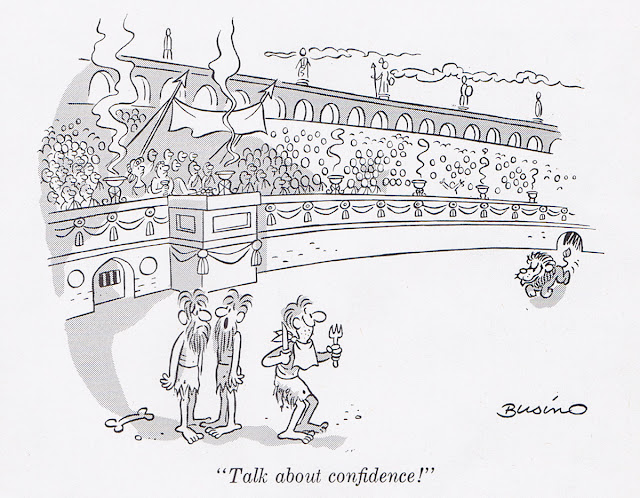
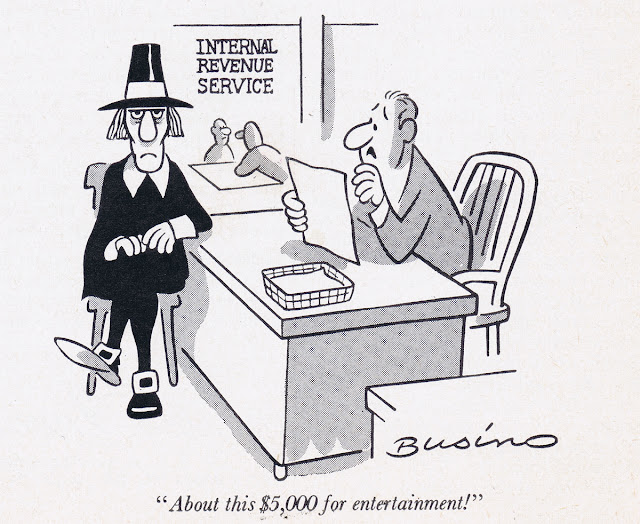
October 10th is cartoonist Orlando Busino's birthday! Whether you know him from his gag cartoons for Saturday Evening Post or Reader's Digest or his many comics and cartoons (including "Gus") for Boys' Life magazine or for his Archie Comics work - Orlando is one of a kind. A three-time winner of the National Cartoonists Society's "Magazine Gag Cartoonist of the Year" award, Orlando deserves a round of applause and a big cyber-birthday cake. Here, courtesy of Dick Buchanan's massive file/pile of single panel cartoons, are a dozen great reasons to wish Orlando the happiest of birthdays. Thanks and take it away, Dick!

--


ORLANDO BUSINO
Gag Cartoons
  (1953 – 1968)

1.  The Saturday Evening Post  August 4, 1965.


2.  Argosy February, 1957.


3.  The Saturday Evening Post May 2, 1964.


4.  The Saturday Evening Post  November 6, 1954.


5.  Look Magazine  August 25, 1964.


6.  The Saturday Evening Post  January 29, 1953.


7.  The Saturday Evening Post  April 24, 1965.


8.  American Magazine  February, 1955.


9.  True Magazine  August, 1964.


10.  Argosy  July, 1965.


11.  Boys’ Life  November, 1968.


12.  Argosy  August, 1965.


Thursday, October 07, 2021

TV Show Title Cards Part Two

Here are some more TV show title cards from 1952. Again, these were all hand mounted, with hand-lettering and art. Some fascinating graphics from some very long gone vintage television shows. 


Racket Squad ran for three seasons from 1950 to 1953. While it starred Reed Hadley and involved ordinary citizens getting duped into confidence schemes, the narrator of the show, Hugh Beaumont, would go on to great fame as the father in the long running Leave It To Beaver series. 


Dr. Froelich Rainey hosted the quiz show What in the World? from 1951 to 1955 "in which the scholar-contestants tried to identify artifacts. The objects were primarily archaeological in nature, but also consisted of fossils, ethnographic items and more. It premiered on October 7, 1951 on CBS." - Wikipedia


Big Town, about a crusading newspaper editor, was a big thing. It started (like a lot of TV shows) on radio (with Edward G. Robinson as the newspaper editor), some movie adaptations, then television -- airing for four years on CBS and one more on NBC. It was also a DC Comic book for fifty issues. TV and radio episodes can be found online.


A classy shot of Jack Benny. 


Perry Como had a number of shows and specials, The Perry Como Chesterfield Show (1950-55) being one.


Steve Allen was another guy who was all over in this time, what with guest appearances on What's My Line and his own shows.

No information on Singing Rails found online.

Here's a pre-Mister Ed Alan Young with his own show! It ran for nine years on radio and TV with different formats.

I think this is an alternate title to Studio One, the long-running, award-winning anthology series.

I love the lettering extravaganza on this Thrifty Cut Rate Presents Story Theatre title card.


Peter Potter's Jukebox Jury was a music/quiz show that started locally on KCBS in Los Angeles, and soon went national.

While this is a title card for a TV series called A Table at Ciro's, the only information that comes up is an IMDB listing for a 1996 TV movie by that name starring Darren McGavin, Sherilyn Fenn, Lois Chiles and Donna Murphy.

Steve Allen, with no glasses? Unrecognizable.

Gee whiz, Beat the Clock, was a game show that came and went and came and went through the years.

"The Continental is an American television series that aired on CBS in 1952. It starred Renzo Cesana in the title role. The 15-minute program was shown on Tuesdays and Thursdays at 11:15pm, at the end of the night's prime time schedule." - Wikipedia

Amos 'n' Andy, first a long-running radio show and then a television series. Reviled, now, for its insensitivity. But in its a day, such a popular radio series that movie theatres advertised that they would stop the feature and pipe the show into the loudspeakers for the audience.

Ghaa! The Guiding Light. My goodness. That soap opera was on for years. Wikipedia says: It is listed in Guinness World Records as the second longest-running drama in television in American history. Guiding Light aired on CBS for 57 years between June 30, 1952 and September 18, 2009, overlapping a 19-year broadcast on radio between January 25, 1937 and June 29, 1956.

From the Ed Sullivan site: "The Ed Sullivan Show aired from 1948 until 1971 and changed the landscape of American television. Sullivan’s stage was home to iconic performances by groundbreaking artists from rock ‘n’ roll, comedy, novelty, pop music, politics, sports, opera and more." It was originally titled Toast Of The Town.

"Sports Beat" with Bill Symes is lost to history so far as the web is concerned. Lovely art here.

Whistling Wizard was a rare, short-lived color TV show for kids with the Baird Puppets (performed by Bil and Cora Baird). The Baird Puppets are best known for the Lonely Shepherd sequence in The Sound of Music movie.