Tomer Hanuka, an outstanding illustrator and a teacher, tweeted this:
"I’ve asked my 3rd year illustration students at the School of Visual Arts to come up with a post-pandemic New Yorker magazine cover. Here is what they sent in:"
Amy Young:
April Xinyu Chen:
Chenmiao Shi:
Dou Hong:
Fan Zhang:
Huahua Cui:
Jane McIlvaine:
Jiaci Grace Qiu:
Jungwoo Lee:
Katrina Catacutan:
Lauren V:
Milly Wen:
Penni Xiaoyi Peng:
Ruoxi Jiang:
Yijun Cai:
Yushan Zhou:
Zoe Stengel:
The results speak to the talent of the new visual artists and Mr. Hanuka's excellent teaching.
Today is the last day of the virtual how to cartoon kids' classes with Waterfall Arts in Belfast, Maine. My thanks to Laura and Chris there for facilitating this. It's been a fun week with a lot of talented kids. Here are a few quick snaps of my drawings.
Today is Earth Day, which was first established in 1970. Walt Kelly drew this famous drawing, which became a print, above.
He also made a short movie about the topic. Nancy Beiman, who met and became friends with Walt Kelly's wife, Selby, posted this on her Facebook page today. Here's Nancy and then a link to the film:
"In 1970, for the first Earth Day, Walt Kelly released a 12 minute animated short film with his wife Selby Kelly called WE HAVE MET THE ENEMY AND HE IS US. I saw it in our Environmental Science class in high school. Kelly's animation is stunning. He was one of the all time greats. Selby was art director and her son Scott Daley wrote the final music.
"In 1979 I started working for Zander's Animation Parlour in New York. I was 21 years old. One day our production manager told me that one of the assistants wanted to speak to me. I figured that they wanted to complain. No. The assistant was Selby Kelly, and she wanted to know who this young female animator was.
"We became friends. One day Selby said casually, 'Kelly and I made a film together. Would you like to see it?' (She always called him Kelly).
"Of course I would love to see the film again, I replied. I had a 16mm projector in my apartment and invited Selby for dinner and the screening. I saw something odd about the reel immediately. WE HAVE MET THE ENEMY was only 12 minutes long, yet this reel was a full 30 minutes (Before digital media we could measure the length of film by how much space it took up on a reel.)
"I checked the first 30 feet for bad splices (another quaint custom.) 'There seem to be a lot of them,' I remarked.
"'Oh, this is the work picture. There are no copies,' Selby replied. My guts turned to ice. I checked the entire reel. I had to make one new splice.
Then I threaded up the projector and worried...but I had nothing to worry about. But I sure had something to look at.
"This was not the same film. Not at all. It was a Leica reel or story reel with filmed storyboards and Kelly reading the script, and a 'needle drop' track. (canned temp music) And it was twice as long because it had a horrific dream sequence and decidedly downbeat ending.
"Walt Kelly could not get anyone to produce this version. No TV studio in the USA, then or now, would have produced it. He got backing from a NGO for a 12 minute version, cut out the horror sequence and gave it an upbeat ending. The 12 minute version still exists, but not on YouTube.
In 1991 I was working for Warner Brothers New York. Selby was planning to move West and leave the city.
"I contacted producer Greg Ford and said 'We have to transfer this to tape before it disappears forever.'
"Greg did this and gave the Kelly family the Beta tape.
"They released the film on VHS in 1992. Here it is.
"A word about the soundtrack: Kelly couldn't afford a session director. So the soundman in the booth never told him when to cut or do a retake. 'He read the script cold, and was getting madder and madder, because he wanted the man to tell him when he made a mistake,' Selby told me. (Kelly was a big bear of a man who took absolutely no crap from anyone and he obviously terrified the sound man). Kelly read the entire script in one take. He did indeed make mistakes, but kept on going. This is what a good animation story pitch man does. I was amazed by how effortlessly Kelly switches between character voices.
"And this is the only recorded example of a Golden Age Disney Studio Story man doing a pitch.
Watch it. The shorter film has some dialogue cuts that help it, and Kelly made some lovely layouts that 'plus' the visuals. But this film is the more powerful version. It pulls no punches.
"There is no happy ending."
EDIT: The YouTube version, which I previously posted, has been pulled, but here's a 13 minute version from Archive.org:
Dick Buchanan has delved into his Greenwich Village trove of magazine cartoons and delivered more long unseen gems by the masters of gag cartooning. As ever, I am thankful and so enjoy it when he shares his treasures with us. Thanks once more, and take it away, Dick!
---
ENTERTAINING COMPANY (1940 – 1966)
From time to time a couple will invite their friends over for the evening. Sometimes they’re neighborhood friends, maybe college friends, work friends or best friends. Some “friends” drop by unannounced. It’s a topic exploited every which way by gag cartoonists since gag cartooning began. It stands to reason the Cartoon Clip File is chock full of gag cartoons dealing with this subject, so we choose a few to tell the complete story of “entertaining company” as illustrated by the leading cartoonists of the mid-20th century . . .
1. IRWIN CAPLAN. The Saturday Evening Post January 15, 1949.
2. WALTER GOLDSTEIN. The Saturday Evening Post February 24, 1951.
3. GEORGE WOLFE. Here! November, 1951.
4. TOM HENDERSON. The Saturday Evening Post May 8, 1948.
5. FRANK O’NEAL. The Saturday Evening Post December 11, 1954.
6. STAN HUNT. The Saturday Evening Post June 14, 1947.
7. BEN ROTH. Collier’s August 7, 1953.
8. DICK CAVALLI. The Saturday Evening Post November 22, 1951.
9. IRWIN CAPLAN. Collier’s March 31, 1951.
10. JEFF KEATE. Collier’s March 29, 1952.
11. JOHN ALBANO. The Saturday Evening Post April 18, 1959.
12. AL ROSS. 1000 Jokes Magazine March – May, 1966.
13. BOB BARNES. The Saturday Evening Post January 26, 1957.
14. WALTER GOLDSTEIN. The Saturday Evening Post. March 27, 1954.
15. DON TOBIN. Collier’s September 14, 1946.
16. JERRY MARCUS. The Saturday Evening Post January 10, 1953.
17. WILLIAM STEIG. Collier’s December 4, 1940.
18. CHARLES SKILES. American Magazine April, 1952.
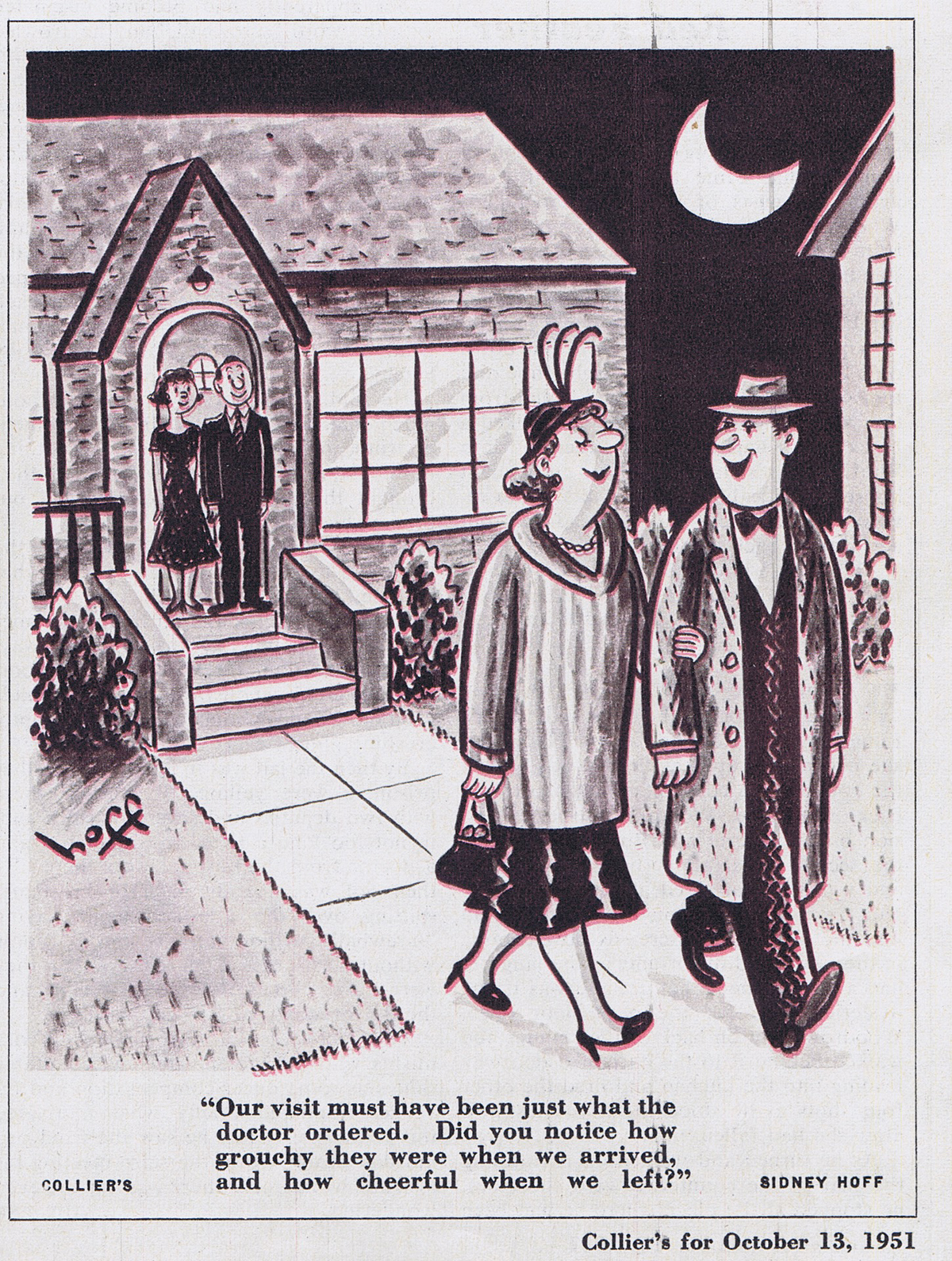
19. SYDNEY HOFF. Collier’s October 13, 1951.
20. BILL RUBLE. The Saturday Evening Post September 26, 1953.
"I draw on a big white sheet printed with four empty blocks—only they're much bigger than the ones that appear in your newspaper. Each block is five and a half inches by six and a half inches. First, you do the lettering so you know how much space you'll have left for the figures. You do preliminary sketching in pencil for the position—otherwise, you'd be bound to make a mistake somewhere and get a character too far to the left or right and have to start over. Then you do it in ink."
Here's a 44 minute documentary about Japanese manga artist Ryoichi Ikegami. He has worked on several notable manga series, admires American comic book artist Neal Adams (Who doesn't?) and drew the manga version of Spider-Man for Marvel Comics.
"Metronomes of the same frequency and resting on the same base are started randomly. They synchronize after a short period of time. In this case the base is free to move. In 1657, Christian Huygens was the first to observe this phenomenon in the form of clock synchronization. The phenomenon of spontaneous synchronization is found in circadian rhythms, heart and intestinal muscles, insulin secreting cells in the pancreas, menstrual cycles, ambling elephants, marching soldiers, and fireflies, among others."
Bill Peet was a long-time Disney artist, not only working on all of the major animated releases from Snow White to 101 Dalmatians,
but also contributing to the choices of these projects. He was a major force at Disney, and Walt Disney himself trusted Peet's opinions.
I had no idea that he tried his hand at gag
cartooning as well. Here are a few from his wonderful Caldecott
Award-winning autobiography BILL PEET AN AUTOBIOGRAPHY.
He
sent his gag cartoons to the top markets of the day: Collier's, True, the Post and
The New Yorker. They were all rejected. From The New Yorker he received
this note:
"Your humor is too undisciplined, but we would like to see more of your drawings."
Bill writes in his autobiography:
"That
small glimmer of hope wasn't nearly enough to spur me on. Doing
cartoons week after week, even if I sold them all, would be frustrating
work."
Bill would go on, after leaving Disney, to focus on
children's books, creating thirty-six books. A lot of them were based on
stories he had made up to tell his own kids.
Here's some of his gag cartoons that were never bought. Bill published them in his autobiography. I thought they were great.
TVDays has this early 1980s interview with editorial cartoonist/production designer Ron Cobb (1937 - 2020). Ron created visuals for movies like Alien, Star Wars, Back to the Future and others. He also created what is now known as the ecology symbol. His extraordinary career, which began as an editorial cartoonist with no formal art training, touched so many movie productions, beginning with Disney's Sleeping Beauty (1959), that they are hard to digest.
"Ronald Ray Cobb (September 21, 1937 – September 21, 2020) was an American-Australian artist. As well as being an editorial cartoonist he worked on numerous major films including Dark Star (1974), Star Wars (1977), Alien (1979), Raiders of the Lost Ark (1981), Conan the Barbarian (1982), Back to the Future (1985), The Abyss (1989), and Total Recall (1990). He had one credit as director, for the 1992 film Garbo.
"Cobb also created a symbol which was later featured on the Ecology Flag. He was born in Los Angeles but spent most of his life in Sydney, Australia.
"By the age of 18, with no formal training in graphic illustration, Cobb was working as an animation "inbetweener" artist for Disney Studios in Burbank, California. He progressed to becoming a breakdown artist on the animation feature Sleeping Beauty (1959). It was the last Disney film to have cels inked by hand.
"After Sleeping Beauty was completed in 1957, Cobb was laid off by Disney. He spent the next three years in various jobs — mail carrier, assembler in a door factory, sign painter's assistant — until he was drafted into the U.S. Army in 1960. For the next two years he delivered classified documents around San Francisco, then signed up for an extra year to avoid assignment to the infantry.
"He was sent to Vietnam in 1963 as a draftsman for the Signal Corps. After his discharge, Cobb began freelancing as an artist, contributing to the Los Angeles Free Press for the first time in 1965.
"Edited and published by Art Kunkin, the Los Angeles Free Press was one of the first of the underground newspapers of the 1960s, noted for its radical politics. Cobb's editorial/political cartoons were a celebrated feature of the Freep, and appeared regularly throughout member newspapers of the Underground Press Syndicate.
"Although he was regarded as one of the finest political cartoonists of the mid-1960s to early 1970s, Cobb made very little money from the cartoons and was always looking for work elsewhere. His cartoons were featured in the back to the land magazine Mother Earth News.
"Among other projects, Cobb designed the cover for Jefferson Airplane's 1967 album, After Bathing at Baxter's.
"In 1972, Cobb moved to Sydney, Australia, where his work appeared in alternative magazines such as The Digger. Independent publishers Wild & Woolley published a 'best of' collection of the earlier cartoon books, The Cobb Book in 1975. A follow-up volume, Cobb Again, appeared in 1978.
"Cobb is credited with designing the "Hammerhead" creature seen in Star Wars (1977).
"Cobb returned to cinema work when he worked with Dan O'Bannon to design the eponymous spaceship for the 1973 cult film, Dark Star (he drew the original design for the exterior of the Dark Star spaceship on a Pancake House napkin).
"After contributing designs for Alejandro Jodorowsky's uncompleted film adaption of Frank Herbert's novel Dune, Cobb was engaged by Lucasfilm to produce conceptual artwork for the space fantasy film Star Wars (1977). Working alongside artists John Mollo and Ralph McQuarrie, he created the designs for a number of exotic alien creatures for the Mos Eisley cantina scene.
"In 1981, Colorvision, a large-format, full-colour monograph appeared, including much of his design work for the films Star Wars (1977), Alien (1979), and Conan the Barbarian (1982), the first feature for which he received the credit of Production Designer. Cobb has also contributed production design to the films The Last Starfighter (1984), Leviathan (1989), Total Recall (1990) (and also appeared in the film in a brief cameo), True Lies (1994), The Sixth Day (2000), Cats & Dogs (2001), Southland Tales (2006), and the Australian feature Garbo, which he directed.
"Cobb contributed the initial story for Night Skies, an earlier, darker version of E.T.. Steven Spielberg offered him the opportunity to direct this scarier sequel to Close Encounters of the Third Kind until problems arose over special effects that required a major rewrite. While Cobb was in Spain working on Conan the Barbarian, Spielberg supervised the rewrite into the more personal E.T. and ended up directing it himself. Cobb later received some net profit participation.
"In 1985 Cobb received credit as 'DeLorean Time Travel Consultant' for the film Back to the Future.
"During the early 1990s, Cobb worked with Rocket Science Games. His designs can be seen in Loadstar: The Legend of Tully Bodine (1994) and The Space Bar (1997), in which he designed all the characters.
"Cobb also co-wrote with his wife, Robin Love, one of the (1985–1987) Twilight Zone episodes, Shelter Skelter.
"Cobb designed two swords for the 1982 film Conan the Barbarian (the 'Father's Sword' and the 'Atlantean Sword'). Cobb's original drawings of the swords are now used, in cinema merchandising, to mass-produce and sell replicas."
Clients worldwide. National Cartoonists Society. Jack Davis Award winner. Recognized New Hampshire Arts Education Teaching Artist. New Hampshire Institute of Art and Design at New England College Comic Arts Program Adjunct Professor. Need cartoons and illustrations? Contact: mike@mikelynchcartoons dot com




 Posts
Posts

