Friday, July 24, 2020
Thursday, July 23, 2020
Fleischer Studios 'Superman' Upscaled to 4k Using Neural Networks
Well, by "upscaled to 4k using neural networks" I mean that the old Superman shorts got cleaned up real good!
Via Geekologie:
Via Geekologie:
"YouTuber Jose Argumedo took the 1941 Fleischer Studios Superman cartoon 'The Bulleteers' and upscaled it using Waifu2x, an image upscaler that uses deep convolutional neural networks. Waifu2x is trained on anime (as evidenced by the name) and it works remarkably well for any animation and even pixel art. Just look at the results. It looks better than any remastering I've ever seen and was done completely with machine learning. It's like looking at those botched art restorations but with the before and after images reversed."
Old version:
New 4K version:
Wednesday, July 22, 2020
Video: Library of Congress Interview with Lynn Johnston 2019
From the Library of Congress, here's a September 19, 2019 conversation with For Better or For Worse cartoonist Lynn Johnston:
Tuesday, July 21, 2020
Video: Garry Trudeau: Creativity in Isolation
From the Beinecke Library at Yale:
"In response to the Beinecke Library's invitation to describe the work he is currently pursuing, Garry Trudeau—cartoonist, writer, and creator of 'Doonesbury'—described the challenges of creating a 'Complete Digital Doonesbury' featuring some 15,000 comic strips in honor of the 50th anniversary of the beloved strip. In the process, Garry’s editor David Stanford identified what he called a “perfect strip” published in 2009. Here, Garry 'deconstructs' this piece, walking us through its creation, frame by frame. Garry shares details of his broader creative practice, thoughts about writing comedy, and the development of his unique and groundbreaking approach to the comic strip format."
Monday, July 20, 2020
Video: Ton Smits House Museum
Let's go visit the Ton Smits House in Eindhoven, one of the smallest museums in the Brabant region of the Netherlands. Here is a video tour of the place.
Even though the Dutch born artist/cartoonist passed away in 1981, the contents of his home-cum-museum are still being cataloged and preserved. I don't speak the language of this 1:43 piece, but I sure would like to visit the place one day.
Mr. Smits' cartoons were bought widely in major US markets, including The New Yorker and The Saturday Evening Post. He visited the United States once. His bio page picks up the story:
Who is Ton Smits? Related: some Ton Smits cartoons in the BEST CARTOONS OF 1964 book.
Even though the Dutch born artist/cartoonist passed away in 1981, the contents of his home-cum-museum are still being cataloged and preserved. I don't speak the language of this 1:43 piece, but I sure would like to visit the place one day.
Mr. Smits' cartoons were bought widely in major US markets, including The New Yorker and The Saturday Evening Post. He visited the United States once. His bio page picks up the story:
Klein museum gewijd aan cartoonist Ton Smits:"After the first cartoon in 1949 hundreds followed and were published in The New Yorker, The Saturday Evening Post, Collier's, Look, and This Week Magazine."Invited by The New Yorker Ton Smits visited The States for some months in 1955 and 1956. At that time he was the first cartoonist of the European Continent to have his cartoons printed in The New Yorker. With the money he earned in the first few years, he had a magnificent house and studio built at Eindhoven for his elderly mother and himself. For a long time he was a confirmed bachelor. Three years after his mother's death in 1970 - she lived to be 88 - he made up his mind to get married."
Who is Ton Smits? Related: some Ton Smits cartoons in the BEST CARTOONS OF 1964 book.
Friday, July 17, 2020
Australian Broadcasting Corporation (ABC): "Retrofocus" Vintage TV Clips
A few man-on-the-street questions of Australians from years gone past via the Australian Broadcasting Company. These are just a few of the 193 features titled Retrofocus.
From August 31, 1962, Ray Taylor asks an eclectic mix of Sydneysiders, “Is there life on other planets?”
From 1961: "Do housewives lead dull or exciting lives?" Includes this exchange:
The ABC took to the streets to ask women what they looked for in a man in 1967. This episode of This Day Tonight aired on 18 May 1967.
In this ABC interview from 1974, science fiction writer Arthur C. Clarke makes the bold claim that one day computers will allow people to work from home and access their banking records.
Just a few more to sample:
1960: I'm a Girl Watcher
1965: What Did Kids Want for Christmas?
1973: Computer Predicts the End of Civilization.
1976: People Struggle with Opening Milk Cartons
Related:
Thames TV television archives
Television Academy Foundation Interviews
UCLA Film and TV Archive
From August 31, 1962, Ray Taylor asks an eclectic mix of Sydneysiders, “Is there life on other planets?”
From 1961: "Do housewives lead dull or exciting lives?" Includes this exchange:
"Have you ever considered going to work?"
"God heavens no!"
The ABC took to the streets to ask women what they looked for in a man in 1967. This episode of This Day Tonight aired on 18 May 1967.
In this ABC interview from 1974, science fiction writer Arthur C. Clarke makes the bold claim that one day computers will allow people to work from home and access their banking records.
Just a few more to sample:
1960: I'm a Girl Watcher
1965: What Did Kids Want for Christmas?
1973: Computer Predicts the End of Civilization.
1976: People Struggle with Opening Milk Cartons
Related:
Thames TV television archives
Television Academy Foundation Interviews
UCLA Film and TV Archive
Thursday, July 16, 2020
Captain Billy's Whiz Bang
Here's something from great grandad's attic: a copy of Captain Billy's Whiz Bang. A "naughty" magazine in its day. This is Volume IX No. 188, June 1934 and was published monthly by Popular Magazines Inc. in Minneapolis, MN.
Captain Billy's Whiz Bang was a pocket-size bawdy joke magazine
that was published by Captain Wilford Hamilton Fawcett AKA "Captain
Billy" (1885 - 1940). I had heard of it, but never actually seen a copy
until I saw a few copies at the Two Brothers used bookstore in Freeport,
ME this past Sunday. Without this popular racy humor digest that had
its heyday 100 years ago, there would be no Captain Marvel or Popular
Mechanix magazines.
Here's the story:
Fawcett
lied about his age when he was 16 to go fight in the Spanish-American
War. After that, he came home and then worked as a police reporter for the Minneapolis Journal until
World War 1. He went off to fight again. Fawcett achieved the rank of captain and worked at Stars and
Stripes. It was while he was there that he got the idea for Captain Billy's
Whiz Bang. The title was a combination of his nickname, and the name of
a WW1 bomb. After the war, he began publishing the risque digest. In 1921, he was quoted as saying that the
racy humor mag was closing in on a circulation of a million. (Records show that circulation was actually more like nearly half that, at 425,000 copies a month at its peak.)
From
Captain Billy's Whiz Bang, Fawcett and his sons created other magazines:
detective magazines, movie gossip magazines, and others, like the
long-running Family Circle and Woman's Day mags. Perhaps its crown jewel
was Mechanix Illustrated.
After their
father's death in 1940, Fawcett's sons began a line of comic books modeled on
the popular Superman character at DC Comics. Fawcett Comics published a
line of comics including Captain Marvel. (Captain Marvel debuted in Whiz
Comics, which I think was a nod to the magazine and the dad who started
it all.) DC sued Fawcett for copyright infringement, saying Marvel was
way too much like Superman. The case dragged on for years. In the 1940s,
the Captain Marvel family of comic books outsold Superman's. Pushing
the lawsuit ahead was affordable while sales were brisk, I suppose. (Captain Marvel Jr. had
such an impact on Elvis Presley that he borrowed the character's poses,
hairstyle and lightning flash chest insignia, as described in Elaine
Dundy's biography, Elvis and Gladys.)
After
WW2, sales began to decline and Fawcett Publications folded its line of
comics. The company had already ventured into the profitable world of
paperbacks with the Gold Medal line.
About the magazine:
It's also cheesy, dated, male chauvinistic. It's a collection of gossip and funny stories and Captain Billy's own stories of his travels and the famous people he hob-nobbed with. There are a series of departments for stories, all with funny titles like "Drippings from the Faucet," "Button Busters," "Howls from Harlem," "Smokehouse Poetry," and so on. There's a kinda nod to the gay culture with a page of "Queeries and Nancers" with faux editor "Percy McNance" and associate editor "Algy Devere." And there's even a reference to a woman's "time of the month" in one of the gag cartoons.
Bill Holman, just a year before his long-running newspaper strip Smokey Stover debuted, is in the mix in this particular issue with one gag cartoon (opposite "Queeries and Nancers"). A fair number of the single panel cartoons are unsigned. Most all are more than competently executed. (The "tramp" cartoon and the "Major's operation" cartoon are particularly skilled.) Some of the signed contributors include Jimmy Caborn (1909-1955), who would go on to work for the Plain Dealer (interrupted for three years when he enlisted into the army in 1943) and create a couple of syndicated features, while doing a lot of freelance work for The Saturday Evening Post, Collier's and other major magazines; Bob Gesteland, who freelanced for magazines and was part of the Disney stable for at least the 1930s and 40s (pretty much no information on him online); there's even a "Campus Rumpus" section with a couple of cartoons from college publications; and there are other cartoonists, with some terrific skills, who either don't sign or there is a signature or mark that I cannot make out. For some, Captain Billy's may have been beneath their status.
Via Wikipedia: The book Humor Magazines and Comic Periodicals notes:
Few periodicals reflect the post-WW I cultural change in American life as well as Captain Billy’s Whiz Bang. To some people [it] represented the decline of morality and the flaunting of sexual immodesty; to others it signified an increase in openness. For much of the 1920s, Captain Billy’s was the most prominent comic magazine in America with its mix of racy poetry and naughty jokes and puns, aimed at a small-town audience with pretensions of "sophistication."But despite its shameful humor, it was a money maker and, most importantly to a freelancer, the checks cleared.
Wednesday, July 15, 2020
The Garden As of July 15, 2020
Here it is, bushy and green and ... SUDDEN REALIZATION! I'm going to be overrun with vegetables. (Ha ha. I just noticed you can see my neighbor's garden in the background to the left, with its scarecrow. My neighbor asked his girlfriend what they should name it, and she said, "Mike." Yeah. Really. And what did I ever do to them? No respect, I tell ya.)
Baby Roma tomatoes.
Zucchini.
Tiny cucumbers.
Not shown: carrots, radishes and peppers.
Here's a parade of dill, basil, parsley, flowers:
Related:
The Garden As of Mid-May 2020
The Garden As of Early June 2020
The Garden As of June 15, 2020
The Garden As of July 1, 2020
Tuesday, July 14, 2020
Video: "John Nesbitt's Passing Parade: 'People on Paper'" 1945
Here's a 1945 MGM one-reeler documentary short featuring classic syndicated newspaper cartoonists.
This edition of John Nesbitt's "Passing Parade" series, released to theaters on November 17th, 1945 by MGM Studios, features classic newspaper cartoonists in action:
H.H. Knerr (Katzenjammer Kids),
Bud Fisher (Mutt and Jeff),
Fred Lasswell (Barney Google and Snuffy Smith),
Frank King (Gasoline Alley),
Chester Gould (Dick Tracy),
Dick Calkins (Buck Rogers in the 25th Century),
Milton Caniff (Terry and the Pirates),
Chic Young (Blondie),
Raeburn Van Buren (Abbie an' Slats),
Ham Fisher (Joe Palooka),
Hal Foster (Prince Valiant),
Harold Gray (Little Orphan Annie),
and Al Capp (Li'l Abner).
"North American Comic Book Sales Have Hit New Record High in 2019"
Hit!
Smack!
Spank!
Get it? Ha ha ha!
Seriously, last year was the best year for comics sales. Comic books (and graphic novels, etc.) tallied up $1.21 billion in sales last year, an 11% increase over 2018. Heaven knows how things will sort out for this COVID-19, Second Great Depression year, but I'm ever hopeful.
Monday, July 13, 2020
Cartoonists' Exchange: HOW TO MAKE MONEY WITH SIMPLE CARTOONS (1949)

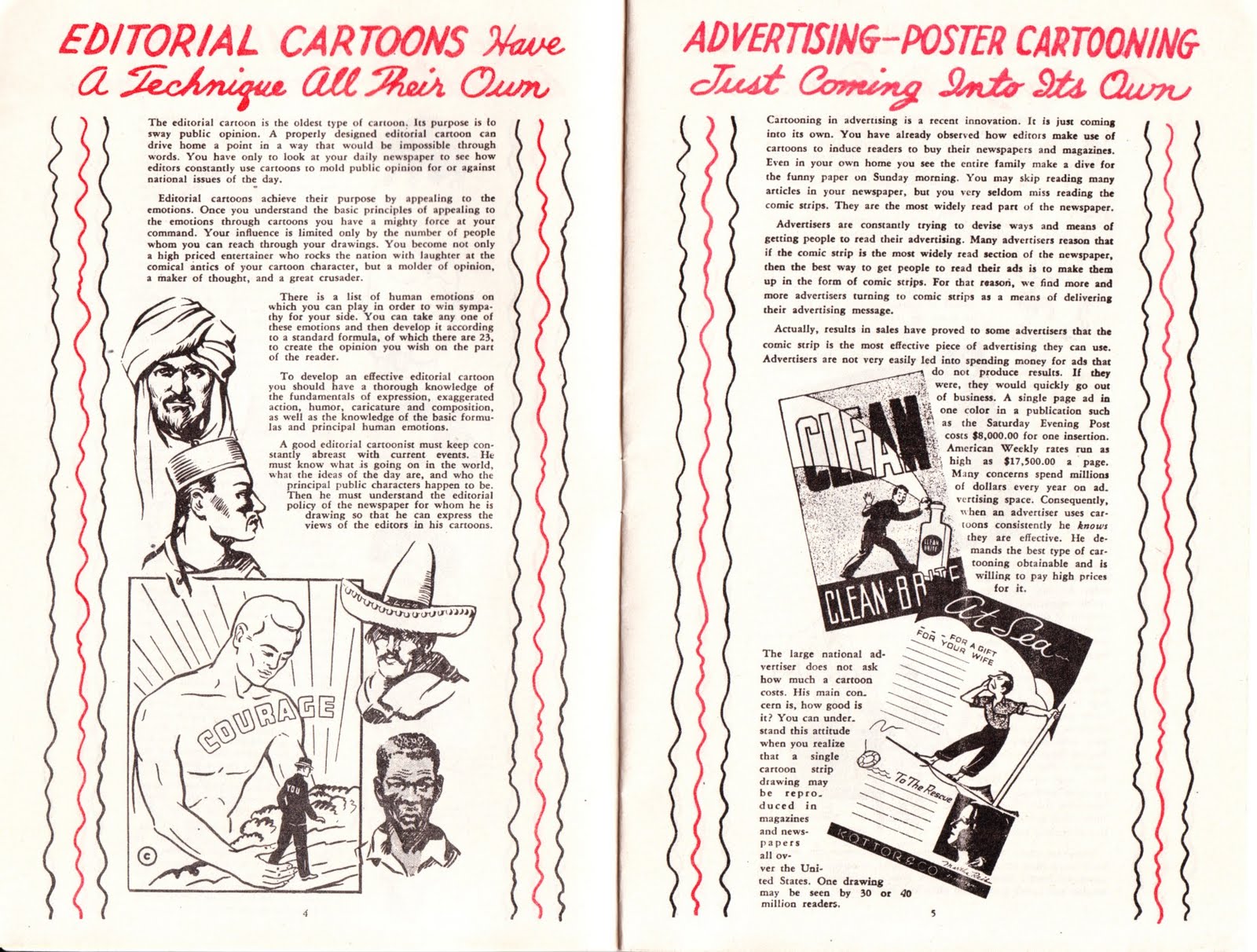
There's big money in cartooning and enormous markets, so says the Cartoonists' Exchange booklet titled HOW TO MAKE MONEY WITH SIMPLE CARTOONS.
This booklet was part of a plethora of Ohio-based correspondence course learn-to-cartoon material that the Cartoonists' Exchange produced for several decades.
Here are the principles that all successful comic strips are based on, editorial cartoon techniques, chalk talk information, caricature, proportions, realistic figure drawing, the "three steps in developing a cartoon sketch" and so much more. This is copyright 1949 The Cartoonists' Exchange, Pleasant Hill, OH.


Friday, July 10, 2020
Video: Keith Knight
Lamorne Morris plays "Keef" Knight in a new streaming Hulu series based on the cartoonist's life.
Cartoonist Keith Knight is known for his comic strips including The Knight Life, th(ink) and The K Chronicles. "Woke", a new live-action/animated comedy based on Knight's life, will premiere on Hulu in June. Warren Bernard, executive director of the Small Press Expo, interviews Knight about his life and career.
Thursday, July 09, 2020
Video: Barry Blitt of The New Yorker
2020 Pulitzer Prize winner Barry Blitt is interviewed by Françoise Mouly, The New Yorker’s long-time art editor, about his career and art.
Wednesday, July 08, 2020
Video: James Thurber Unsold Pilot "Christabel"
Here's a rare half hour of TV from June 8, 1959. From Alcoa-Goodyear Theater, this is "Christabel;" an unsold pilot for a series that was to be titled "the Secret Life of John Monroe." It's based on a James Thurber story, and there's animated segments created by the UPA Studio.
UPA had animated Thurber before, for the animated short "The Unicorn in the Garden."
From Betagems:
"'Christabel' was written by Mel Shavelson, who ten years later created (and sometimes wrote and directed) the James Thurber-inspired series My World and Welcome to It, with a fourth episode called "Christabel" (10-6-69) that was very similar to the Alcoa-Goodyear version, right down to the cartoon dog in the credits. Directed by James Sheldon and also starring Georgeann Johnson, Susan Gordon, Charles Herbert, and Dabbs Greer. Music by Joseph Liebling. Alcoa Theatre was a half-hour anthology series that ran from September 30, 1957 through May 23, 1960. You can find more episodes of this and other vintage TV anthologies in the BetaGems playlist 'Anthology Television 1950s-1960s.'"
Hat tip to Steve Thompson!
Tuesday, July 07, 2020
Former Marvel Comics Letterer Rick Parker: Notes for Aspriring Comics Artists Regarding Lettering
Photo of Rick Parker in the Marvel Bullpen, ca.1979 by Eliot R. Brown.
If you know comics, you know Rick Parker. He first went to work for Marvel Comics as a letterer in the late 1970s. Lettering ma be how he got his start, but he's also known as a writer and cartoonist. His work has appeared in The New York Times, The Village Voice, Time Magazine and various comics. He's best known as the artist of MTV's Beavis and Butthead comic book, which was published by Marvel from 1994 to 1996. He wrote and drew his own graphic novel, Deadboy, in 2010. His work also appeared under the Papercutz imprint.
Here's his advice on lettering, from Rick Parker's Facebook page:
PANDEMIC PRACTICE
NOTES FOR ASPIRING COMICS
ARTISTS REGARDING LETTERING:
Lately, so many people have messaged me asking about lettering, I thought perhaps I would make a few public comments in the hope that they might help aspiring comic artists with their lettering.
It's my opinion that cartoonists and the people who look at their work would all be better off if we all hand-lettered our work.
Fonts are really cold and have no soul. At best, comics is an artform done by a human hand. There is almost no lettering in comics today that is as good as the hand lettering on comics in the good old days by artists like Ben Oda, Sam Rosen, Joe Rosen, Gaspar Saladino.
Look around. All the great cartoonists working today letter their own work. Crumb, Dan Clowes, The Hernandez Brothers, Chris Ware, Noah Van Sciver and many others.
There is a good reason for this. They want their lettering to be a perfect match with their artwork stylistically. And for other reasons. It's more enjoyable to look at.
In my experience, and to be as brief and possible, the most important thing is that the lettering has to be EASY TO READ. One of the most important ways to accomplish this is to avoid having any letters touching and to leave ample white space around the lettering in the balloons.
I put together this sample with you in mind. Look at each letter and copy it a few times. Don't worry about your work looking like mine. After a while your own style will develop.
Each letter is composed of a variety of strokes. The vertical mark, the horizontal mark, the diagonal mark and several variations of circles. There are not that many strokes. Practice making them. The entire alphabet can be written down in only 62 simple strokes.
Finally, please keep in mind that the "I" with the serifs on it is a personal pronoun and should not be used in a words like "ship, thin, crisp or little".
It should be used in a case such as , "I went out for a walk."
Good Luck.
Subscribe to:
Posts (Atom)