Thursday, August 23, 2012

Number of Submissions/Cartoon Style

I'm on the road today, meeting with my fellow RACONTEUR cartoonist contributors. Here's an entry from 2009:


---


Time to open the email letter bag of cartooning questions. One email is about the number of gag cartoon submissions to send to an editor, another has questions about cartoon styles and, lastly, a question about selling to Playboy. My thanks in advance to those who have written in, asking me to answer them.

# of SUBMISSIONS

Here's a recent email about magazine cartooning:

How many cartoons do you really have to send to a magazine. I have read your blog's 'How to Submit to Magazines' and you mention between 10 and 20.

I've also read Randy Glasbergen's how-to-cartoons book and he says no fewer than six. Another book says between five and ten.

Now, I'm not submitting to any big magazines, like the Reader's Digest, Saturday Evening Post or anything like that--just little $25 ones.

And basically, I want to know how few cartoons can I get away with. I know I'm going to be rejected first off, and I hate the idea of doing up 10, 12, 15 cartoons for nothing. And I'm still practicing my art and it takes me forever to actually finish a complete drawing.

Will a magazine really dismiss a submission if they open it up and find only six or eight cartoons? Do I really look bad to editors if I send only that many?

You must be one of the few people out there who have recently decided to draw magazine gag cartoons. Congratulations and much good luck.

Please consider speeding up production. Taking forever to finish a cartoon is not going to make you a professional. You need to be able to come up with a lot of ideas regularly. I come up with 20-40 ideas a week, toss out about half of the weak cartoons, and draw up the rest. There is no magic, just the work of sitting down and drawing and drawing, until you can draw faster and faster.

I urge you not to limit your submissions. Consider all of the potential markets you want to cover. Make a list. The places that pay the most go on the top of the list; you send them the cartoons first. If there are no buys, then 30 days later you send the cartoons to the next lower-paying market, and so on, down the list.

I would not count on rejection. Yeah, it's likely, but you never know. A friend of mine got a sale the very first time he submitted to The New Yorker. So far as wanting "to know how few cartoons can I get away with" sending; gee whiz, you are working against your own interests. Editors want to see regular, quality material that's appropriate to their readership. If you can only get 6 or 8 out there every couple of months, that may not be a good sampling of your potential. An editor would look at it, but when you compete with someone like me or my pal Mark Anderson, you would have your 6 chances against our 10 or 20 chances.

Okay, here's some technique questions:


STYLE

How do/did you decide on what style, medium and/or technique to use for rendering your cartoons? I ask because I have cartoon ideas but have trouble choosing what style I want to use. My style is always changing. It seems to depend upon what happens to be influencing my creativity that day. On some days my drawings are loose and free. On other days they are crisp and tight. Sometimes the lines are smooth and bold. At other times my lines are fun and artsy and sketchy. I've tried working with micron pens (crosshatch for shading), brush pens (grey scales for shading), pencils, china markers, ball point pens, and so on. I just can't decide which I like best. And the feedback I get from others doesn't help me narrow down my options much either because responses are split pretty evenly.

So, none of this is problematic until it comes time for me to submit a cartoon to a publisher. It is clear that at this rate -- until I can decide upon a style -- I'll never submit anything. That's no good.

If you are in art school or drawing as a hobby, it's fun to talk about technique and try new materials.

You're right: it's no good to NOT begin presenting your work commercially because you are too unsettled about your technique to get on with it. If you want to draw for a living, you need to create work to submit.

I think it's okay to be unsettled. The work that you create changes through the years regardless. Mine did. Two examples:


I use Pigma Micron Pens on 24 lb. laser printer typing paper because the pens are permanent and the paper is decent and inexpensive. I usually do not pencil. This saves me time and makes my lines look like drawing lines, not lines that art statically tracing pencil lines.


Above: "The Pens on My Desk"

So, just as it's never the right time to move, to marry, to have a child -- it may never be the right time to pick a style. But, as you can see from the above links, a style can and will change.

One of my favorite quotes about style is from the late gag cartoonist Lo Linkert, who scoffed about style and advised to simply "draw fast" and the style will emerge naturally. I wrote more about Lo Linkert (1923-2002) during a guest blogging-stint at the Andertoons blog here.

Here's a quote from Mr. Linkert:

“So if you want to be a cartoonist, be sure that there is nothing else in the world that you want to be, work hard and practice self-criticism to the utmost. Make sure every new cartoon you draw is better than the last one. Be sure that it will seem funny to most people. You can’t please them all. Work fast because speed gives you a distinct style. Slow lines look stiff.”
Do we have time for one more? I think so.

Here's another:

Selling to Playboy Magazine

I would like to know if you could offer any advise on my work or how to get my foot in the door with Playboy Cartoon Dept.

It took me years and many cartoon submissions before my first sale to Playboy, which is a coveted gag cartoon market.

Consider what the editor wants and imagine what they have seen already. Beware of cartoon ideas that are tired, or too easy. See what they are buying, read the magazine. Playboy publishes a variety of cartoons -- not just the sexy ones (as you know if you have read the mag). Persist.

Thanks to those of you who have written in. I don't know if these are the answers you are looking for, but I hope that they may have helped somebody.

Serendipitiously related: My pal graphic novelist Brian Fies gives Newbie Advice.

--

The above is a bloggy rerun from August 12, 2009.


Wednesday, August 22, 2012

Full HD Doctor Who BBC America Series 7 Trailer 3

The premier of the new series is September 1, 2012.

DOCTOR WHO turns it up to 11!


Via Life, Doctor Who & Combom.

"Tain't Funny, McGee"

One of the records I remember growing up with is THE LONGINES SYMPHONETTE PRESENTS REMEMBER THE GOLDEN DAYS OF RADIO with Jack Benny. I listened over and over again to Jack Benny, Fred Allen and Fibber McGee and Molly. It was my first introduction to old time radio.

One movie that pops up on Turner Classic Movies is OH HEAVENLY DAYS. ("Oh heavenly days," was an exclamation that Molly used when McGee did something outlandish; i,e,. she said it a lot.)

This 1944 B-picture is the last of a handful of Fibber McGee and Molly movies, and, from the description, is very much a WWII propaganda picture.

It's funny, but these old radio shows remind me of my childhood in the 1970s, since that's when I first heard the recordings. First, I listened to my Dad's Longines record set, and then I checked some records out of the library -- I think that companies like Radiola and Decca were releasing old time radio shows.

Remember those library "listening stations?!" I remember having to go to the librarian, filling out cards and pieces of paper and being told I only had an hour in the listening station, etc. And, in the stale-smelling listening station cubicle: those big great metal turntables that looked like they could survive an armed assault and the big clunky tone arms that would sometimes have about 8oz. of dust clinging to them. And those big, vinyl headphones you had to wear! Those big headphones always made me rather hot and itchy after about 5 minutes. They were definitely designed to be so ungainly that no sane individual would ever consider for a moment trying to steal them. And when you were finished, you had to walk back the librarian, and, standing there, s/he would take the records out of the sleeves, looking for any scratches. Always a serious visual inspection, both sides scrutinized for abuse, before being allowed to take my nerdly leave.

Jim Jordan, "Fibber McGee" himself, had a special radio series one summer (maybe in 1972 or 73) where he would play the old programs. There was this gimmick in the show. The deal was (and suspend about 20 tons of disbelief, OK?) that Fibber had his old Philco radio in the garage, and would tell the listeners that it was full of old radio shows that he hadn't listened to back in the day. These old shows were still inside the radio tubes, waiting to be unleashed and heard. I remember listening to these old comedies and thinking seriously -- maybe waay too seriously -- about the structure of the jokes, the wordplay, the puns, the way an actor could get a laugh just by the tone of his/her voice (Titus Moody, Throckmorton P. Gildersleeve, Baby Snooks, etc.).


Woody Allen's RADIO DAYS film had it right: all of these people, all of these beloved shows are dead because the way we listen to radio changed.

Oh, and Eugene Pallette in OH HEAVENLY DAYS. I love Eugene Pallette.

Many cartoonists and illustrators enjoy the old comedy, the ones we listened to on those old records. And as my pal, and fellow old time comedy fan, the award winning illustrator Sean Kelly, suggested to me: "That's why we're all so warped, today.... (Just like the old LPs!)"

Above Fibber McGee and Molly ad nicked from The Digital Deli. The uncredited color illustration is from this OTR download site.

--

Edited from a previously published blog entry from April 15, 2010.

Video: Unseen Jonathan Winters

What a find!

Here's a wonderful rarity: Jonathan Winters riffing between takes of a Big Boy Restaurant commercial. And even better: he's dressed line Big Boy.

This is all off the cuff, unrehearsed improvisational video that someone on the crew of this 1970s era commercial, thankfully, saved.. In other words, Winters gold!


Big hat tip to Scott Shaw!

Related:a 1970s Disney Halloween TV special featuring Mr. Winters

Tuesday, August 21, 2012

Dave Astor's New Book: COMIC (AND COLUMN) CONFESSIONAL


If you work in the world of syndicated cartooning or publishing, you know the name Dave Astor.

COMIC (AND COLUMN) CONFESSIONAL (with the subtitle Finding Myself While Covering Syndicates, Celebrities and a Changing Media World) is Dave's book about his 25 years of reporting on syndication for Editor & Publisher Magazine. So, there are lots of stories about cartoonists from those years -- and Dave intertwines his own personal story here too. One that I did not know. There's more about that at the bottom of the entry, in the photo of the back cover.

Here are a few photos from the book:


Garry Trudeau and wife Jane Pauley, 1990.


Milton Caniff and Charles Schulz, 1987.

Here's Dave:

The part-humorous Comic (and Column) Confessional -- which has endorsements from Gary Larson ("The Far Side"), Lynn Johnston ("For Better or For Worse"), Mort Walker ("Beetle Bailey"), and others on its back cover -- includes anecdotes about cartoonists, material about changes in the syndication and media worlds, personal stuff, and much more. 
Interested readers of a possible mention you do could order a signed copy of the book directly from me (by emailing me at dastor@earthlink.net) or order via Amazon.

The just-posted listing has several temporary errors, including the wrong publication year (it's 2012 not 2008) and the wrong publisher (Xenos not Lulu; the book is not self-published). But the book can still be ordered via Amazon despite the errors.

Since leaving E&P, I've worked as a Huffington Post blogger; my pieces about books (http://www.huffingtonpost.com/dave-astor) have drawn more than 2,000 "fans" and many hundreds of comments since 2011. I also write an award-winning weekly humor column for The Montclair (N.J.) Times and serve on the board of the National Society of Newspaper Columnists.


I hope you will consider buying this terrific book.


At Home with Alison Bechdel


Above: Ms Bechdel in her studio in a photo by Free Press photographer Glenn Russell.


Alison Bechdel talks about writing autobiographical graphic novels in this new interview written by Sally Pollak for the Burlington Free Press.

“I’ve always believed very whole-heartedly that writing about my family was a very productive and useful thing to do, that ethical obstacles could be overlooked. I’m starting to re-think that. I probably won’t change my ways, but I am thinking about that in new ways.”

Monday, August 20, 2012

Mark Anderson: The Modern Freelance Cartoonist


Above: A custom cartoon by Mark Anderson.

Today, my pal Mark Anderson writes about how to make it as a cartoonist in today's economy. He has a lot of good advice on markets for cartoons. The general rule here is to diversify. I agree: there are a lot of potential cartoon markets.

Sure, you may get a potential client who wants a cartoon and when you bring up the topic of being paid for your work, you might get this reply like I did 2 weeks ago (I smudged out the name, even though it's easy enough to find this message in my Twitter feed backlog):


But don't let that get you down. You just can't.

Like Mark says, keep moving. There are people who love and value cartoons out there.

Bill Mauldin Photos


Above: 1958 cover story "Bill Mauldin Takes You on a Family Tour" from the Sports Illustrated Web site.


Some rarely seen photos of Pulitzer Prize wining editorial cartoonist Bill Mauldin through the years.


LOS ANGELES, Oct. 23 1945 -- MAULDINS IN HAPPIER TIMES -- William H. (Bill) Mauldin, 24-year-old cartoonist and Pulitzer Prize winner, greets his wife Norma Jean, and their son, Bruce, 2, after his release from the army. Yesterday, he charged his wife with adultery in a divorce suit here, in which he asked for custody of his son. AP Wirephoto.


February 8, 1965 - Sun-times cartoonist Bill Mauldin (left) admires the helicopter pilot helmet awarded to his son Bruce upon Bruce's graduation last year from the U.S. Army's Aviation Center, Fort Rucker, Ala. Mauldin was visiting Bruce with the 52d Aviation Battalion, when the Viet Cong attacked Saturday.


October 28, 1965 - AUTOGRAPH PARTY - Bill Mauldin, Pulitzer Prize winning cartoonist of the Sun-Times, autographs copies of his new book "I've Decided I Want My Seat Back." The autographing party was held at Barbara's Bookstore, 1434 N. Wells. The new book contains cartoons and commentary. (Sun-Times Photo by Bob Kotalik..)


March 17, 1966 -- Bill Mauldin, Sun-Times editorial cartoonist, and Paul Ghali, Daily News Paris correspondent, exchange greetings and discuss Mauldin's work in the gallery of the Sun-Times and Daily News building. The exhibit of original Mauldin cartoons will continue until the end of March and is open to the public without charge.


May 3, 1966- Sun-Time cartoonist Bill Mauldin (left) is notified that he'll receive the "Communicator of the Year" award next Wednesday at the 19th annual communications division dinner of the Combined Jewish Appeal of Metropolitan Chicago. With Mauldin are Larry Fanning (center), of the Publishers Newspaper Syndicate, and Morris Rotman, Chairman of the CJA division. Sun-Times photo.


September 13, 1985 - Cartoonist Bill Mauldin thinks President Reagan is "wrong a lot."


Bill Mauldin in his studio, 1984:


Some related links:


Bill Mauldin gets his best ideas in the bath, according to this 1977 Bill Mauldin Profile

1990: Bill Mauldin in Saudi Arabia
Brian Hoag on Bill Mauldin and Charles Schulz
More rare photos of Mauldin here and here

More rare and unseen cartoonist photos in general (lots of 'em):
Part one
Part two
Part three
Part four
Part five
Part six 
Part seven
Part eight
 

Sunday, August 19, 2012

Ira Glass: "[A]ll the books I loved as a kid were comic books"

 
NPR host Ira Glass has an interview in today's New York Times Book Review. When asked about books he loved as a child, Mr. Glass replied:
So all the books I loved as a kid were comic books; “Peanuts Treasury” as a little kid. It defined the emotional climate of my elementary years. I completely identified with the loneliness and melancholy of Charlie Brown. And “Doonesbury Chronicles” was a revelation to me when I was in middle school. I’d never met people like the ones in “Doonesbury,” or a world like that where the people were so smart and talked about politics and the stuff they talked about.
The entire interview is here.

Above cover image from MyComicShop.com.

Friday, August 17, 2012

Richard Thompson Ends CUL DE SAC


Above: a "SELF-PORTRAIT: RICHARD THOMPSON" / Special to The Washington Post from Michael  Cavna's 2011 interview with him.


Sad news from a beloved cartoonist. My friend Richard Thompson will end his award-winning CUL DE SAC comic strip next month.

From his syndicate, Universal Uclick:

“The last year has been a struggle for Richard. Parkinson's disease, first diagnosed in 2009, has so weakened him that he is unable to meet the demands of a comic strip. For a time, he worked with another artist, but the deadlines became too much of a task.”

Richard talks about the decision in Michael Cavna's Washington Post interview today:

"I’ve known for a year or more that I was working on borrowed time. My lettering had begun to wander off in 2009, but that could be fixed easily enough. But when Alice’s and Dill’s heads began to look under-inflated last winter, I figured I was losing control of the drawing, too. When I needed help with the inking (the hardest but most satisfying part of drawing the strip),well that was probably a tipping point. Parkinson’s disease is horribly selfish and demanding. A daily comic strip is too and I can only deal with one at a time. So it was a long, gradual, sudden decision."
CUL DE SAC appears in 250 papers, The last strip will appear on September 23, 2012.

I send Richard all my best and wish this was not so. CUL DE SAC is beloved by many regular people and so many cartoonists. The CUL DE SAC books are perennials and will stay in print forever. Otterloop lives!


Above: from the 2009 OSU Festival: Tom Stemmle, Mark Anderson, Mike Lynch and the one and only Richard Thompson.

RACONTEUR #2 Now Shipping


RACONTEUR #2, our comic book by "cartoonists who usually don't do these sort of things," is now in print. If you preordered a copy, it's already in the mail to you.

By "cartoonists who usually don't do these sort of things" I mean that the four cartoonists who wrote and drew these autobiographical stories are best known for those single panel gag cartoons for magazines like The New Yorker, Reader's Digest, The Wall Street Journal, Down East, etc.

Here are a few peeks at RACONTEUR #2:

David Jacobson:

John Klossner:


Mike Lynch:


 Jeff Pert:


My thanks to everyone who preordered. I have received some very kind emails from you about RACONTEUR. I think you will like the second issue. 

RACONTEUR #2, 20pp, color wraparound cover, staplebound, 8.5" x 5.5," delivered first class mail. (The first issue is out of stock.)

How to order:


Ship To ...

Thursday, August 16, 2012

Podcast: 1991 Gene Roddenberry Speech


Above: Gene Roddenberry and wife Majel Barrett on the STAR TREK THE NEXT GENERATION STAR TREK: THE MOTION PICTURE set.


Listening to this speech by Gene Roddenberry upon the occasion of him receiving the 1991 Humanist Arts Award from the American Humanist Association.

After he's introduced. you can hear him thank his son for helping him to the dais. He wasn't in good health and would die of heart failure later that year. Maybe this was his last public appearance.

He pauses and talks in bursts. Despite sounding tired, I think the speech, which is sincerely about joy and mischief and having fun in life, is off the cuff. His wife, Majel Barrett, tells him a couple of times to talk into the mike.

Hat tip to dear ol' Dad for this! Thanks, Dad!

1945 British Pathé Short: MEET GILES, CARTOONIST


Daily Express cartoonist Giles is the guest in this Pathé Personality Pictorial short from 1945 titles "Meet Giles, Cartoonist:"


"Yes. Giles is the name. He's a concerned snooper. Always noting down details wherever he goes to be used later on in one of those drawings that thousands of readers turn to first when the Daily Express or the Sunday Express arrives in the morning."

This is the first time I have ever seen footage of Giles, a cartoonist who a couple of generations grew up with. Foe decades, there was a yearly Giles Annual book produced and so many cartoonists I know have one or more.

I like how he goes onsite to sketch -- to make sure he gets details right in the finished drawing. I, too, have drawn in a chair in my garden, but I have to get my own strong coffee.

1973 National Cartoonists Society Reubens Dinner Placecard


The National Cartoonists Society has awarded its Reuben Award every year to the "Cartoonist of the Year" since 1946. It was, for the first eight years, called the Billy DeBeck Memorial Award. Beginning in 1956, it was named after NCS founder Rube Goldberg.

The Reuben Awards are a fancy occasion. It's a black tie event and is held in the ballroom of a hotel. The NCS used to be New York-centric, but nowadays the annual event is held in different locations around the country: Boston, Las Vegas, New Jersey, Hollywood, New Orleans, Orlando, and so on.

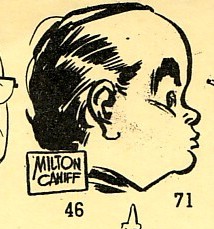
Here's the placecard that was on the table at The Plaza on April 23, 1973, in New York City, with self-portrait caricatures of all of the winners to date.