Showing posts with label obituary. Show all posts

Tuesday, September 08, 2015

Brad Anderson 1924-2015


Brad Anderson, best known for his long-running syndicated feature MARMADUKE, died August 30, 2015. He was 91. There was no cause of death reported.

Brad sold his first cartoon to Flying Aces magazine when he was 15 years old. He graduated from Brocton High School in Brocton, New York, in 1941. After serving in the Navy during World War Two, he enrolled in Syracuse University. In 1951 he graduated with a BFA in Fine Arts, with a major in advertising.

He worked at a Utica, NY advertising agency, Ball and Grier, for a couple of years. But being a cartoonist was in his blood. Leaving the agency after a couple years, he focussed his attentions on magazine cartooning. In 1954, he achieved the dream of syndication. MARMADUKE, a daily panel, first appeared in 1954.

From the MARMADUKE Wikipedia page:

The strip was created by Anderson, with help from Phil Leeming (1955–1962) and later Dorothy Leeming (1963–1969), and (since August 2, 2004) Paul Anderson. The strip revolves around the Winslow family and their Great Dane, Marmaduke. The strip on Sundays also has a side feature called "Dog Gone Funny", in which one or more panels are devoted to dog anecdotes submitted by the fans. Anderson, who says he draws on Laurel and Hardy routines for his ideas,[1] received the National Cartoonists Society Newspaper Panel Cartoon Award for the strip in 1978. Anderson died unexpectedly on August 30, 2015,[2] leaving the long-term fate of the strip unknown; strips co-drawn with the help of his son, Paul Anderson, continue to be syndicated. 

Mr. Anderson also drew a comic strip titled GRANDMA'S BOY from 1954 to 1966.

In the 1980s, MARMADUKE was a Saturday morning cartoon, paired with HEATHCLIFF. In 2010 a MARMADUKE theatrical movie was released, with the voice of Owen Wilson as the title character.

Two years ago, Mr. Anderson received the Milton Caniff Lifetime Achievement Award from the National Cartoonists Society.

Brad Anderson was a prolific gag cartoonist. Here are a few of his many gag cartoons from the 1950s and 60s:


Related:

Brad Anderson obituary

Monday, June 15, 2015

Gag Cartoonist Aaron Bacall 1939 - 2015


Veteran magazine cartoonist Aaron Bacal died Tuesday at the Richmond University Medical Center in West Brighton, NY. He was 76 years old.

His clients included The New Yorker, Barron's, The Wall Street Journal and many others.

From his bio page at BacallCartoons:

"I always loved cartoons. As a kid I would go into apartment building basements and rip out cartoons from bundled Look, Saturday Evening Post and New Yorker magazines left near the incinerator. I didn't own a scissor but I would take the pages to school and there I would cut them out neatly. I got an allowance of ten cents a week which I used to purchase a pad at Woolworth, to practice my drawing.


Aaron Bacal (he changed his name when signing his cartoons, adding an extra "L" to his last name) was born in Bensonhurst, then moved to Flatbush. He made his home in Staten Island about 40 years ago.

He was awarded a full scholarship at the City College of New York, where he received a Bachelor of Science Degree in chemistry. He then attended NYU. Mr. Bacal earned two Master's Degrees, one in advanced organic chemistry and another in business administration. He earned these degrees at night school while working as a pharmaceutical research chemist by day.

He worked as an antibiotic research chemist. He "retired" in 1956, becoming a chemistry teacher at Clara Barton High School in Brooklyn. It was a job he held for 27 years.

During this time he was a curriculum coordinator for the former city Board of Education, developing science programs in health-related professions. He also learned computer software and Web applications to create at-home courses for students.

From Aaron Bacall's bio:

"At night I worked as a humor writer for print media, for corporate communications and for comedians and continued to sell my cartoons to many publications. I now sell cartoons to most national magazines and I create cartoons and concepts, for corporate communications, for several multinational corporations. I hope you like my work. Oh, and let's not forget that I taught courses, chemistry, pathology, anatomy and physiology, and medical terminology, in college and also created one of the first online interactive courses in medical billing and coding for a university program. How did I do that? I taught myself computer programming and medical billing/coding then interviewed and got the job. This is a wonderful country. If you apply all your talent and love learning, you will be successful."

From SILive:

"'He had an unlimited supply of cartoons in him,' said his wife, the former Linda Gold. 'It was a gift, he was a natural cartoonist.' 
The couple met at a Jewish community house dance in Brooklyn, and it was love at first sight, she said with a laugh, 'He was a chemist and we had chemistry.' They remained in love throughout their 50 years of marriage, celebrating their anniversary recently with a grand party. 
Mr. Bacal's favorite pastime, of course, was creating cartoons. He also loved having his family around him and relished being a grandfather and an uncle to his nieces and nephew.
Surviving, along with his wife, Linda, are his son, Darron; his brother, Paul; his sister, Evelyn Shustack, and two grandchildren.

Monday, March 16, 2015

Irwin Hasen 1918 - 2015


Golden Age comic book artist and co-creator of the long-running Dondi comic strip Irwin Hasen died in the early hours of Friday, March 13th at Lenox Hill hospital. He had been admitted a couple of days prior with high blood pressure and slurred speech. The cause was heart failure. He was 96.

Born in Manhattan and raised in Brooklyn, Hasen went to the National Academy of Design.
"Across the street was the National Academy of Design, a huge structure like a garage, an airplane hangar. One of the oldest art schools in America, one of the most prestigious. Classical art. I was always drawing. I was drawing... on the empty pages of books. So my mother, God bless her soul, took me across the street and enrolled me in a course of drawing... I was there for three years, every night during the week, drawing in charcoal all the statues of Michelangelo and all the Bernini and all the classics... During the day, I would hawk, sell, drawings of prizefighters down in New York. That was my first job—boxing cartoonist. I made a very small, very slight living. I was 19-20 years old. I sold my cartoons to the Madison Square Garden Corporation. They were printed all over New York in different newspapers. It was like public relations for the fights."
-- Alter Ego Magazine, Vol. 3 No. 1 "So I Took The Subway And There Was Shelly Mayer..."An Interview with Golden Age artist Irwin Hasen, conducted by Roy Thomas, transcribed by Carla Conway.
Hasen got work in the then-fledgling comic book industry after additional study at the Art Students League. First, with Harry "A" Chesler's studio, and then with National Comics (later known as DC Comics).

During the war, Hasen was stationed at Fort Dix, where he managed the newspaper.

"I edited it, I published it, I took it to the printers, I learned how to set up type, I did the comic strip, I wrote the whole goddam thing, and I interviewed all the celebrities coming in from New York. I worked my ass off, and I wound up in the hospital. But that was my proudest time, editing that newspaper for a year and a half." -- -- Alter Ego Magazine, Vol. 3 No. 1
Returning to New York after being discharged in 1946, he took up where he was, drawing covers and interiors for many comics. Some of the characters he worked on:

The Green Hornet

The Fox

Cat-Man

The Flash

Green Lantern

Johnny Thunder

Justice Society of America

He created The Wildcat, a DC Comics character who now appears on The Arrow TV series.

It was also during this time that ne drew a comic strip version of the radio show The Goldbergs for the New York Post from 1946 to 1945.

He was active in the National Cartoonists Society, a then-New York City-based group of professional cartoonists. In 1954, while on an NCS tour of Korea, Hasen met Gus Edson. They hatched the idea of a comic strip based on a war orphan. Dondi was the name of the strip. It was sold to King Features and debuted the next fall. The comic strip would run for 32 years.

"I belonged to the National Cartoonists Society, and we had USO trips to Korea during the war. I went to the frontlines with six cartoonists ... And Gus Edson ... he and I got to be very close on the trip. One day, he asked me, 'What are you doing?' Now usually, when you're not working, you say, 'I'm in advertising.' I wasn't doing any advertising. So then he said, 'Well, would you be interested in anything?' I said yes. I would have done anything at that time. Finally, we got back to New York. Three days later, I get my mail and I'm sitting in my car going through it, and I come to an envelope: 'Gus Edson.' Inside is a little piece of stationery and a very crude drawing of Dondi — a little kid with a big, oversized hat ... big, oversized everything. And Gus writes, 'Dear Kleine — ('Kleine" means 'short' in German. He was making a cartoonist's half-assed joke ...) — 'Dear Kleine — The kid should look like this.' He had told me he had an idea for a strip about an orphan ... and I'll tell you something. I looked at that drawing, Mark, and it's like that old story that you're on a dance floor, and you look across a crowded room and you say, 'That's the woman I'm gonna marry!' What inspired it was that during the Korean war, officers were adopting war orphans. That was where it was started. And then we just made it World War II, instead. Gus wrote it. He wrote it in longhand — no computer, no typewriter. He couldn't use a typewriter. He drank a lot." - Mark Evanier POV, October 20, 2000
Bob Oksner shared the writing duties when Mr. Edson died in 1966.


In 2005, with Bill Gallo, I organized a group of cartoonists to create a mural on the wall of The Overlook Restaurant (formerly Costello's) in New York City that would serve as a counterpart to the famous wall decorated by cartoonists a generation earlier. It was a great event. My efforts brought together a number of legendary artists and received significant media coverage.

Irwin was there, of course. He drew Dondi, looking over his shoulder, while peeing on a tree.

A year later I got a call from Stan Goldberg. He and his wife Pauline were going to be in the city that night, and did I want to join them at the Jewish Museum for a panel of cartoonists? The panel was Irwin Hasen, Jules Feiffer and Jerry Robinson, with Danny Fingeroth moderating. Well, of course I did! 

Hasen was asked about his comic book work, and he had to remind everyone that he really didn't remember and, at the time, didn't much care about the comic book industry. It was a throwaway product. Most of it was crap. And comic books were just something to do before he got his big break. The big break that all cartoonists want: a nationally syndicated comic strip. He never imagined that decades later people would talk about comic books or that he would be on that panel talking about his covers and stories. 

He had a minor stroke the following year, but he still attended conventions actively. I talked with him at one of the Big Apple conventions, and asked him about that drawing of Dondi peeing on a tree. He explained that the tree symbolized the syndicate and Dondi was peeing on it because of what it did to Dondi. 

Here's more of that Alter Ego interview conducted by Roy Thomas:

Alter Ego: At what point wasn't the strip worth doing anymore? 
Irwin Hasen: 1987. When I got my last royalty check, I looked at it and I said, "Oh Jesus, forget it," 'cause I had to pay my letterer, and Bob Oksner, who was helping me with the writing. When he saw my check, he cried. At the syndicate they don't give a damn, as long as they get enough money to pay for paper clips. It just wasn't worth it any more. And I was very proud that I made that decision. No regrets.

Twice Dondi won the National Cartoonists Society Division Award for Best Story Strip.

Friday, March 13, 2015

Yoshihiro Tatsumi 1935-2015


(Image from the 2012 movie TATSUMI. Review here.)


Japanese manga artist Yoshihiro Tatsumi died on Saturday in Tokyo. He was 79. The cause was cancer.

He is best known for creating the "gekiga" style of manga comics (Mr. Tatsumi coined the word in 1957); literally stories with "dramatic pictures," aimed at a mature audience.

His 2009 autobiography A DRIFTING LIFE was awarded the Tezuka Osamu Cultural Prize, as well as the regards sur le monde award from the Angoulême International Comics Festival and multiple Eisner Awards.
From the New York Times obituary:

Mr. Tatsumi grew up in this tradition, drawing manga as a child and publishing as a teenager. But by the time he was in his early 20s, he had begun producing stories with more adult concerns, part of a Japanese movement that predated the American underground comics of the 1960s and beyond created by the likes of R. Crumb and Art Spiegelman.
Often cited as an innovator, Mr. Tatsumi was one of a group of young writers and illustrators who, in the late 1950s, created a manga subgenre — Mr. Tatsumi christened it “gekiga” — that dealt, realistically and dramatically, with subjects like sex and violence, behavioral motives like greed and betrayal, and emotions like anguish and regret.
In “A Drifting Life,” Mr. Tatsumi wrote that he had been influenced by the gritty American novelist Mickey Spillane and the bad guy played by Jack Palance in the film “Shane.” He often went to the movies when a story he was writing had ground to a halt, and the influence of cinematic imagery and technique, especially in the dramatic interplay of light and shadow, is recognizable in his work.
Drawn and Quarterly Obituary


Tuesday, March 10, 2015

Roy McKie RIP


(Roy McKie in a 2013 photo by Suzette Wenger for Lancaster Online)


Cartoonist and children's book illustrator Roy McKie died on January 8, 2015 in New Holland, PA. He was 93.

A prolific children's book illustrator from the 1960s to the 1990s, he was known for drawing the pictures for books that Theodore LeSeig (Dr. Seuss) wrote.


From the New York Times:

Roy McKie was born in Medford, MA and attended Vesper George School of Art. While he was at Vesper George, he won the prestigious prize "Prix de Rome". Because of WWII, it wasn't possible for Roy to go to Rome for further study. Instead, Roy was given the privilege of attending the Louis Comfort Tiffany Foundation on Long Island, NY.  
Then Roy worked in a commercial art studio in Boston. He married his first wife, Lois, and they had two children. Roy worked at N.W. Ayer advertising in Philadelphia. There, among other jobs, Roy did some humorous drawings titled, "Never Underestimate the Power of a Woman" for the Ladies Home Journal. 
For a short time Roy lived and worked in London. One of the books that Roy illustrated in London was Melisande, with Marjorie Sharp, inspired by Julie Andrews and her dog, published in 1960. During that time, Roy was interviewed by the B.B.C. television. After his return, a divorce took place, and he moved to NYC where he freelanced.   
In 1963, at an art opening at the NY Society of Illustrators, Roy met June Reynard, an artist doing fashion, story illustration, and portraits. They married in 1964, shared an art studio, lived in Greenwich Village, and traveled throughout the world between jobs. 
Roy is survived by his wife, June Reynard McKie, and his children from his first marriage, Todd McKie(Judy Kensley McKie) and Sara McKie Coar (Lance). Additionally, Roy is survived by two grandsons, and two great-grandchildren. He was predeceased by three brothers, his first wife, Lois, and one grandson.
Memorial contributions in Roy's name can be made to the public library of your choice. A private memorial service will be held in the future.


NY Times Obituary
Paul Giambarba recalls his friend Roy McKie: 100 Years of Illustration
Roy McKie Recalls Collaboration with Dr. Seuss

Friday, January 30, 2015

Joseph Farris 1924 - 2015


Veteran New Yorker cartoonist Joseph Farris has died. He was 90 years old.

His death was announced by his daughter on his Facebook page.

A World War II veteran, Joe began cartooning under the tutelige of the New Yorker's Richard Taylor. Taylor, like him, lived in Connecticut. Farris' cartoons appeared everywhere, with his first cartoon appearing in the New Yorker in 1957. He would go on to sell the magazine nearly 300 cartoons, and draw a couple of covers as well.  He had a couple of collections of his work (UFO - HO HO in 1968 and JUST A COG IN THW WHEEL in 1989), as well as a nonfiction hardcover A SOLDIER'S STORY(2011) featuring his illustrated letters home from the war front.


(Above: Farris' first New Yorker cartoon from 1957. Hat tipi to Michael Maslin's Ink Spill blog for this.)


I knew Joe through attending the "look day" at the New Yorker for years. He was a very kind, quiet fellow who was generous with a big smile. It was only after meeting him that I began to notice that, like the good, hard working golden age gag cartoonist that he was, the man had a cartoon in every market that I saw: Reader's Digest, Harvard Business Review, The Chronicle of Higher Education, Funny Times, and so many more. Not just that, I would buy second-hand cartoon books like BEST CARTOONS OF THE YEAR and there he was, all the time.

Out of the blue, four years ago, he mailed me a copy of his nonfiction book A SOLDIER'S SCRAPBOOK. So very kind of him.

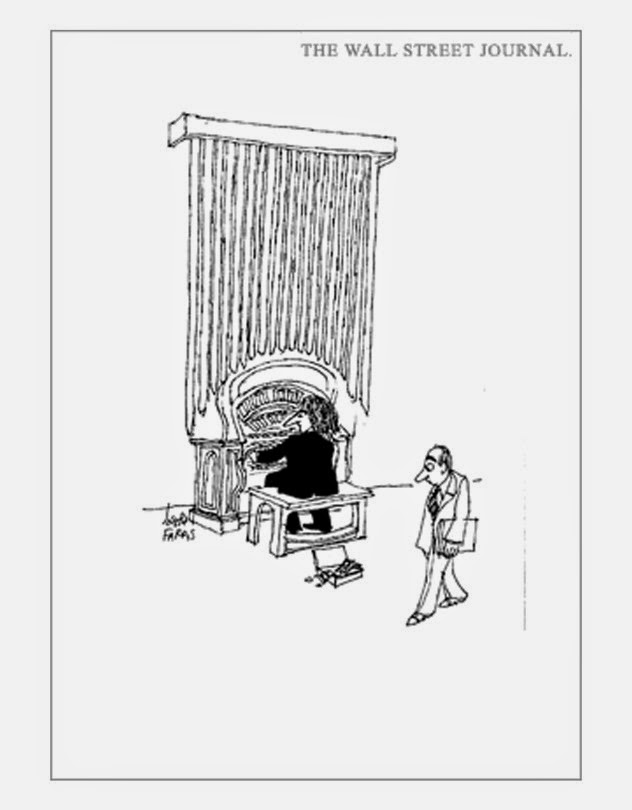
According to their cartoon editor, The Wall Street Journal published his "last okay" this week. Here's the drawing which appeared January 29, 2015:


My friend writer/editor and comics scholar Rick Marschall wrote the below on Facebook. I was given permission to share Rick's story and this drawing that Joe Farris drew of Mr. Marschall here:


 Rick Marschall:

"I stipulate that this is not a great likeness or up to Joe Farris's usual standard -- he later said so -- but this WAS drawn at a Christmas party, far into the night. For decades it has been a tradition for cartoonists in the Bethel/Ridgefield area of Connecticut to meet (at least) weekly for lunch. For a while it was the Opera restaurant on the towns' border. I lived in Bethel, then Westport, then Weston, for years, and would spend one afternoon a week so engaged with Ron Goulart, Jerry Marcus, Orlando Busino, Bob Weber, Gill Fox, Jack Berrill, others. Sometimes we would run into Bob Kraus or William Steig. Happy days. One year Joe offered to host an evening convocation of the "roundtable" at his house, with spouses invited and Christmas as the excuse. He managed to draw this caricature of me, as I say, well into the evening's festivities. I miss those days; I miss Joe."


Related:

Michael Maslin's Ink Spill
Bethel New Times: "Famed Bethel cartoonist remembered as 'selfless person'"

Saturday, December 20, 2014

Lowell Hess RIP


American illustrator Lowell Hess, whose work was part of the "Golden Age of American Illustration," died on Wednesday.  I have no details about his age or how he died at this time.

He was born in Oklahoma, went to high school there and then he attended the University of Oklahoma. He was, like so many illustrators, always drawing. 

"When he attended the University of Oklahoma he 'picked up a few covers for the school's humor magazine,' drew humorous depictions of student life for the college dance hall and caricatures at the student carnival. Lowell remembers that 'long after the festivities, I went home and drew funny faces late into the night.'" -- Leif Peng, Today's Inspiration

He married, and then found himself in Europe. He served as an artillery lieutenant in the US Army during WWII from 1942 to 1945. 

After the way, New York City was where he studied. He attended the Pratt Institute in Brooklyn, and made the city his new home. 

In the 1950s, he worked hard to get assignments. And he go it, with a client list that included Colliers, Reader's Digest, Time-Life, Golden Books and many others. He drew 22 covers for Boy's Life. 

Photography began to supplant illustrations by the late 1950s. Lowell, like so many great freelance illustrators, found jobs scarce. By the 1960s his own income was, through no fault of his own, starting to dry up.

"After not making a dime for eight months, I told an employment agency in desperation, 'I can work with paper, I can do anything!'" he writes in THE ART OF LOWELL HESS (Dog Ear Publishing, 2011). 

This led to an interview with Graphics3. The interview must have went well, because Lowell became 

"the resident paper engineer and in-house illustrator at a company that specialized in creating pop-up greeting cards called Graphics3. Below are just a few of the many magnificent pop-up cards Lowell designed, engineered and illustrated during the 30 years he worked at Graphics3." --  Leif Peng, Today's Inspiration


Speaking personally ….

I am very sad to hear of Lowell's death. He had a wonderful life, and I know he was much loved by his own family, as well as the illustration community. 

I met him once, at a lunch in Westport, CT in 2006. The occasion was Frank Bolle's birthday. Ron Goulart, Bob Weber (the KIng Features "Moose and Molly" Bob Weber, that is), Orlando Busino and Frank McLaughlin were there. Those guys were all locals, but Lowell had somehow found his way from New Jersey, where his family now lived. 

Lowell was quiet, and I remember I had to ask Orlando twice if that was THE Lowell Hess. It was. Lowell listened to me for a minute and smiled broadly and chatted with me when I told him how much I loved his work -- especially those Boy's Life covers. A gracious gentleman whose skill will always be there for us all to look and wonder at.


The Lowell Hess Web Site
The Lowell Hess Flickr collection (maintained by Leif Peng)
Hardcover book THE ART OF LOWELL HESS
Leif Peng's Today's Inspiration: Lowell Hess: "I had a reputation as an artist with talent."

Monday, September 01, 2014

Stan Goldberg 1932-2014


Pauline and Stan Goldberg at a Berndt Toast Gang lunch a few years back.


Stan Goldberg died on the last day of August 2014 due to the effects of a stroke he suffered about two weeks ago. He was 82 years old.

Like a lot of people, I just found out via email and social media. So many people are calling Stan their friend, and they are right. Stan was a gentleman and when he spoke with you, you got 100% attention. He was generous and enthusiastic about comics, and people. And when it came to comics: he was there. There for everything: the golden age, the anti-comcs crusade of the 1950s, the silver age, and so on.

He could tell you stories of working for Stan Lee. He was there in the Empire State Building as a teenager, in the Marvel bullpen. This was during the 1940s, before Marvel was Marvel. It was called Timely Comics then. As a teen, he assisted Carl Burgos, the creator of the original Human Torch.

Best known for his work on ARCHIE Comics, as well as his coloring work for Marvel. (He chose the colors for the superheroes and super villains.) Stan was also the man behind many issues of MILLIE THE MODEL.


(Above: the cover of ARCHIE #571, December 2006. Of course, Stan drew this. What I didn't know was that he put my wife's name right there on Santa's list. I know, it's hard to see in this tiny image, but it's there. He did this without saying a word and handed me the original art to keep. He knocked my socks off with this act of kindness out of the blue. Whatta guy!)


Mark Evanier cites the number of comics pages he produced during his nearly 60 years as "staggering."

I had the pleasure of knowing Stan as a friend for the past 15 years. He was a fellow member of the Long Island National Cartoonists Society, the "Berndt Toast Gang." We also co-curated an original comic art gallery show in 2005. The show was big and tough to put together, but working with Stan was a pleasure.

Stan drew Archie for over 200 issues. He is considered the seminal Archie artist. If you wanna know how to draw Archie, he's your go-to guy.

When I first met Stan, he and his wonderful wife Pauline were sitting at a table during a Berndt Toast Gang lunch. This was maybe my second time I attended a BTG lunch. I asked if it was OK to sit next to them, and got friendly smiles and they both said, "of course, of course." I told him that I knew his work, and I called him "Mr. Goldberg." To which, he politely, but sternly, replied, "Don't call me Mr. Goldberg. 'Mr. Goldberg' is my father's name. Call me Stan."

Since then, we've become friends and he's invited me to his studio, which overlooks Eastchester Bay. He has a wonderful view of the bridge, but he admitted to me that he is usually looking at his board and not at the water. (Typical cartoonist!) The first time I was there, he showed me many of his originals. He has an amazing collection of original cartoon art by many cartoonists, framed on the wall. We rifled through his bookshelf. At one pint, Stan pulled out a a large, oversized hardcover book by children's illustrator Richard Scarry. "This guy could draw anything." Of course, I had to go and buy a few Scarry books for myself! He was showing me piles of pencils and inked ARCHIE pages. Basically, I was a kid in a candy store and he let me behave like one.

I mentioned about how generous he was. We were in the green room, waiting to go on a Long Island TV show. I think it was in connection with that gallery show. Anyway, Stan was showing me all of the comics he had brought to show, and I had maybe a dozen color printouts of my gag cartoons. He told me, make sure you tell them about how you got into cartooning. I said something like my story is not as interesting or as important as his own life story. He pooh-poohed that idea. He wanted to make sure that the spotlight was on me as well, as an equal. Oh, heck! I'm not worthy!!! See what I mean about generous?

I could go on and on about Stan, and Pauline, and the times I have spent with them since. Okay. One more: They both took time out to come and hear me lecture about 1950s comics a few years ago. I couldn't help but think that the audience would have been better served if we traded places, and they listened to a guy who was actually there at that time. Several cartoonists were there that day, and I remember at the end, after the initial applause, I introduced some of the cartoonists in the audience. Stan got the loudest applause.

I almost forgot to mention his many awards: The National Cartoonists Society Gold Key Award, the Stanley, the Ink Pot. Those are a few and some of the most prestigious. Russ Burlingame writing at Comicbook.com has a good rundown. NCS President Tom Richmond remembers Stan. There are dozens of links out there already, and hundreds more to come.

Stan, I will miss you dearly. My deepest condolences to Pauline, and the Goldberg family.

Pauline and family have sent along a request. In lieu of flowers, please make a donation to:

East End Hospice
481 Westhampton-Riverhead Road
PO Box 1048
Westhampton Beach, NY 11978
(631) 288-8400
www.eeh.org

Monday, October 14, 2013

Syrian Cartoonist Akram Raslan Reported Slain


From Cartoonists Rights Network: Syrian cartoonist Akram Raslan is reportedly dead.

According to unconfirmed reports, Mr. Raslan was put on secret trial in Syria on July 26, 2013, along with other prisoners of conscience (fellow journalists, artists and other intellectuals). Mr. Raslan was subsequently sentenced to life imprisonment, but, then was taken away from the others and executed by the Deputy Vice President for Security Affairs in Syria, Mohammed Nassaf Kheir Bek. He is buried in a mass grave near Damascus.

Mr. Raslan, who had been drawing cartoons about the ruthlessness of president  president Bashir al-Assad, was "disappeared" from the newspaper offices where he worked about nine months ago. He was incarcerated in a Syrian prison. During that time, he received the Cartoonist Rights Network International's 13th annual Award for Courage in Editorial Cartooning.

"As Mark Twain once said, 'against the assault of laughter, nothing can stand.' The tyrant might be able to call out an army to quell a rebellion in the streets, but against his own people laughing at him, there’s no defense. The power of the pen is nowhere more powerful than in the hands of a daring cartoonist. 
"Akram Raslan knew the risks when he started drawing president Bashir al-Assad as a ruthless dictator. Two years ago, another Syrian cartoonist, Ali Ferzat, was kidnapped, driven to the outskirts of Damascus and brutally assaulted because of the growing popularity of his cartoons criticizing Assad. As the goons were finishing their work they broke his fingers, telling him that his broken hands would assure he never drew another cartoon embarrassing the big boss. 
"When this attack became public, political cartoonists and journalists all over the world responded with an unprecedented flood of anti-Assad cartoons, editorials and newspaper articles. The regime paid a heavy public relations price for the attack on Ferzat. This time, instead of an extrajudicial beating during the dark of night, the regime chose to trump up charges of sedition against the cartoonist. The only evidence against him will be the cartoons he has drawn that embarrass Bashir al-Assad and his minions.


My thanks to Bado for alerting me to this story. 

Thursday, September 19, 2013

Editorial Cartoonist Eldon Pletcher 1922-2013


Sad news. From The Times-Pacayune:

Eldon Pletcher, The Times-Pacayune's editorial cartoonist from 1966 to 1984, died Sunday of emphysema and congestive heart failure at Good Samaritan Hospital in San Jose, Calif. He was 91.

Eldon Pletcher started sending me emails some years back. And then we began to exchange Christmas cards. He chatted to me like an old friend -- some shop talk, some talk of cats or a nice comment about the garden, which he saw on the blog. He was one of those fellows who, if I ever got to the New Orleans area, I should stop by and shake his hand. He treated me like an old friend, even though we never met in person.

Before he was at The Times Pacayune, he was at the Sioux City Journal from 1949 to 1966. And before that, he was in the army (Eldon was in the Battle of the Bulge), and a contributor to Yank magazine.

He was a traveler -- studying in Chicago, and, after the war, at the University of Scotland in Aberdeen, as well as the John Heron Art School in Indianapolis.

The funny thing about Eldon, ot "Pletch," as he signed all of his emails and notes, was that he kept in the "now." He never mentioned his editorial cartoonist career to me at all. He sent me a long personal note of comfort when our beloved kitty died in 2012. He had been there too, losing his sweet cat Callie -- but now he had a new cat named Blitzen.

He thanked me for a blog entry I wrote about coloring.

He wrote, "I appreciate your tips on using color. I'm sure in my case it would be big help if I wasn't color blind."

Pletch would only email about his past life when it was relevant. Like this email I received in 2010, which was in response to my email to him about some great gag cartoonists I admire -- specifically: Don Orehek and George Booth. Here's Pletch, talking about his days at the Chicago Academy of Fine Arts:

"Don Orehek and George Booth are certainly cartoon greats, all right. I also like and admire their work.

"Martin Garrrity, now deceased, who drew gag cartoons in the better period of magazine cartooning, the 50s and 60s, also taught gag cartooning at the Chicago Academy of Fine Arts and [George] Booth was a student of his. Marty was a good friend whom I knew well from my Chicago days. At an earlier time, when I studied at the Chicago Academy for awhile, I had Don Ulsh, for gag cartooning and Vaughn Shoemaker, for editorial cartooning. After Marty and his wife moved to Fair Oaks, California, he stopped doing magazine cartoons and did editorial cartoons for a paper in that area. He belonged to the AAEC and when the convention was in Orlando Florida, in 1985, he arranged for me to sit in a seat with George Booth on a bus trip. We had an interesting conversation, about Missouri, where he was from and my wife being, from Kansas City etc....and about our military life. I believe his first work was printed in Leatherneck magazine, the Marine publication. Booth gave a humorous talk at the convention."

A memorial service will be held on Saturday at 11:30 a.m. at the Yoder-Culp Funeral Home, 1911 S. Main St., in his home town of Goshen, Indiana. Burial will be in Rock Run Cemetery in Goshen.

I'm thankful Pletch took the time to send emails and chat. I will miss seeing his name in my in-box. What a kind and talented soul.

But I would be remiss if I didn't pass along some samples of his work through the decades.

Here's some of his cartoon work, and more details about his life. The below is from a 2007 blog entry titled "The Three Cartoon Worlds of Eldon Pletcher." It's a terrific overview of his career.


I got a note in last month from Eldon Pletcher:

"My friend Dave Carpenter has told me of your conversation, in which you expressed an interest in possibly doing a blog on me ... going from editorial cartooning to 'gag' cartooning. While I haven't felt there was anything special in doing both types, if you would like to do a blog on the subject, it's OK with me."
So it is written, so shall it be blogged!
Cartoonist Eldon Pletcher was born in Goshen, Indiana on September 10, 1922. After his first year at the Chicago Academy of Art, he went overseas, to serve in World War 2.


Like a lot of cartoonists, he started by drawing some gag cartoons, which are reproduced here. But he didn't have to buy his art supplies. Art supplies found him. Here's Pletch:


"I was in Germany when World War 2 ended. At that time I found some art materials at a bombed out artists supply store and started sending some cartoons to the Continental edition of Yank magazine, published in Paris. It was some early efforts in 'gag' cartooning. 


"I've enclosed a few of those they used while I was in Germany and while at the University of Aberdeen, in Scotland, while waiting for the number of 'points' I had (the Army had a point system in determining the order of when troops came home) to be enough to get me home."


When he got back to the States, Pletch attended the John Herron Art School in Indianapolis. He married Barbara Jeanne Jones in 1948. By the next year, he was the editorial cartoonist for the Sioux City Journal, a position he held for seventeen years.

The family moved to New Orleans in 1966, where he drew the editorial cartoons for the New Orleans Times Picayune for the next 19 years. Here is a selection of his editorial cartoons that he passed along for me to share:

There's Kennedy ...

The more things change, the more they stay the same. There's Romney, Sr. in the line up!

The pendulum swings back and forth.

Remember Billy Beer?


Dick Nixon piloting the capsule? Now that's a NASA disaster waitin' to happen!

So, from gag cartoonist to editorial cartoonist and now ... back to gag cartoonist. Award winning cartoonist Eldon Pletcher continues to cartoon. Here are a few recent ones.


Thanks for sending these along, Eldon. I loved the story of finding those art supplies in the rubble of post-war Germany. Keep toonin'!


Hat tip to the Wichita State University Library for the biographical info.

Thursday, June 20, 2013

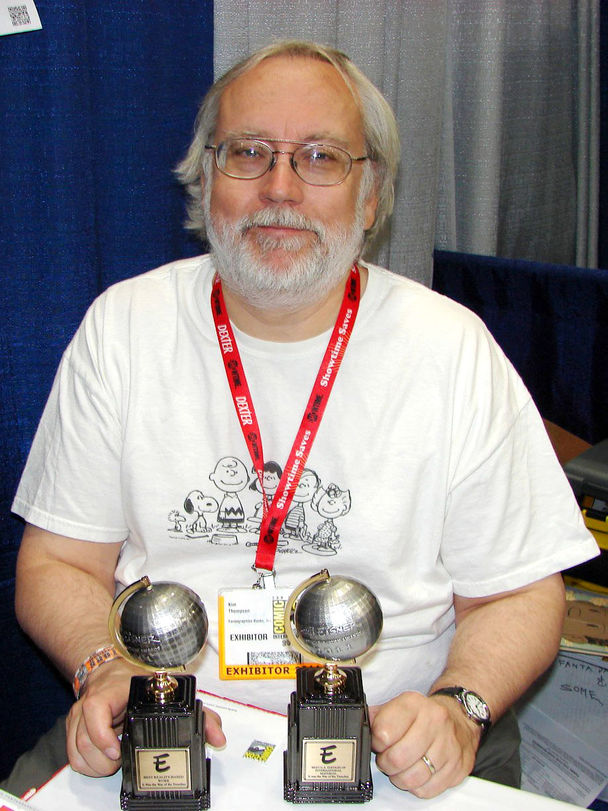
Kim Thompson 1956-2013


Kim Thompson, co-publisher of Fantagraphics Books and champion of comics as art, died on Wednesday morning, June 19, 2013. The cause was lung cancer. He was 56 years old.

Warren Bernard, founder of the Small Press Expo, tells The Washington Post:

Kim helped bring some of the greats in comics to the forefront, such as Chris Ware, Jacques Tardi and the Hernandez Brothers,” Bernard says of the Fantagraphic-published creators. “The comics world is a much better place because of Kim’s efforts over the last 35 years of the comics continuum.”


Bleeding Cool News has the press release from Fantagraphics:

Fantagraphics co-publisher Kim Thompson died at 6:30 this morning, June 19. “He was my partner and close friend for 36 years,” said Gary Groth.

Thompson was born in Denmark in 1956. He grew up in Europe, a lifelong comics fan, reading both European and American comics in Denmark, France, and Germany. He was an active fan in his teen years, writing to comics — his letters appeared in Marvel’s letter columns circa early 1970s — and contributing to fanzines from his various European perches. At the age of 21, he set foot, for the first time, on American soil, in late 1977. One “fanzine” he had not contributed to was The Comics Journal, which Groth and Michael Catron began publishing in July of 1976. That was soon to change.

“Within a few weeks of his arrival,” said Groth, “he came over to our ‘office,’ which was the spare bedroom of my apartment, and was introduced by a mutual friend — it was a fan visit. We were operating out of College Park, Maryland and Kim’s parents had moved to Fairfax, Virginia, both Washington DC suburbs. Kim loved the energy around the Journal and the whole idea of a magazine devoted to writing about comics, and asked if he could help. We needed all the help we could get, of course, so we gladly accepted his offer. He started to come over every day and was soon camping out on the floor. The three of us were living and breathing The Comics Journal 24 hours a day.”

Thompson became an owner when Catron took a job at DC Comics in 1978. As he became more familiar with the editorial process, Thompson became more and more integral to the magazine, assembling and writing news and conducting interviews with professionals. Thompson’s career in comics began here.

In 1981, Fantagraphics began publishing comics (such as Jack Jackson’s Los Tejanos,Don Rosa’s Comics and Stories, and, in 1982, Love and Rockets). Thompson was always evangelical about bandes dessinées and wanted to bring the best of European comics to America; in 1981, Thompson selected and translated the first of many European graphic novels for American publication — Herman Huppen’s The Survivors: Talons of Blood(followed by a 2nd volume in 1983). Thompson’s involvement in The Comics Journaldiminished in 1982 when he took over the editorship of Amazing Heroes, a bi-weekly magazine devoted to more mainstream comics (with occasional forays into alternative and even foreign comics). Thompson helmed Amazing Heroes through 204 issues until 1992.

Among Thompson’s signature achievements in comics were Critters, a funny-animal anthology that ran from 50 issues between 1985 to 1990 and is perhaps best known for introducing the world to Stan Sakai’s Usagi Yojimbo; and Zero Zero, an alternative comics anthology that also ran for 50 issues over five years — between 1995 and 2000 — and featured work by, among others, Kim Deitch, Dave Cooper, Al Columbia, Spain Rodriguez, Joe Sacco, David Mazzuchelli, and Joyce Farmer. His most recent enthusiasm was spearheading a line of European graphic novel translations, including two major series of volumes by two of the most significant living European artists — Jacques Tardi (It Was the War of the Trenches, Like a Sniper Lining up His Shot, The Astonishing Exploits of Lucien Brindavoine) and Jason (Hey, Wait…, I Killed Adolf Hitler, Low Moon, The Left Bank Gang) — and such respected work as Ulli Lust’s Today Is the Last Day of the Rest of Your Life, Lorenzo Mattotti’s The Crackle of the Frost, Gabriella Giandelli’s Interiorae, and what may be his crowning achievement as an editor/translator, Guy Peelaert’s The Adventures of Jodelle.

Throughout his career at Fantagraphics, Thompson was active in every aspect of the company, selecting books, working closely with authors, guiding books through the editorial and production process. “Kim leaves an enormous legacy behind him,” said Groth, “not just all the European graphic novels that would never have been published here if not or his devotion, knowledge, and skills, but for all the American cartoonists he edited, ranging from Stan Sakai to Joe Sacco to Chris Ware, and his too infrequent critical writing about the medium. His love and devotion to comics was unmatched. I can’t truly convey how crushing this is for all of us who’ve known and loved and worked with him over he years.”

Thompson was diagnosed with lung cancer in late February. He is survived by his wife, Lynn Emmert, his mother and father, Aase and John, and his brother Mark.

Tuesday, April 09, 2013

Ed Fisher 1926-2013


Ed Fisher, whose cartoons appeared in The New Yorker from 1951 to 2000, died on April 3, 2013 in Canaan, CT. He was 86.

His son, Mark Fisher, said his father was diagnosed with Alzheimer's in 2000.

Despite this, I saw Ed routinely on The New Yorker "look day" in the early 2000s. He would be sitting on the couch, in the cartoonists' waiting room, with his portfolio, ready to chat. I introduced myself and was really glad to meet him. More than once he pulled out his roughs and showed them to me. Ed treated me like an equal.


His style was stunning. Halfway between illustrative and cartoony, it relayed an assured knowledge of form and mass, and how to play with it. His writing was erudite as well.

Like Bob Mankoff wrote:

"Ed was also an inspiration to my generation of cartoonists, and his work will continue to inspire cartoonists for generations to come."

Born in the Bronx on October 26, 1926, to a chiropractor and a professional singer, Mr. Fisher sold his first cartoon while attending Antioch College. Interrupting his studies, he served in the Pacific Theater in the Army Air Force. Returning stateside, he completed his degree and came back to New York home with a new wife, Ann Sharp. The young couple settled in Upper Manhattan.


From the NY Times obituary by Bruce Weber:

"'He had the same phone number for 60 years,' his son [Mark Fisher] said. At first he tried to find work at graphic design studios, telling potential bosses that he’d sold cartoons to The New Yorker, after which, according to family lore, he wouldn’t be hired because, he was told, he was overqualified."

His cartoon collections include ED FISHER'S FIRST FOLIO, ED FISHER'S DOMESDAY BOOK and MAESTRO, PLEASE. He also wrote a satiric novel in 1960 about ancient Rome titled WINE, WOMEN AND WOAD.

If you look at the cartoons in the books, you'll see why I like him. It looks like he just picks up whatever drawing tool is closest to his board -- a brush, a ball point pen -- and goes at it with skill and energy.


From the NY Times obituary:

Mark Fisher said that years after his parents’ marriage ended in divorce, they remarried when his mother was ill with cancer; she died in 2000. In addition to his son, Mr. Fisher is survived by a daughter, Nancy Rupert; a sister, Carol Romano, and two granddaughters.


The cartoons reproduced here are from ED FISHER'S FIRST FOLIO and are copyright 1959 by Mr. Fisher.


Read: Michael Maslin on Ed Fisher.

Wednesday, April 03, 2013

Bob Clarke 1926-2013


Above: Bob Clarke's 1967 self portrait from MAD #111.

Bob Clarke, who contributed to MAD Magazine for six decades, died March 31, 2013. The cause was complications from pneumonia. He lived and worked in Seaford, Delaware.

From the MAD Magazine site:

“We’re sad to announce that on Sunday, legendary MAD artist Bob Clarke passed away at the age of 87. 
“Bob was with MAD nearly from the start — first contributing in 1956 and continuing through 2010. 
“During his amazing career as one of ‘The Usual Gang of Idiots,’ Bob was one of the magazine’s most versatile artists, illustrating everything from covers, to articles, to Spy vs. Spy, to bonus inserts for MAD specials [including the MAD Zeppelin paper model and the MAD mobile]. Bob’s contribution to MAD’s legacy is massive, and he’ll be greatly missed.”


From the Seaford DE Statesman Journal:

Clarke had fun being part of the MAD staff – self-proclaimed as “The Usual Gang of Idiots” – and did his share of pranks and jokes, his nephew said. 
When publisher Bill Gaines took artists and writers on yearly adventures, one of Clarke’s pranks was a classic. 
Their hotel had a room behind the registration desk with banks of lights to show when room doors opened or closed. “Bob, whose first wife was Lithuanian, convinced the fellow Idiots to wake up throughout the night and open and close their doors a dozen times or so to keep the KGB on their toes!” his nephew said.


Friday, February 22, 2013

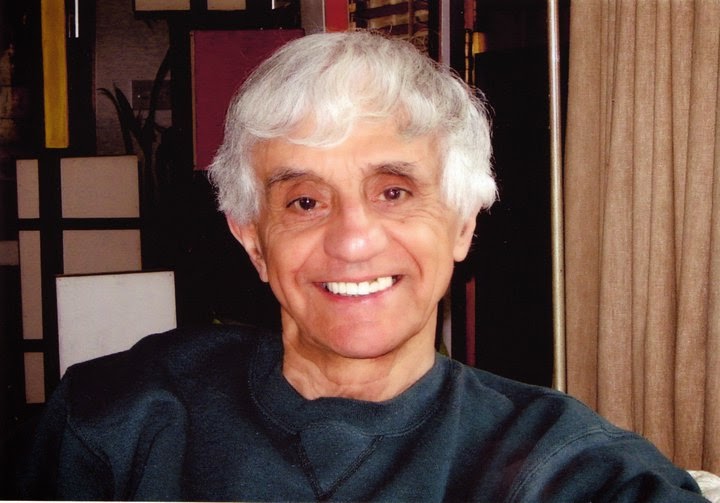
Vahan Shirvanian 1925-2013


Prolific cartoonist Vahan Shirvanian died January 30, 2013.

Mr. Shirvanian began his career during the "golden age" of gag cartooning, the 1940s ... and he never stopped. He has a cartoon in the latest issue of Playboy -- a full color four panel cartoon -- that was just published this week.


He was born in Hackensack, NJ in 1925, the son of Vahan Shirvanian, Sr. and his wife Gladys.


He served 2 years in the Army Air Force during World War II, where he was first a bombardier, and then an artillery instructor.

Mr. Shirvanian attended Seton Hall University where he majored in English Lit and was art editor of the campus newspaper, where he, of course, put his cartoons. He graduated in 1950.


Vahan had already broken through to the major markets. His first cartoon was sold to the Saturday Evening Post in 1946. The New Yorker, Reader's Digest, Harvard Business Review, Playboy and all of the other major markets followed. By 1959, he had won Best Gag Cartoonist of the Year Division Award from his colleagues at the National Cartoonists Society. He would be named "Best Cartoonist of the Year" ten times between the NCS and Highlights for Children.

It was during the 1950s, he married Monica Williams and they moved to Mountain Lakes, NJ, raising two kids. He worked in his studio at home. He was also a member of the "Jay Vets," a group of New Jersey friends who grew up and served in the War together. They met for 65 years.

King Features syndicated his "No Comment" comic strip, a wordless gag-a-day strip from 1979 to 1981. He's currently syndicated by the New York Times' "Wit of the World" News Service.


Mr. Shirvanian continued creating and sending out his cartoons. Like all great cartoonists, he never retired, despite a spinal injury last year.

Although I never met him, I knew his distinctive ink line and sense of humor well. More than once I laughed out loud at a Shirvanian cartoon.


The Star Ledger published his obituary on February 17, 2013.

Vahan also never missed a chance to share his artistic skills, whether teaching children in a classroom or creating designs and invitations for friends' events. In his spare time, he found enjoyment playing tennis, completing The New York Times crossword puzzle, devouring mystery novels, hiking in the great outdoors, and rooting for his beloved Yankees. Vahan is survived by his wife and constant companion of 57 years, Monica Shirvanian; daughter, Nancy Shirvanian Reynaud of Washington, D.C.; son, Thomas Vahan Shirvanian of Boonton Township, N.J.; brother, Robert M. Shirvanian of Monmouth Beach, N.J., and his only grandchild, Emily Reynaud of Washington, D.C. His family will always love and miss him dearly, remembering his capacity for wisdom, his genius in finding laughter everywhere, and the way in which he beautifully touched so many lives, in so many ways.