Tuesday, January 28, 2014

Morrie Turner 1923-2014


Photo by Kat Wade for The Chronicle.


Morrie Turner, creator of the nationally syndicated WEE PALS newspaper comic strip, died in a hospital in Sacramento, CA on Sunday, January 26, 2014. He had been hospitalized for kidney problems. He was 90 years old.

He served with the 477 Bomber Group (the Tuskegee Airmen) Special Services in World War 2.

Urged by Charles Schulz, Mr. Turner launched WEE PALS on February 15, 1965. The strip became a children's' animated TV show titled KID POWER in 1972.

The San Francisco Cartoon Art Museum award him a "Snoopy," a Charles M. Schulz "Sparky" Award. He also received the Bob Clampett Humanitian Award, the California Black Chamber of Commerce Lifetime Achievement Award, and the National Cartoonist Society's Milton Caniff Lifetime Achievement Award in 2003, among others. He was also a founder of the Northern California African American History Museum and Library in Oakland, CA.


Sunday, January 26, 2014

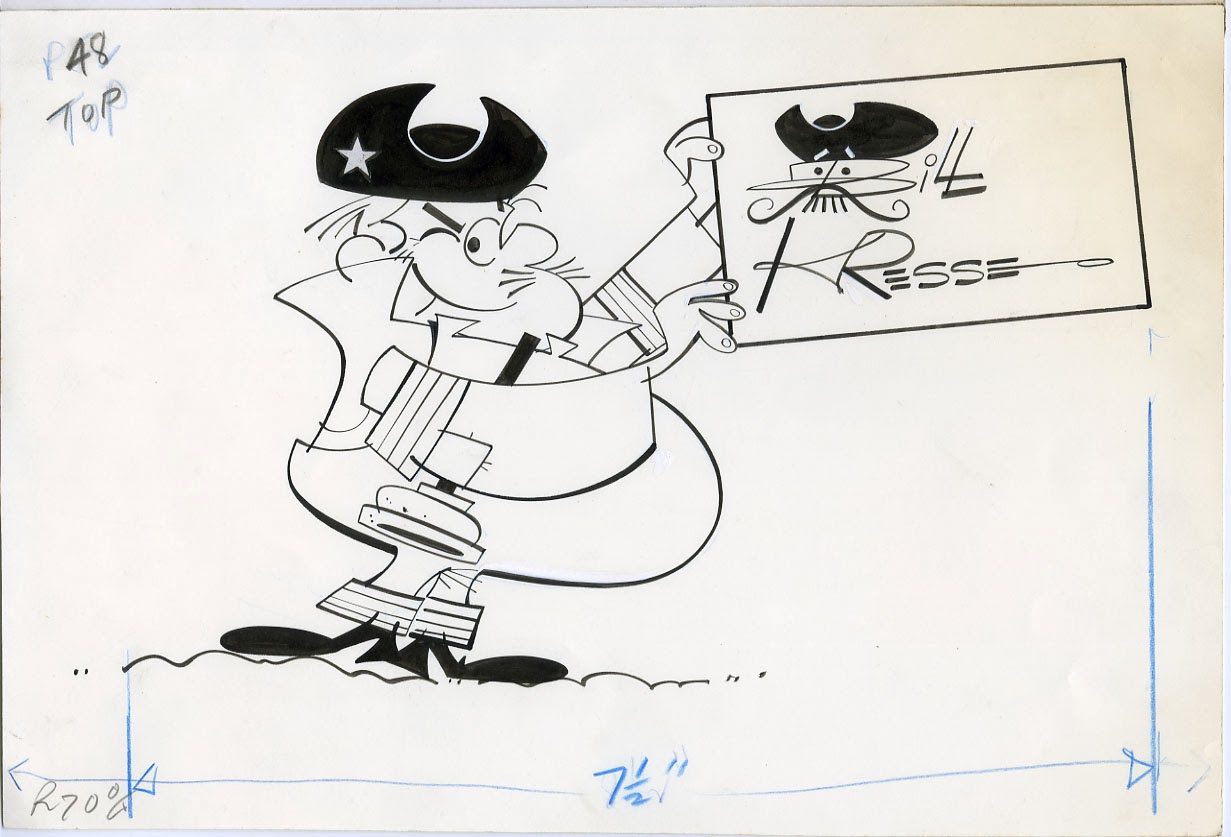
Bill Kresse 1933-2014 "Arrived with a pencil in my hand …."


Cartoonist Bill Kresse died on Tuesday, January 21, 2014. No cause of death was given. He is survived by his wife, Lorraine M. Kresse. There are visiting hours today (Sunday) and tomorrow (Monday, January 27th, 2014) at the Conway Funeral Home, in Jackson Hts., NY.  A funeral mass will be held Tuesday morning at 10:30.

Bill Kresse was a friend, and a fellow member of the Berndt Toast Gang.


I don't think that when Bill was born that the phrase "multi-tasker"had yet been coined. So, let's call Bill a renaissance man.

He admits that he's had at least five careers. "Maybe six."

"I arrived with a pencil in my hand and scribbled my way through the High School for Art and Design," he recounts in his NCS bio.

Just out of school, he found a job a bit north of the city, in a suburb, New Rochelle.

"I was awarded the princely sum of $25 and a job with Terrytoons."

The teenaged Bill Kresse got hired by none other than Mr. Paul Terry himself. Terrytoons was in high production mode after the war, churning out its cartoons for television consumption, especially Mighty Mouse and Deputy Dawg. This was, he notes, Career No. 1.

While the days he spent at Terrytoons were "great fun," he didn't find the mindless inking of animation cells to be in any way challenging.

So, he embarked on Career No. 2, "a brief stint in the world of design/drafting."

Bob Buethe writes in his Hogan's Alley magazine article Bill Kresse and "Super" Duper that Bill took an NYU cartooning class taught by veteran syndicated and gag cartoonist Dave Breger. They became friends, and Dave took Bill to some National Cartoonists Society get togethers. Dave stood for Bill, sponsoring the young man for membership to the prestigious professional organization.


During this time, Bill was selling gag cartoons at what is now referred to as "Vintage Sleaze" types of magazines, specifically one called Humorama.

He also met and married Lorraine, his wife of now over fifty years, during this time. In his NCS bio, he calls her his "fantastically talented bride," as well as a "super artist … and my severest critic." With her, and later with his beloved schnauzer Willie, they had a loving home life, settling in Jackson Heights, NY.

While Terrytoons did not in any way help him prepare for the drafting job (Career No. 2), he said it did prepare him for Career No. 3: a series of newspaper art department jobs.

It was at the NCS events that Bill, thru networking, had found jobs with the New York Herald Tribune, the Suffolk Sun, and, finally, with the art department at the Daily News.

At the News, Bill met Rolf Ahlsen. Together, they pitched a comic strip about a goofy building superintendent to Sunday editor Worth Gatewood. The News bit, and the comic strip "Super" Duper debuted in 1968. It would run for over five years, exclusively in the News.

By the early 1970s, Bill was appearing occasionally on The Joe Franklin Show, as well as presenting a weekly cartoon lesson on a live-action kids' show hosted by a young Irene Cara, titled "The Everything Show." This was his 4th career, he says.

He also found time to draw the playbills and posters for the local St. Joan of Arc Theater Group in Jackson Heights.

Mary Jane Blaney remembers. She was a young person in the 1960s and, like Bill, active in the St. Joan of Arc Theater Group. Here's her post at Legacy.com about this time:


Was so sorry to hear today that Mr. Bill Kresse has passed away. Mr. Kresse was a most talented man and wonderful person. Mr. Kresse was so supportive of the St. Joan of Arc Theater Group ( 1970's and 1980's) under the direction of Mr. Daniel Tomasselli and the St. Joan of Arc Children's Choir and Folk Group directed by Mr. Tomasselli and then Mr. Dennes Striny . I will never forget while in the folk group; playing the guitar and singing at the 10 30 am Folk Group Mass ..always looking up and seeing him sitting right in front of us and always with a smile on his face every Sunday.  
Each and every St. Joan of Arc Theater Group Production Playbill as well as, Poster for the purpose of marketing the production was designed by Bill Kresse. Thank you Mr. Kresse! You had such a positive effect on myself and all the children, teenagers and young adults you came in touch with at St. Joan of Arc, Jackson Heights through those years. My thoughts and prayers are with your wife and your family. 
May you rest in peace.  
- Mary Jane Blaney, Bayside, NY

During these years, Bill served on the board on the National Cartoonists Society and became Vice President. In 1974, he won the NCS Advertising and Illustration Division Award. During these years, he was nominated for other awards as well. Bill was awarded the prestigious NCS Silver T-Square in 1977.


Above: "The House I Live In" a coloring book by Bill Kresse.


Career No. 5: The next decade would see more freelance projects, like coloring books and comics, and AN INTRODUCTION TO CARTOONING, a how-to trade paperback cartoon book, published in 1984. In it, photos of Bill cavort with his drawings. 

In the '90s, he became a designer for Zippo lighters, as well as souvenir pins and fobs. He was VP graphic design director for a lapel pin company, specializing in designs for the Olympics, the Paralympics and their associated sponsors.


He created a series of pins for the 1996 Atlanta Olympics (including a collection of 12 “I Survived the Blast” pins that were conceived, drawn and rushed to the manufacturer in under four hours).

That was Career No. 6 at the very least!


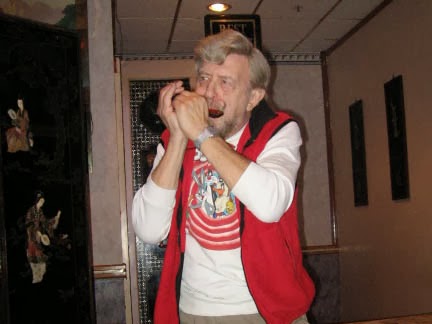
Above: Bill plays the harmonica at a 2006 Berndt Toast Gang luncheon.


Bill Kresse and Rowdie the schnauzer from a 2009 Queens Courier article. (Willie the schnauzer had passed away, and Rowdie was their new pup.)


Bill was a fellow member of the Berndt Toast Gang, the legendary chapter of the National Cartoonists Society. He always brought his harmonica to the meetings. Sometimes he would play a melody, other times accompany any birthday announcements with the birthday song. Most often, Lorraine would be sitting next her husband, smiling.

The last time I had lunch with Bill, it was a few blocks from the old Daily News building. It was just the two of us. He had come in from Queens and I had taken the subway from Brooklyn. We were at the old watering hole The Overlook Lounge, which used to be called Costello's. It was the place to hang out if you were a cartoonist (along with The Pen and Pencil and The Palm).  We arrived at 2 o'clock. Late for lunch, but your get 2-for-one drink specials! And they really do have great food.

Bill had a stack of new gag cartoons that he had drawn and he hauled them out. He spread them on the table and talked about them. He was drawing some editorial cartoons for the Queens Courier at that time. Bill always spoke to me like an equal, despite me having only been in the cartooning business for a fraction of the time he had been. He was a generous soul.

Enthusiastic, and knowledgable, Bill never stopped drawing and thinking cartoons -- and getting them out to markets. Or, for that fact, loving Lorraine and schnauzers. Like so many of us, cartooning had infused itself in his soul. The scribbling that had begun in high school had never stopped. For a man like that, there is no retirement.


Above: one of the cartoon walls at the Overlook Lounge. Bill's Super Duper drawing is there to the right of Sy Barry's Phantom.

Related:
Vintage Sleaze Bill Kresse Master Cartoonist
Scott Edelman Remembers Bill Kresse
Daily News Annnouncement
Hogan's Alley: Bill Kresse and "Super" Duper
Italian site (translated) AFNews
Bill Kresse, Longtime O'Dwyer's Illustrator, Dies


Friday, January 24, 2014

Interview: Sam Ferri "Do not personalize failure or rejection ..."


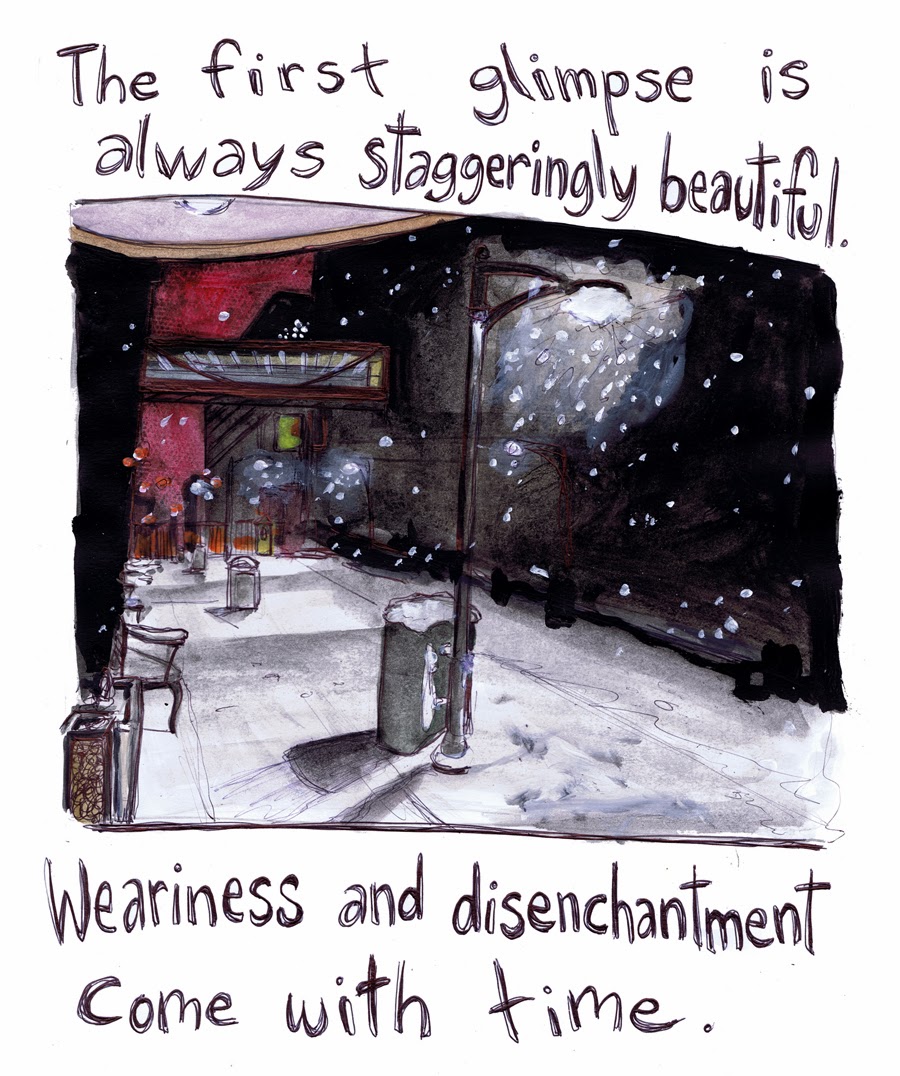
If you live in New York City, you know Sam Ferri's work. Sam comments on urban life in his "Misconnected" single panel cartoon, which was in a couple of NYC papers. Or maybe you saw it in Funny Times. Here's one of my favorites that we talk about in the interview below:

But Sam gathers no moss. He's a multi-tasker; a cartoonist, painter and animator, equally comfortable with old school and new techniques. His clients include Time Out New York (where he drew the "Photo Finish" feature), The New York Post, The Jerusalem Post, The NYPress, The Brooklyn Paper, The Brooklyn, Rail, Funny Times, A and E Biography, Jack Daniels and others.


He has a new animated short. It's for Jack Daniels and it's part of a series by different animators. Each animator was given the audio of a real life Brooklyn bartender and then they (the animator) created a short based on it. Viewers vote for which animation they like best. Please consider voting.

This interview was conducted via email earlier this month. I'm grateful to Sam for taking the time out of his busy schedule to give thoughtful and thorough answers about the challenge of being a cartoonist during this time in history.


INTERVIEW: SAM FERRI

Mike Lynch: Are you from a big family? Does anyone else in your family have artistic tendencies?


Sam Ferri: I did some research and found that the average family size is 3.14. So, between myself, my parents and 2 younger brothers, I guess that would make us subjectively larger than average.


Both of my parents actually met at R.I.S.D. where my father was studying photography and my mother, sculpture. Both are very talented and continue to produce interesting work to this day. I would say most of my artistic training was gleaned informally from growing up in the house with them. Also, as a skilled web designer, my father has actually helped me in building and maintaining my site. I kind of got lucky with all that stuff.


Mike Lynch: Did you go to art school?


Sam Ferri: I attended your average liberal arts college for 1 year and then opted out. I’ve often gone back and forth wondering if this was a mistake, but for now seem to be doing okay without it, and compared to my brother finishing law school, my debt is minimal. I suppose when he enters his field and starts making money that dwarfs that of my puny cartoon paychecks I might feel differently, but I think the moral here is that it’s okay to drop out of college and become an artist if you properly set up in advance having a sibling you’ll be able to mooch off of.


Mike Lynch: Do you have favorite creators (living or dead) who inspire you? Can you name a few off the top of your head?


Sam Ferri: In no particular order:


Red Grooms, Bob Dylan, Woody Allen, Norman Rockwell, Winsor McCay, Jules Feiffer, Bill Watterson, Gary Larson, Shel Silverstein, Weegee, Mark Twain, Dr. Seuss, Charles Schulz, most of the artists who ever worked on Mad Magazine (Particularly the first 25 issues and also Sergio Aragonés), John Callahan, Jeffrey Lewis, Chris Ware, Art Spiegelman, Will Eisner, Maurice Sendak, Alison Bechdel, Seth, Honoré Daumier, Jack Kirby, Ray Bradbury, Phillip K Dick, Andy Kaufman, George Carlin, Louis C.K., Rod Serling, The Kinks, The Rolling Stones, Joni Mitchell, Leonard Cohen, Charlie Kaufman, Charles Bradley, Charlie Chaplin, Charlie Parker, Adrian Tomine, Lenny Bruce, George Herriman, Peter Arno, A.B. Frost, R. Crumb, Yoshihiro Tatsumi, Neil Gaiman, John Steinbeck, Robert Sikoryak, Jerry Moriarty, Roald Dahl, James Thurber, Ralph Ellison, Miyazaki … (This list could continue. The more I think about it, the more brilliant people come to mind, but this is getting absurdly long. Despite the fact that I’ll kick myself later for leaving a number of people out, let's end it here.)


Mike Lynch: Your writing hinges on observational humor and irony. Do you have to go hunting for ideas? Are the ideas in Misconnected for real or are they written? I mean, like, "The Eternal Optimist" -- is it something you saw and then came up with the tag line or are they fiction? A mix of the two?


Sam Ferri: It’s probably a healthy mix of the two. Every idea is inspired by something I saw or experienced, but I think, just like any individual, the world is filtered through one's own warped perceptions of it. I probably have a tendency to be looking for this sort of stuff.


There’s a really neat experiment where a viewer is shown a video of people playing basketball and asked to count the number of times the players make a pass. Meanwhile, at some point in the video, a random person in a gorilla suit walks across the screen, and more than half the time, when asked later, the viewer will not remember having seen the gorilla because they are so focused on the task of counting. I think, metaphorically speaking, that like some other people out there, I work in reverse; I lose track of how many times the ball is passed because I’m so busy trying to spot gorillas. I don’t feel like I have to hunt cartoon ideas out most of the time. There are gorillas everywhere. Mostly, I think it’s just about being open to seeing them.


Mike Lynch: In "Got Hemorrhoids" it's like we are sitting next to a driver and he's in the middle of a story -- which the road sign outside has reminded him of (maybe). The photographic fisheye POV makes it documentary-like, and more like a brief visual New Yorker "Casual," than a gag-driven single panel cartoon. Would you agree?


Yes, I think so. This is part of a series that I’ve named ‘Misconnected'. A couple of years into it, I discovered the travel cartoons that Shel Silverstein had created for Playboy (http://www.amazon.com/Playboys-Silverstein-Around-World-Shel/dp/0743290240/ref=sr_1_1?ie=UTF8&s=books&qid=1300207344&sr=8-1). In these, we follow the artist as he travels across the world, each piece drawn from the eyes of someone with a sense of innocence, making all of the clever pratfalls of any average traveller. Unusual to most gag comics, Shel has drawn himself into all of them. However, he simply functions as a stand-in for the reader. This is not terribly different from any gag cartoon which is essentially a composite of relatable symbols and stand-ins for universal experiences that we laugh at because we see ourselves in them.


What I was thinking about in my own Misconnected series was to take out the middle-man and attempt something slightly more literal; to have everything appear as if out of the eyes of the reader, have the characters within the comic look as if they are addressing the reader directly instead of another character on the page, or create a scene as vividly as possible to make the reader feel like a truly present observer in that moment.


I think I’ve had mixed results selling these in some venues because they do buck the usual cartoon formula a little bit. I'm particularly fond of those artists like Winsor McCay or Bill Watterson who were constantly playing with and challenging the visual formula in their work, rather than relying on the safety of them, often blurring the invented line between comics and fine art.


Mike Lynch: If you go to your "About" page at your Misconnected site, we see a "Wet Paint" sign, shoes on a city street, an Italian ice and other urban images. These are drawn/painted with different old school (non digital) techniques and it seems that almost each element is drawn in a different way. Which materials did you use? When doing your Misconnected series, what is your medium of choice? Why the choice of old school techniques over digital?


Sam Ferri: I love to paint and do work by hand. When I started out, I refused to touch computers, thinking that I was holding onto some of the techniques I admired that seemed to be on the wane. These days, I switch back and forth depending on the project. I feel like I’ve come to see different techniques as tools in the toolbox, each appropriate in its own time. There are some things that are only achievable using computers and the same can be said vice versa.


I use a lot of pen and not very much pencil. I like creating lines spontaneously that I have to commit to. Sometimes I like attempting to do a final draft in pen without outlines or a light box, creating mistakes along the way like playing Houdini, chaining yourself in a tight spot and then attempting to get out of it. I used to use a lot of ballpoints, but grew out of that and am currently obsessed with a .1mm Uniball by the name of Impact 207. These are kind of expensive for my taste, but they have the thickest, juiciest lines. I’ll do fills in water colors, acrylics or Photoshop.


Mike Lynch: The "Thoughts of an Artist In Time of Recession" piece is very true to me. Looking for new markets, promoting your work -- it's an uphill fight. You've had clients come and go. Do you want to talk about that? And what happens when a major client decides to stop buying your work? Does a new one step in? Where do you see yourself in five years?


Sam Ferri: That’s a tougher question. Let’s go back to the size of my family.


Hmmm… Well...Honestly, I don’t know. I grew up on the cusp of a lot of changes in the world of comics. I hear a lot of voices of doom from more experienced cartoonists, some I’ve met on visits to try my stuff at The New Yorker and then others like Scott McCloud or Art Speigelman seem to have a lot to say about incredible untapped potential in the field. Certainly, both the audience and the number of people interested in creating comics and cartoons has grown dynamically. The problem is the number of markets that have dried up or grown stale. Many seem to have had a hard time adapting to new media forms. I worked on weekly comics for both the NYPress and Time Out New York before they decided to cut their comics sections to cut costs. And while I don’t think certain magazines and newspapers have been agile enough to transition or realize potential reader interest, new online markets and venues have formed that are filling that demand. The trouble is that there’s such a saturation of material online that these venues are slow to adapt to a model that pays decently for contributions. How does one then make a living at a job where only those in the top tier make a decent living wage?


I think the answer is similar to advice you gave a reader on this blog not long ago. Branch out. Do not personalize failure or rejection because there’s a lot of it coming and despite whatever plateau of success you may think you’ve achieved there’s probably a lot more to come. Often times I feel like Ralph Kramden from the Honeymooners, each week coming up with a new scheme for a niche I could fill or a million dollar concept that will solve everything, only to get slapped back down by status quo. On the other hand, the rapid growth of technology has created a wide open frontier for the intrepid artist to evolve into something new. Maybe in the words of Horace Greeley, it’s time to “Go West!” and maybe one of these schemes will bear fruit.


I’ve been doing a lot of animation lately. That seems promising. I’ve been thinking about doing a new series of my aforementioned comic-strip as 15-20 second shorts. I’m also planning on putting out a book collection of my comics relatively soon either through a publisher or independently if necessary. This all game is simultaneously incredibly rewarding but also a constant struggle, so in five years… who knows? I am open to suggestions.


Mike Lynch: You have a couple of clients (A and E Biography, Jack Daniels) that you have been doing animation for. Can you tell me about the Jack Daniels project? How did it come about?


Sam Ferri: Essentially, Jack Daniels found 8 bartenders to tell a story about one of their bar tending experiences. Each of those recordings were then handed off to different animators commissioned to do with them as they would. Up until the 30th, people can vote on the story they like most and the winning bartender goes on a trip to Tennessee. I’m not biased or anything, but I think you should vote for mine.


In all seriousness, they are all interesting and worth checking out.


The other project you mentioned for A and E is a short piece about the artist Seurat and his painting Sunday on La Grande Jatte. Though it’s completed, I can’t tell you when it'll be released. Soon, I think.

Thursday, January 23, 2014

New York Times Executive Editor Jill Abramson: What's Missing from The Times? "Cartoons."

The New York Times Executive Editor Jill Abramson is interviewed by John Siegenthaler for Al Jazeera. 

The last couple of Qs and As are revealing

What do you think is missing now from The New York Times? 
Cartoons. 
Seriously? 
I mean, well, we've never had cartoons. We run, you know, the review section runs one. 
Political cartoons? 
But we don't have, like, a strip, like "Doonesbury." 
You'd like to see that? 
I don't know. Maybe so. It depends on who's in what.

Hat tip to Matt Wuerker. Thanks, Matt.

Jack Kirby's New Yorker Rejections


Did you know that at the age of 14, Jack Kirby sent some gag cartoons to The New Yorker? I did not!

The teenaged Kirby, who would go on to co-create Captain America, the Fantastic Four, and many, many other superheroes (Pretty much the entire Marvel universe, natch!), did get a rejection for the entire batch from the magazine.

io9 has one more sample here. TwoMorrows has more in its new KIRBY UNLEASHED tabloid. The print edition is sold out, but digital editions may be had for $5.95. This is a rerelease of his 1971 portfolio, with some extras and updates:

This extremely scarce collectible spotlights some of JACK “King” KIRBY’s finest art from all eras of his 50-plus year career, including exquisitely detailed 1930s pencil work, unused comic strips, illustrated World War II letters, 1950s pages, unpublished 1960s Marvel pencil pages and sketches, and Fourth World pencil drawings (many done expressly for this portfolio in 1970)! We’ve gone back to the original art to ensure the best reproduction possible, and Kirby’s assistants at the time—Mark Evanier and Steve Sherman—have updated the extensive Kirby biography they wrote for the original printing, and added a new foreword explaining how this portfolio came to be! PLUS: We’ve recolored the original color plates, and added EIGHT NEW COLOR PAGES, including Jack’s four GODS posters (released separately in 1972), and four additional Kirby color pieces from the 1960s and ’70s! It’s all presented at the colossal KIRBY COLLECTOR tabloid size!

Nucleus Gallery: Jeff Victor WICKED CRISPY Book Launch

Above illustration by Jeff Victor. All rights reserved.

Hey, if I lived in or near Alhambra, California, where the Nucleus Gallery is, I would want to be there to look at Jeff Victor's terrific art. He has a show there. Reception on Friday, and there's going to be a launch of his book, WICKED CRISPY.

Video: Austin Briggs Illustrations

Wednesday, January 22, 2014

Illustration Art: That Knob on Mort Drucker's Lamp


This is for people who like to draw that are their own worst enemy.

Here's the problem: you have finished your drawing. It's done. You're ready to send it to the client.

But there's something that's bothering you about it. Maybe it's the way you drew a hand, or maybe it's some small element of the drawing that you don't like.

The key word is "you."

You figure that the client won't see what's bothering you, and probably people won't notice when the work is published.

But you know that you have not drawn an element to the best of your ability.

Should you spend the time to fix it? Such a small thing? Or should you send work out that you're dissatisfied with -- even in a minor way? Is being a perfectionist a bad thing?

David Apatoff at Illustration Art talks about one case like this in That Knob on Mort Drucker's Lamp.


Video: Dan Martin

Cartoonist Dan Martin is interviewed by Executive Director of the National Churchill Museum Dr. Rob Havers. Dan illustrated Richard J. Mahoney’s The Quotable Winston Churchill. 

Video: Simon Fraser on "It's a Draw with Natalie Kim"

This is a cool show where guests come on and then, while host Natalie Kim asks questions, she and the host draw. So, it's talking and drawing at the same time.

Tuesday, January 21, 2014

Remembering Editor and Cartoonist Bill Dunn


Bill Dunn, newspaper editor and cartoonist, died on January 18, 2013. He was 62 years old. He was being treated for esophageal cancer. The World-Herald news service has his obituary here.

Don Smith, Grand Island Independent Publisher:
"'Bill was one of those rare people who possessed great intelligence and wisdom, and yet had a wonderfully gifted creative genius and sharp sense of humor. 
"'Bill worked hard to give the newspaper a strong, fair voice and develop the page of opinion into a vibrant public forum,” Smith said. 'Bill’s editorial cartoons and Louie Longshot illustrations were popular staples of the Independent that really elevated Bill to celebrity status in the region.'"

Jeff Koterba remembers Grand Island Independent editor and cartoonist Bill Dunn in a prose piece titled Editor's voice will be missed. That's Jeff's editorial cartoon above.

"Bill’s imagination never rested. If he wasn’t creating, he was thinking about ideas that would make people think, understand, laugh and sometimes get steamed. Bill could rarely go out in public without being approached by his growing legion of fans. You would be hard pressed to find a more genial or accessible editor than Bill.

"The Independent was truly blessed to have had a world-class editorial cartoonist, newspaper leader, and genuinely great human being on staff for these past 13 years."

Photoshop Parody Ads by Anna Hill


Having trouble keeping hubby interested, gals? Well, try Photoshop!

CreativeBloq showcases Anna Hill's parody ad series "Beauty is Only Pixel Deep."

BBC Video: Moebius Redux: A Life in Pictures (2007)


Above: a 1979 issue of Jim Steranko's MEDIASCENE, with ALIEN concept art by Moebius.


Below is the complete BBC documentary, "Moebius Redux: A Life in Pictures," filmed five years before Jean Giraud's death.

One of the most influential cartoonists of the 20th century, Jean Giraud, who also drew work as "Gir" and "Moebius," talks about his life and influences. Included are interviews with Alejandro Jodorowsky, Philippe Druillet, H.R. Giger, Stan Lee, Jim Lee and Mike Mignola. Some wonderful moments here, and so many terrific quotes from Moebius and his collaborators and admirers.


Sherm Cohen: How to Draw Cartoons…the Old-School Way


A big reason to love Sherm Cohen is that he not only has a lot of fascinating toys -- but he will also share them with us.

Case in point: his shelves full of vintage "how to draw cartoons" books. At Cartooning Classics, he shows us many of his terrific books that he's collected over the years. We're talking hi res scans here!

Now showing: Tack's Cartoon Tips for the Aspiring Cartoonist (1923):


Take a stroll through the site and you'll see some amazing books. Then, bookmark this trove of knowledge from this nice cartoonist who shares his cool toys. Thanks, Sherm!

A partial list:
“The Know-How of Cartooning” by Ken Hultgren
“Draw Cartoons — It’s Fun to Know How” edited and drawn by George Lichty
“Basic Shapes for Heads” by Jack N. Miller
How to Draw Cartoon Hands by Dick Ebbeson
“Popeye’s How to Draw Cartoons” by Joe Musial

Monday, January 20, 2014

Mark Anderson: Henry Martin - An Appreciation


My pal Mark Anderson shows us a bunch of gag cartoons by Henry Martin and tells us why he (Mark) likes his work so much.

I love write ups like this: dissections of why a cartoon works, both visually and funny-wise. Single panel gag cartoons are exacting. They need to work within a few seconds, and a good one depends very much on the cartooning and the writing. These are nothing but good ones.

If you haven't heard of Henry, then you know about Ann M. Martin, Henry's daughter. She wrote the Babysitter's Club series of books. She has cited her Dad's work ethic as inspiration for her success.

Saturday, January 18, 2014

Winter Storm January 18, 2013

A winter storm, dropping about half a foot of snow, whipped up the coast this afternoon. We were up north, where it was cloudy but no snow. As we returned south, along the eastern edge of the White Mountains, the snow came down hard. We arrived to find about 3-4 inches of fresh powder.


Fortunately, the fire is going full blast in the wood stove.


Snow continues through the night. Looking forward to doing some snowshoing tomorrow.

Friday, January 17, 2014

William Shatner STAR TREK TOS Music Video: "Common People"

STAR TREK TOS clips cut to music of "Common People" by William Shatner from his album "Has Been."

Funny stuff, and wonderfully edited. Thanks LordRicco666.


Hat tip to Rob McGrath! He was right when he advise, "Go pee first!"

Writing Single Panel Cartoon Gags

I just had a gag writing session with John Klossner. John is a friend and a fellow cartoonist. You know his work from The New Yorker, Reader's Digest, Wall Street Journal, etc.

So … hmm. Now that I type that, it sure looks like what I'm saying about John is that he is my RIVAL … but he's also a pal. Unlike most rivals, cartoonists tend to be friendly souls who help each other. Yeah, I know. Go figure!

Case in point: gag writing.

We have done this a couple of times before and each time we've yielded some good gags. So, for the first time, I'll share the first part of the experience of writing gags with another person. The second bit (Do these gags sell?) has not happened as of yet, natch!

HOW WE DO IT

So, we sat down at a table at the local deli and within 90 minutes, I think we had about ten ideas that were workable cartoons. John came up with about five or six, and I came up with 5 myself. I would admit that half of that 90 minutes we talked shop about other stuff.

THE LIST

I need some more new business cartoons. So, my idea was to come up with some typical areas in a typical business. So, I wrote a list, on the back of a receipt that was in my jacket pocket. Thje deal is: you take a word from the list and develop a single panel gag cartoon.


Above is a shot of the list. John helped with this:

Elevator
Desk
Reception
Water Cooler
Snack Room
Entry Way
Security
Meeting Room
Mail Room
Presentation
Telecommuting
Office Art
Office Plants
Street Food
Security Cameras

THE PROCESS

We each took a few ideas and drew up gags in our sketchbooks. Then we exchanged sketchbooks and critiqued what we had done. Some ideas were fully formed, others were just silly drawings. More than once we each pointed at the other's sketchbook and said, "Oh, that's good. That'll sell."

Since we've known each other for some time, we were able to make critical comments without bruising an ego. We tried to flesh out each other's rougher ideas. And then we both went home to draw up the final versions.

SUCCESS PENDING

Well, like I said, the test of this will be in the sales.

So … this is just a half of a story for now. I'll check back in later and we'll see how many winners we got!


Above: five of the gags roughed out in my sketchbook.

RESOLVED

It helped enormously to be with a friend who does the same kind of stuff I do. Although we digressed for about half the time, talking about other cartoon-related topics, the session was productive and regardless of future sales from this, I thought we each walked away with some solid ideas.

About Ginger Meggs


GINGER MEGGS has been called "the PEANUTS of Australia."

Created in 1921 by James Charles "Jimmy" Bancks, the strip continues on, helmed now by Jason Chatfield.

If you are a non-Aussie (like me) and have ever wondered about the strip, The Oz Typewriter has a wonderful write up by Robert Messenger here.

Hat tip to Jason Chatfield for the link!

Wednesday, January 15, 2014

Parody: SHERLOCK: THE MUSICAL Season 3

Question: Does Making a Living as a Cartoonist Get Easier and Easier?


Above: a cartoon of mine with a note of acceptance (and some notes for a redraw) from the Wall Street Journal.


QUESTION:

I don't know if you take question like this from strangers over email. If not, I apologize for bothering you. But I have been reading your blog for a long time now, and, honestly, I've learned more about the business (and the art) of cartooning from your site than I have from the library full of "how-to" books I've bought over the years.

I've only just really started to sell a few cartoons here and there and only to the most obscure, unknown magazines. They usually pay in the $15 to $35 range, I find. So, nothing like what you and your colleagues are doing, but that's what my question is about.

When you get to the level you guys are at, selling to magazines people have actually heard of it, have you reached a point where you know and can expect to sell a piece out of every or most of your submissions? All the how-to books say that 90 percent of the time you'll be rejected and to just continue sending out stuff in large quantities but does that still hold true for someone like you or Anderson or Glasbergen or Piccolo etc. or do you pretty much sell every time you send something out?


ANSWER:

Thanks for the kind words about my blog.

I get a lot of questions, so no worries.

First off, congrats on your sales. It tells you without doubt that you create content people will pay for.

The question you ask -- does it get easier? -- is a good one.

There is not a guarantee that you will sell 10 out of 100 -- but I don't think that that's what you're asking.

Is it a statistical likelihood that you will sell 10% of your output?

Yeah, well, sometimes it works out, sometimes no.

I have had editors that will buy my stuff a lot and others that might buy 1 out 200. So, it depends if you resonate with the client.

I augment my income with other kinds of cartoon work, so that helps. Look at Rina: 2 syndicated strips, gag cartoons in The New Yorker, Parade, Reader's Digest, etc. She is always working. Randy Glasbergen has been selling to national publications, publishers and businesses for years. My pal Mark Anderson has tons of cartoons for business clients and has sunk a lot of time and energy to sell his
cartoons automatically thru his extensive, searchable site. He also does custom cartoons.

As the print gag cartoon markets dwindle, it's important to diversify. Last year, I decided to helm, with my friend cartoonist John Klossner, a new self-published comic book titled RACONTEUR. Fellow gag cartoonists Jeff Pert and David Jacobson joined in. The comic was so successful that we did
4 issues. 


I think you have to keep trying new things; keep moving, you know -- like a shark.

I don't know if this helped. Hope so.

Tuesday, January 14, 2014

Alex Toth Critiques Steve Rude's Pencils on Jonny Quest Comic Book Art


From the 1980s: David Marshall shares a page by page, panel by panel critique of Steve Rude's pencils by Alex Toth.

Steve wanted to get Toth's feedback, so he faxed over (I told you this was the eighties!) his penciled JONNY QUEST comic book pages -- and Toth got very nitty- gritty.

For instance, here's Toth on the splash page:

I won't mince words! You're too good to be so bad! Right up front! Your 'Quest' splash is fake everything! From palm tree, camel (!?), tarp, supplies, 'copter, shack, pumps, incidental props! Terrain, etc. You could have researched the lot (since it was your story's setting) via photobooks, mags, like National Geographic, etc., etc., and your library or bookshop! The fakery's so obvious, in the most important splash, that it detracts from what follows — you cripple credibility at the start (yours! And the story's!) by sloughing off the setting and integrity of your depiction of it. Christ, man, you weren't asked to depict another planet! Just (what I assume to be) North Africa or the Middle East — (I can't read your copy!) — So why didn't you document the locale?! Authenticate it?! Or, fake it, one helluvalot better!

The whole thing is here.

Hat tip to David Campiti!

EDIT: My sincere thanks to John Platt for pointing out (very politely) that I had initially called this "Alex Toth Critiques Dave Stevens' Pencils on Jonny Quest Comic Book Art" when it was actually Steve Rude's pencils. I really must go and get more coffee now ….

Roger Corman's FANTASTIC FOUR Movie "Doomed" Documentary


It wasn't until I saw the preview for this new documentary that I realized that Roger Corman's version of THE FANTASTIC FOUR was now twenty years old.

If you were around way back then, maybe you saw a photo or two and an announcement that the movie was to be released on Labor Day weekend, 1993. If you went to see Roger Corman's CARNOSAUR, a low-budget dinosaur movie released two weeks before JURASSIC PARK, then you even saw a trailer for Corman's FANTASTIC FOUR.

Then the release date was pushed back to January 1994. And then … it was shelved. No release.

The new documentary DOOMED! THE UNTOLD STORY OF ROGER CORMAN'S THE FANTASTIC FOUR talks about the film's inception, production and then … its disappearance, and why.

Here's the trailer:

Monday, January 13, 2014

BIG NATE's Lincoln Peirce Returns to Hometown


Photo from Foster's Daily Democrat.

BIG NATE comic strip and graphic novel creator Lincoln Peirce returned to his hometown of Durham, NH this weekend to talk about cartooning.

The local paper, Foster's Daily Democrat, has the story, Big Nate artist, Durham native Peirce share his cartoons with hometown by Jennifer Puk, on its front page today.

On flip chart paper, Peirce revealed how he creates his characters, emphasizing that practice and repetition helps him succeed. He drew a large image of Big Nate’s face. He then drew his other characters chosen by the audience. Peirce gave these drawings to the Durham Public Library.

Afterward, Peirce invited the audience for questions. His young fans proved that they knew and loved his books as much as he did by asking specific questions about his books, such as, “Why is he called Big Nate when he is so short?” The answer: Big Nate has big ideas and he is destined for big things, explained Peirce.

This sure is the case. Big Nate chapter books’ popularity is rising. Peirce travels nationally giving similar talks to libraries and schools and now travels in a Big Nate tour bus created by his publishers, HarperCollins. The Adventure Theatre MTC in Maryland produced Big Nate: The Musical.

Mitch O'Connell's Photos of 1980s Times Square


Back when Mitch O'Connell was an aspiring artist, he would drop off his portfolio and go for a walk. Here are a bunch of 1980s photos of Times Square, still in its seedy days, that Mitch took one day while killing time.

Hat tip to Jim Keefe.

Vintage Behind the Scenes STAR WARS Photos by Peter Mayhew


Peter (Chewbacca) Mayhew tweets vintage behind the scene photos from the STAR WARS movies. They are collected here.

Video: Jim Rugg

Video: An Introduction to WORDLESS! Art Spiegelman's Intellectual Vaudeville Show

Saturday, January 11, 2014

CBS Special Promo TV Bumper Spot

For some oddball reason, the music for this very short CBS promo popped in my head. I haven't heard it since I was a tot.

It's not really music you can hum; just some brass notes and some drumming, revving us up.

I remember seeing this when I was a kid before, for instance, a Christmas special, and getting that oh-boy-this-is-gonna-be-great feeling all over. Twas rarely the reality, but I was willing to suspend my disbelief and get excited time after time.

Harry Wayne, TV Cartoonist


Harry Wayne, a TV cartoonist. From an ad I saw for sale on eBay. 

Here he is in 1948, hawking some kind of pen. Never heard of him! Nothing on the Web! 

Hmm ….

Friday, January 10, 2014

How to Open a Bottle of Wine -- Without a Corkscrew

Finally, news you can use!

Via Mirabeau Wine: