Friday, February 14, 2014

Love Cartoons


Here are a few cartoons I've drawn about love. Dating cartoons, love cartoons, marriage cartoons. courting cartoons, lover's quarrel cartoons, married cartoons, penguin love, people loving people, spousal love spats, geriatric love, urban love ...

These are available for you to look at and enjoy (that's free) and for presentations and newsletters (for a fee).


 Above: a cartoon from Reader's Digest. The penguin in love with a bowling pin cartoon is the one I use on my business card.


"I look forward to growing old with you. It's the maintenance I hate."


I actually said this while jogging along Pacific Street in Brooklyn. Every once in a while I say something that becomes a cartoon. The fact I remembered it, drew it up and sent it out is a testament to my concentration. Usually when I say something funny, it disappears into the ether. I forget it. The cartoon was published in the Wall Street Journal.


"Breaking up is hard to do. So how 'bout I just send an e-mail?"


"I won't know how I really feel about him til I hack into his Netflix queue."


"This is all very romantic, but I can't see my fork."


"I accept. But there may be some monitoring for quality assurance."


"If you get half the closet for shoes, then I get a drawer for my old rock concert t-shirts."


"Do you know I haven't eaten a pie tip since before we were married?"


"I converted all our old love letters to text messages."


"Let's quit this exhausting dating routine and get married all ready."


"I'd be glad to accept your invitation to come in cutie -- if your kids have grown up and left."


"Why do all my inner demons look like you?"


"I'm emotional. It's just that yours scare mine into hiding."


"We're in the tub together. But not like it used to be."


"Remember when we were young and fancy free -- back before everything had to have coasters under it?"


"No, you're not interrupting a damn thing. We're just having our usual argument about who came first."


A Retro Valentine's Day Poem

From an old greeting card from Joli Greeting Card Co. in Chicago, IL.


Laurel and Hardy as Drawn by Harry Langdon


My friend, illustrator Adrian Sinnott, sends the above screen grab along with this note:

"You may already know this but I thought I'd pass it on. Watched 'Flying Deuces' with Laurel and Hardy. It opens with them in a Paris cafe having a 'photograph' taken. Turns out the sketch (according to IMDB) is by fellow comedian and writer on the movie, Harry Langdon."

Ha ha! No, I did not know that! 

Harry Langdon, a major star in the silent era (making $7,500 a week at his peak in the 1920s), whose best features were directed by Arthur Ripley and Frank Capra. The story goes that he fired Capra, and directed himself in some movies. They all tanked. Capra would explain that Langdon did not understand the character he had created. 

But Langdon persevered, acting in the sound era, as well as writing. He was a writer on "Flying Deuces." But I do know know for sure if he was the fellow who actually drew this drawing. I tend to think that he may very well be for some reason.

February 14, 2014: Clearing the Snow

I don't know what they are calling this storm ("Stormageddon," "Stormpocolypse," "Shirley" -- I don't know), but it was a big one. High winds in this corner of New Hampshire, so snow was anywhere between 8 and 14 inches. And wet. It was a slog to clean up.

Ahh. The trusty snowblower!


Uo and down the driveway ….


Thursday, February 13, 2014

Video: What If the Olympics Were on the Hoth Ice Planet?

Here's a …. well, just take a look. 


Big tip of the Imperial helmet to Brian Fies!

Gerry Anderson and DOCTOR WHO Comics in COUNTDOWN #2 (1971)


Want to see comic book stories of Gerry Anderson's UFO TV series, Captain Scarlet, Joe 90 -- or Jon Pertwee's Doctor Who? Saved From the Paper Drive has the British mag COUNTDOWN #2 from 1971, scanned in all its retro TV Sci Fi glory. Go gorge!

Wednesday, February 12, 2014

February 6, 2014: "Savers" in Newington, NH: Cool Record Covers

Some nicely designed retro record covers seen in thrift store.

One thing you can't tell: except for the first two, these are all 45RPM 7 inch records! They are not regular size LPs.

Some inspirational design here -- at least so far as I'm concerned. And, no, I did not buy these. I just took the photos and put them back. Is that bad?

Such a nice looking group, this Lynchburg (no relation) Baptist College Chorale. Where are they now?


The provocatively steamy cover of Tabu.


Love the juxtaposition of illustration and graphic design and photo.


Oh to be the tiny couple dancing/drowning in the pink champagne glass!


Morton Downey Sings! Not the guy with the 80s TV show, but his dad. Love the cartoon dudes with the pilgrim hats!


A big pink John Philip Sousa head will make these singles fly off the shelf!


Shep Fields looks more like an account than a guy that can ripple anyone's rhythm. But, mama always said not to judge a person by their looks.


The floating red, white and blue masks of Freddy Martin and His Orchestra. What they all got to do with Marie Antoinette here in anyone's guess.


The Capitol REcords' Ray Anthony "Daddy Long Legs" cover is simple and evocative of its time.


Love the colors on this Guy Lombardo one.


Tuesday, February 11, 2014

Should Gag Cartoonists Use Writers?


It's kind of an open secret that some gag cartoonists do not do their own writing.

For instance, Dan Piraro notes that Wayno wrote his BIZARRO panel by writing his (Wayno's) name at the bottom.

The gag panel cartoonist Kaamran Hafeez will sign his name at the bottom, and then "with ________ (name of gag writer)."

Here's a revised essay on gag writers and cartoonists that I wrote in 2006. I've edited it slightly to update some links.
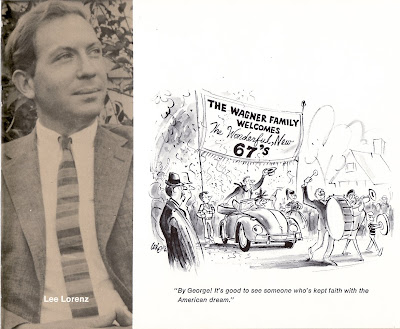

Above: Lee Lorenz and one of his cartoons from a 1960s hardcover giveaway cartoon collection titled Compliments of Your Volkswagen Dealer.

Here's a snippet from the book:
Lee Lorenz, cartoon editor of the New Yorker since 1973, says, "The biggest change over my career — I started here as a cartoonist in 1958 — is that the generation of cartoonists that came to prominence in the sixties and seventies all do their own writing. For the first twenty-five years of the New Yorker, captions were nearly always written by people other than the artists — writers on the staff or outside gag writers. 
— Behind the Cartoonist by Sarah Werner, Smithsonian Magazine, June 1995 
My cartoonist pal Tony Murphy asked my opinion about gag writers. He wrote in an email:
I'd be interested to know more about why the NYer editor then was deciding he wanted cartoonists who could write their own material. In other words, why didn't that happen ten years earlier — or later?
A good question! I don't know, but being a good American, I'm lousy with ill informed opinions and my right to pontificate about 'em.

Let's go back in time, to when cartoons were gorgeously illustrative -- but clunky.

In 1925, when the NYer mag began, Harold Ross, who as we all know started the magazine, wanted a different type of cartoon. So many of the cartoons had dialogue back then. Not just a one line quip, but 2 or more lines of dialogue. Looking back at it from 100 years on, it was darn clunky looking:


Voice from bank — Hey, mister, your oars are driftin' away!
Contented lover — That's all right. We don't need 'em any more.

These cartoons are from Judge magazine, a leading humor mag if the 19th century, created by Puck magazine contributors who jumped the more successful Puck ship to create their own rival humor magazine.


A FOURTH OF JULY OUTING
Gamin — Carry your bag for a nickel, mister.
Pater — No, never mind, boy.
Gamin — Carry the kind fer a quarter.
(Ahh, the street urchin gag! So rarely seen these days!)

So, how did we get away from the multi-line single panel cartoon?

E.B. White is generally credited with crafting the typical one-line New Yorker style cartoon in the aryl New Yorker Magazine days. Cartoon captions were routinely handed over to White or Thurber for "tinkering."
It was never easy, and still isn't, for a new artist to break in to the New Yorker. Some of those whose names have become well known tried for months, or even longer, sending in dozens of rough sketches week after week. If an unknown's caption, or sketch, seemed promising, it was often bought and turned over to an established staff cartoonist. Arno usually got the cream of the crop; the wonderful Mary Petty has never worked from any idea other than her own; James Reid Parker did most of Helen Hokinson's captions; and other artists either had their own gagmen or subsisted on original inspiration, fortified by captions and ideas sent in by outsiders or developed by the staff. 
— The Years With Ross by James Thurber

I believe that since the NYer was run by writers and editors, then the approach with cartoons was the same: Great cartoons are not written, they are rewritten and rewritten and edited and poked and prodded at by many on the staff. It's odd to think that Charles Addams had writers who would write for his distinctive style of humor. But this is all part of the branding of these different cartoonists. James Reid Parker, who wrote the introduction of The Hokinson Festival cartoon collection, is cited on the book jacket as the guy "who wrote most of the original captions" of her cartoons. Gag writers are, as Ms. Wernick writes, "an open secret of the cartoon business."
Most gag cartoonists buy some of their ideas from outside sources. They pay the writer 25 percent of what the cartoon earns and keep 75 percent for themselves. Only the cartoonist signs the cartoon. 
— Cartooning by Roy Paul Nelson
"Any professional humorist is out of his mind if he doesn't surround himself with talented writers. Otherwise you get to the bottom of your own barrel too quickly," says Hank Ketcham in Sarah Wernick's Smithsonian article.

One cartoonist I know who uses more than 3 dozen gag writers. He tells me that by using them, he can concentrate on drawing and be more prolific.

Gag writers tell me that the cut for magazine gag writers is 30% of the sale price.

I don't use gag writers myself.

I like Dave Coverly's note to gag writers at his Speedbump site:
Note to Gag Writers: I don't buy cartoon ideas. It's nothing against you, I'm sure you're damn funny. I just don't. I like the daydreaming part of my job too much.
Bob Mankoff, who took over the cartoon editor position at the NYer after Lorenz, says that there are people who like to draw and there are people who like to write. Cartoonists are the rare combination of those two types.


Related: 


"Gag Writers Are Funny People" by Larc Relhoc from Mother Earth news, 1970.
Rod McKie interviews prolific gag writer and cartoonist Rex "Baloo" May on his Cartoon Fiend blog

EDIT: The Daily Cartoonist "Can a Cartoonist Use a Gag Writer or Is That Cheating?"

Monday, February 10, 2014

Saved From The Paper Drive: Rocket Ship Comic Book Covers


The Saved From The Paper Drive blog gives us a gallery of Rocket Ship Comic Book Covers from Western Publishing. Some vintage art from the spinner rack from Dell and Gold Key comics here.

Sam Ferri: The Woody Allen Test


Sam Ferri in the New York Observer talks (and, of course, draws) a column/comic titled The Woody Allen Test.

Mr. Allen was accused of child abuse 21 years ago by Mia Farrow. The charges, after investigation by the Connecticut Police and the Child Sexual Abuse Clinic of the Yale-New Haven Hospital, were dropped.

But this is all back in the news, with social media masticating the events for weeks now.

Is she, Mia Farrow, heroine or victim? Is Woody Allen a talented saint or a villain? What of the grown-up children? Do we need to decide, for certain, whether these people are angels or devils? 

Many would like, in general, a summing up: a concrete knowledge of ourselves and our world. But, because we are human and flawed, so is our ability to "know." 

A lot of people disagree with that. Absolute knowledge is something a lot of people want, and there are all sorts of activities (religion, self-help-books) that pitch that view.

Being certain in a world of chance brings comfort and closure. But is it realistic?

Maybe people really think that we can "know the unknowable" and have the absolute knowledge of the gods. And we can say unto everyone via our Facebook pages. 


Related: the NY Times: Woody Allen Speaks Out.

Friday, February 07, 2014

Richard Sherman Vs. PEANUTS' Shermy by Eric Spitznagel


From the February 2, 2014 New York Times Magazine: the weekly "Compare and Contrast" feature by Eric Spitznagel.

"Compare and Contrast" tends to mash up two disparate people who have names (or part of the their names) in common. For instance, Chris Christie vs. Agatha Christie. For instance:
CATEGORY: Mysterious Disappearance
THE NEW JERSEY GOVERNOR: Millions in Sandy relief funds
THE CRIME NOVELIST: Her personally, for 10 days in 1926

 Or Liz Cheney vs. Lon Chaney, Jr.
CATEGORY: Political Achilles’ Heel
THE VP DAUGHTER: Same-sex marriage
THE HORROR ACTOR: Booze

He has a list here.

Last Sunday, the column was about the PEANUTS character Shermy vs. Seattle Seahawks' Cornerback Richard Sherman. Shermy, as you can see, does not fare well.

Shermy, a bit player in the strip who, so far as I know (and I'm not breaking concentration to go Google this right now) hasn't been active in the strip for a couple of generations, is an odd choice. But it's nice to see Mr. Spitznagel and the Times believe that we all get the reference.

Video: California State Assemblymember Rob Bonta (D-Oakland) Remembers Morrie Turner


(Sacramento) -- California State Assemblymember Rob Bonta (D-Oakland) rose on the Floor of the Assembly to adjourn in memory of cartoonist, Morris "Morrie" Turner. Born and raised in Oakland, Morrie Turner created Wee Pals in 1965 - a groundbreaking comic strip that reflected his own racially and ethnically diverse upbringing in Oakland. Each week, readers would bear witness to his unique ability to address racial and social justice issues with a playful and lighthearted finesse. Turner was the first African American cartoonist to have a nationally syndicated comic and will have a long-lasting impact on California through his insightful teachings of tolerance and acceptance. Hear Assemblymember Bonta's memorial to Turner in this Assembly Access Video.http://www.asmdc.org/Bonta

Thursday, February 06, 2014

Snowstorm February 6, 2013 UPDATE

And here's yesterday's snowfall, today: now all cleaned up.


Mark Fiore: Court Papers Claim Chevron "Injured" by His Editorial Cartoon

From Mark Fiore:

I'm hearing this morning that Chevron filed court documents saying they were "injured" by this cartoon I did in conjunction with Amazon Watch.

Here's the cartoon:


More at Mark's blog.

Salon has an article "Chevron’s now going after political cartoonists" by Lindsay Abrams.

Hat tip to Bado!

THE SIMPSONS "Please Stand By" Interstitials


Snowstorm February 5, 2014

Got about a foot of snow last night and now it needs to be cleared. It's in the 20s out there, but about -2 what with the windchill. Have a cup of hot tea ready for me when I finish snowblowing, OK?


Wednesday, February 05, 2014

The Heath Robinson Museum and the Bletchley Women Code-Breakers


Photos copyright Geoff Robinson.


The Daily Mail has a heartwarming article about Joanna Chorley, who was one of the secret "Bletchley Circle" female code-breakers during World War 2. Above, unseen for about 70 years (kept hidden in her bureau), is a photo of them. Ms. Chorley stands on the far right.

The top secret group operated a primitive computer, named "Colossus" and used it to assist in decoding enemy messages. It's Colossus' 70th birthday tomorrow.

"'Colossus' was very big and took up half a room, but it wasn’t too noisy, it chugged away to itself."


What I didn't know until today, was that the predecessors of the machine -- an even more primitive primitive computer -- were electro-mechanical "Robinson" machines, which were named after the cartoonist Heath Robinson. But he never knew that!


Heath Robinson was best known as a sort of British Rube Goldberg; drawing elaborate contraptions to accomplish simple and sometimes odd jobs, like the above spaghetti stretching mechanism. This was a way, during rationing, to extend the rationed pasta. I love the look on the diner's face. So happy!

Anyway, the elaborate machine 

"… consisted of three parts: a frame onto which two teleprinter paper tapes were mounted -- weaving their way through a convoluted network of reels -- and read optically; a rack containing counters and another rack for valved logic circuits. 
"It was a tricky system: the teleprinter tape had to be prepared meticulously, requiring two very long loops of the paper … to be fed into the machine, woven around a sequence of spools. The second tape had to be precisely one character longer than the first so that it would automatically change the punched patterns by one position after completing a single circuit of the tapes. Keeping these tapes synchronised when they were moving at over 1,000 characters a second was a major challenge, and they would often tear or stretch." -- "Heath Robinson: the unsung hero of British eccentricity and innovation" by Olivia Solon, Wired.co.uk

Of course, the reason Mr. Robinson never knew is that he died in 1944, when the whole Bletchley project was top secret. That's too bad!

Anyway, do take a look at the link above. They are raising funds for a Heath Robinson Museum and are close the their goal.

Video: New "Christmas Truce" Play Based on Cartoonist Bruce Bairnsfather's World War One Experience


Warwickshire, UK: Phil Porter has written a new play based on a real event in the First World War. "The Christmas Truce," directed by the Royal Shakespeare Company's Deputy Artistic Director Erica Whyman, tells the stories of local soldiers from the Warwickshire Regiment and

"… in particular, the experiences of local cartoonist, Bruce Bairnsfather, who worked at the original Shakespeare Memorial Theatre as an electrical engineer, and whose famous comic creation 'Old Bill' was hugely popular with the troops."

From the RSC page:

December 1914. As families across Europe gather to celebrate Christmas, a generation of young men find themselves far away from their loved ones in the trenches of the Western Front. There they face a world seemingly devoid of any peace or goodwill. But on Christmas Eve 1914, as the men of the Warwickshire Regiment shelter in their trenches, something astonishing happens 
Across no-man's land they hear music. The German soldiers are singing Christmas carols; the same carols their families are listening to, hundreds of miles away in Birmingham, Warwick and Stratford-upon-Avon. Leaving their trenches, carrying only their courage and their humanity, they go to meet their enemies; not to fight, but talk, to exchange gifts, to celebrate Christmas. And the next day, together, they play an unforgettable game of football. 
Inspired by real events of exactly 100 years ago, RSC Deputy Artistic Director Erica Whyman directs Phil Porter's uplifting new play for families that celebrates a remarkable Christmas story.

Below: Erica Whyman and Phil Porter introduce "The Christmas Truce" | Royal Shakespeare Company:


Tuesday, February 04, 2014

Jack Markow Balloon Cartoon


Jack Markow: a balloon seller gag from Saturday Review magazine.

"Since I hate to do lettering, I borrowed these balloons from various comic strips. A paste-up job which earns me the fancy word 'collage.'"

From Cartoonist PROfiles #55, September 1982.

Vermont's Next Cartoonist Laureate: Ed Koren


Above cartoon copyright Edward Koren.


Vermont resident Ed Koren will be appointed Vermont Cartoonist Laureate on February 27, 2014. 

The Center for Cartoon Studies has the press release here.

Montpelier, Vermont—Brookfield, Vermont resident Edward Koren will become Vermont’s second cartoonist laureate on Thursday, February 27, 2014, when he will be recognized on the State House floor. Vermont is the only state that regularly appoints a cartoonist laureate. 
Edward Koren has long been associated with the The New Yorker magazine, where he has published over 1,000 cartoons, as well as numerous covers and illustrations. David Remnick, The New Yorker’s editor, has this to say about Koren’s work: “The great imaginative artists, comic or seriocomic (what other kinds are there?), are great at least in part because they create a world: Baldwin’s Harlem, Faulkner’s hamlet, Chekhov’s dachas. Ed Koren not only created a world—the Koren worlds are both urban and Vermontian, but all Koren—he also created creatures, part human, part fantastical, to represent and give voice to all of our anxieties, joys, and craziness. Long live Ed Koren, his world and his creatures!”

The rest is here.

Stripper's Guide: Cartoonist Ralph Smith Interviewed


I have met Ralph Smith a couple of times. Every time I see him, he has a big grin on his face. He could be the happiest cartoonist I ever see at the NCS Reuben conventions. He wrote a reminiscence of his life and times for Stripper's Guide titled Ralph Smith: Life in the Funny Papers. Part one is here. (EDIT: part two is now here, and galleries of Ralph's cartooning are here and here.)

That smile is an important bit of armor. Being optimistic, like Ralph, sure can help when you are a cartoonist. Ralph is no stranger to success or failure. He's worked on a number of comic strips. And he's also had disappointments: the demise of his first syndicated strip -- the same year as his friend and mentor Dik Browne passed away. Then, he picks himself up and fights; pitching an editorial panel and co-creates a new syndicated strip.

Ralph was, like a lot of cartoonists, born in Ohio (in the same town as Richard Outcault). After high school, he did a four year stint in the Air Force, then 2 years at the Ringling College of Art and Design. He was fortunate to land a job in the art department of the Sarasota Herald Tribune, where, for ten years, he did paste-up, illustration and cartooning.

"One of my jobs was to illustrate a daily column called 'Hotline.' It was a reader-generated Q and A thing wherein readers sent in questions ranging from bad bargains in town to how to get mildew out of dressers. I did 2 cartoons per page, every day, for nearly ten years. It was like boot camp. Drove me nuts because I only saw the column about three hours before the art had to be with the engravers."

He met HAGAR THE HORRIBLE creator Dik Browne when he intentionally tagged along with a reporter. Dik and Ralph hit it off, and he joined Dik, and his sons in creating the popular King Features daily for a number of years.

He submitted a couple of strips to King Features. One of them, CAPTAIN VINCIBLE, about an inept superhero, was green lighted. It ran for about six years beginning in 1983.

"Dik’s health deteriorated rather quickly and he died on June 4, 1989. I miss him as much today as I did that day. He was one super man. I learned so very much from him, and only part of it was about how to produce a comic strip. A comic as successful and loved as Hagar must go on, so everybody went back to work."

Ralph continued with HAGAR for four more years, and then became Fred Lasswell's assistant on SNUFFY SMITH.  But working with Fred was "not a good fit," and Ralph was, ostensibly, now out of a cartooning job.

He called his old paper and proposed a regular freelance editorial cartoon. They said OK!

Ralph also contacted his friend Bill Schorr and they collaborated on THE GRIZZWELLS.

It's a wonderful remembrance in his own words, and shows how fearless you have to be to be a professional cartoonist. And this is only part one.

Go, read: Ralph Smith: Life in the Funny Pages, Part I
And Part 2 is now here.

Monday, February 03, 2014

DC Comics 1982 Color Guide


Hat tip to Chris Wozniak!

Film Short: FAMOUS CARTOONISTS (1950)

From the SCREEN SNAPSHOTS series of films, here is FAMOUS CARTOONISTS, a six-minute short subject all about our "funny papers habit." Narrated by Jack Benny's own Don Wilson, and with the cooperation of the National Cartoonists Society and the U.S. Savings Bonds Division of the Treasury Department, we get to see, in order of appearance, these 44 cartoonists:

Gus Edson
Rick Yeager
Clifford McBride
Milton Caniff
Walt Disney
Ham Fisher
Tony DiPreta
Jimmy Swinnerton
J.P. McEvoy
Al Vermeer
Jay Irving
George McManus
Elmer Mesner
Roy Justice
Cecil Jensen
Elmer Woggon
Lank Leonard
Fred Neher
Scott Fisher (editorial cartoonist Minneapolis Tribune)
Joe Long (editorial cartoonist Chicago Sun-Times)
Frank Willard
Raymond Van Buren
Alfred Andriola
Mel Casson
Merrill Blosser
Bruce Russell
George Baker
William de la Torre
Chic Young
Allen Saunders
Reg Manning
Milt Gross
Gus Arriola
John Pierotti
Ray McGill
Henry F----- (not a dirty word - I just didn't catch it; created "Joe Jinx" comic strip)
Ving Fuller
Charles Biro
Meyer Mayo (unsure of name; a Hollywood Citizen News editorial cartoonist)
Don Trachte
Bill Holman
Howard Sparber
Al Posen
Ferd Johnson
The clip runs about four minutes shy of its reported 10 minute length. Regardless, this is a terrific chance to see all these fellows, all in suit and tie, eating and drinking while Mr. Wilson reels off their cartoon stats.

Who's missing? NCS President Rube Goldberg. This was shot in California, so maybe Mr. Goldberg stayed home in New York.

What's different now? Obviously, what's changed is that cartooning is no longer an exclusive white boys club. The cartooning field is no longer so formally attired, either.


Hat tip to Jay Lynch and Mark Newgarden!