My nephew, who lives in North Carolina mailed me a Flat Stanley. I didn't know WHAT a Flat Stanley was or that there was something called the Flat Stanley Project.
A lot of people know about it. But I had never heard of it.
Flat Stanley is a character from a children's book titled FLAT STANLEY by Jeff Brown and illustrated by the one and only Tomi Ungerer. The plot in the book is that Stanley has a mishap and is rendered flat. Stanley is fine, but is now 2 dimensional and is able to slip under doors, etc.
As for the real-life Flat Stanley Project: thankfully, the semi-reliable Wikipediahad the goods on this:
"The Flat Stanley Project was started in 1995 by Dale Hubert, a third grade schoolteacher in London, Ontario, Canada. It is meant to facilitate letter-writing by schoolchildren to each other as they document where Flat Stanley has gone with them. Dale Hubert received the Prime Minister's Award for Teaching Excellence in 2001 for the Flat Stanley Project."
So, back to my nephew: he mails me a hand colored Flat Stanley doll, with instructions that I should take photos of him up here in New Hampshire and then mail him back. And so I did.
This is Flat Stanley's Adventure in New Hampshire.
My thanks to Holy Rosary Credit Union, Tri-City Energy Products, Hair Excitement and Jetpack Comics for their enthusiastic participation.
Until stumbling on this YouTube clip from ARTISTS AND MODELS (1937) I had no idea that there was a movie starring Jack Benny, with cartoonists and illustrators Russell Patterson, Peter Arno and Rube Goldberg. Yet, here it is, with those fellows all drawing the beautiful Sandra Storme -- and trading some bad jokes with Jack Benny.
Jackys Diary, the cult favorite by Jack Mendlesohn
The Katzenjammer Kids by Dirks
Little Iodine by Jimmy Hatlo
Mandrake the Magician, the Falk/Davis run
Ted Shearer's gorgeous and deserving-a-comeback Quincy strip (for moreon Quincy take a look here and here)
Radio Patrol by Eddie Sullivan and Charlie Schmidt
The above titles join other vintage strips at DailyINK like Mandrake, The Little King, Rip Kirby, Buz Sawyer, Bringing Up Father and Brick Bradford. The annual fee is $15 to join DailyINK.
A big hat tip to the one and only Bhob Stewart for this news!
Above: Sherilyn Fenn. Yes, she could NEVER be mistaken for Uncle Arthur. More about her in a moment.
There is a little known tradition in TV series. The tradition has no name, so I just call it the "That's NOT Uncle Arthur!" effect.
If you watch TV, you know what I mean. You're watching a show and suddenly, a familiar character is acting a strange way.
Let me explain.
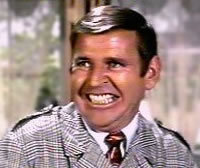
OK, here's Uncle Arthur:
Here's a description. There is an episode of BEWITCHED with Paul Lynde NOT playing Uncle Arthur -- he's this nervous driving instructor. Here's a (colorized) clip from the first time Lynde appeared on the show. It's from the very first season.
This 1965 episode is titled "Driving is the Only Way to Fly," and you can watch the whole thing on Hulu here (or there's a MySpace cut up Minisode, which runs under 5 minutes and really has all the best bits).
Paul Lynde would return the following fall, in his new role as the recurring Uncle Arthur character.
This is the Uncle Arthur Effect.
OK, here's another example. Harry Morgan appeared on M*A*S*H as 2 characters. The first: a one-time appearance as Major General Bartford Hamilton Steele. Here he is in his 1974 episode:
And the next season, he returned in a different role: that of Commanding Officer Colonel Sherman T. Potter. He would stay with the series until its demise in 1983 -- and would reprise his role in the short-lived spin-off series After M*A*S*H.
So, how many times have actors wandered in, played a guest part -- and then are asked to return for a regular role in a series?
Above is Vincent Gardinia, who played Frank Lorenzo in ALL IN THE FAMILY. But before he played Frank, he played two other characters in 2 earlier episodes of the sitcom.
And the same thing with veteran character actor (and ubiquitous cartoon voice talent) Allan Melvin. Melvin was, like, in a zillion shows like PHIL SILVERS, DICK VAN DYKE, ANDY GRIFFITH and GOMER PYLE USMC. With both VAN DYKE and GRIFFITH, he played different characters before being brought in as a semi-regular character.
Alex Borstein, maybe best known for her long running gig as a great comedic character actress in Mad TV, played "Drella," a sarcastic harp player in the first few episodes of the Gilmore Girls series. It was the producer's hope that she play the second banana role of Sookie, but her Fox TV contract prevented that commitment. She returned a 3 years later to GG as "Miss Celine."
Sherilyn Fenn played 2 characters in Gilmore Girls: she was first cast in a pilot-within-the-series as Jess' mother figure and then, later on, a semi regular role as an ex-lover of series regular Luke
And then there's Dennis Franz. Back before NYPD Blue, he was on Hill Street Blues for a short multi-episode arc. He played Detective Sal Benedetto, a drug-hooked, crooked cop for 5 episodes. He returned two years later, portraying Detective Norman Buntz for the remaining two years of Hill Street's network run, and starred in the 12 episode spin-off series Beverly Hill Buntz.
Freema Agyeman played Adeola Oshodi, a "red shirt" who had to die in "Army of Ghosts" to emphasis the danger of the invading Cybermen in Doctor Who. (To quote Guy Fleegman in Galaxy Quest: "I'm just "Crewman Number Six." I'm expendable. I'm the guy in the episode who dies to prove how serious the situation is. I've gotta get outta here.") In less than a year, Freema was back, this time in her new continuing role as series regular Martha Jones.
And on it goes.
That's all I can think of. But there must be more. Please let me know.
When Ray Alma won his National Cartoonists Society Division Award for Best magazine Illustration, he gave the following speech. It was very touching and I'm glad to find out today that Ray's lovely bride, Caryn, taped it:
Ray adds another 48 seconds to his speech below. He explains:
"Caryn filmed my acceptance speech for the NCS Reuben award for "Best Magazine Illustration - 2009
"She was unfamiliar with the new camera - which explains some of the avant garde camera angles she unintentionally used.
"She also didn't realize the camera cut off the end of my speech where I thank my mom. I'll have to recreate that part and post it. :)"
Comics artist Al Williamson passed away on June 12, 2010. He is best known for his work on FLASH GORDON and the STAR WARS comic strip. A journeyman comics artist who is admired for his fine ink line and dynamic composition, Williamson's passing brings an outpouring of appreciation from fans and pros around the word.
His family has posted the announcement below:
The Official Statement From The Williamson Family
Al Williamson, who for over fifty years drew for both comic books and comic strips, died June 12, 2010, at age 79. In recent years he suffered from Alzheimer's disease. He is survived by his wife of thirty-two years, Cori, his daughter Valerie and his son Victor.
Williamson was born in New York City in 1931, but spent his first thirteen years primarily in Bogota, Colombia. In 1941, his mother took him to see the science fantasy movie serial Flash Gordon Conquers the Universe, an experience which, combined with his love for comics storytelling, set his career course at an early age.
Williamson, who first and foremost considered himself a cartoonist, excelled at illustrative science fiction, adventure and western stories, pulling inspiration from both classic comic strips and motion pictures. He is highly regarded both popularly and critically for his excellent draftsmanship and dynamic storytelling. Most notably, Williamson was extraordinarily accomplished at rendering the human figure in motion. His classically proportioned characters twist and leap with a startlingly vivid illusion of movement in part evolved from his study of motion picture action choreography.
Williamson began his professional career in 1948 and achieved popular recognition in the early 1950s as the youngest and one of the most talented contributors to the legendary EC line of comics. Beyond EC, Williamson drew superior work for many comic publishers, including American Comics Group, Atlas/Marvel, Charlton, Classics Illustrated, Dark Horse, Dell, Harvey, King, Prize, Toby and Warren. From 1967 until 1980 he produced the art for the King Features Syndicate's daily Secret Agent Corrigan newspaper strip, and from 1981 to 1984 drew the daily and Sunday Star Wars newspaper strip.
Beginning in the 1980s Williamson reintroduced himself to a new generation of comics readers as an inker for DC and then Marvel Comics, enjoying memorable stints finishing the work of other artists on Superman, Daredevil and Spidergirl.
The single comics character, however, with whom Williamson is most identified would be Flash Gordon. The science fiction adventurer, created in 1932 by Alex Raymond for King Features, engaged the lifelong imagination of Williamson. He produced a much beloved series of stories for King Comics' Flash Gordon comic book in the 1960s. He returned to the character in 1980, drawing a comics adaptation of the contemporary Flash Gordon motion picture. In the 1990s, he produced a Flash Gordon mini-series for Marvel Comics and later contributing to the original Sunday strip. In addition to the stories, he produced countless other Flash Gordon images for uses in advertising, merchandising and the fan press.
He gradually retired from the professional ranks in the early years of the new century as one of comics' most admired and influential creators. Over his career he received numerous professional awards, including multiple Harvey and Eisner Awards and the National Cartoonists Society's 1967 Award for Best Comic Book Cartoonist.
Beyond his remarkable accomplishments as an artist -- the works mentioned above represent only a sampling -- Williamson deserves recognition as a veteran who often opened professional doors for many others starting their careers. An impressive number of comics contributors owe at least part of their success to Williamson's willingness to recommend and promote new artists and writers to his editorial contacts.
Williamson was also an avid collector of comics and illustration art, valuing the beauty of original drawings produced for comic books and strips long before the physical art created by commercial artists was popularly appreciated. He will be fondly remembered by those you knew him for his generosity, his indefatigable sense of humor and his great enthusiasm in sharing his love of comics, illustration, movies and music.
Al Williamson took inspiration from a legion of cartoonists, illustrators and motion pictures from the first half of the twentieth century and created works of timeless appeal -- and then he passed that inspiration on to new generations of comics creators.
The family requests that, in lieu of flowers, a donation in Al's memory be made to either:
The Joe Kubert School 37 Myrtle Avenue Dover, NJ 07801 Attn: Al Williamson Scholarship Fund
or
Yesteryears Day Program 2801 Wayne Street Endwell, NY 13760
"Here's another installment of my new autobiographical comic series, NOW IT CAN BE TOLD!
"... This time, I reveal the time "I Danced With Joseph Barbera!" -- yeah, THAT Joe Barbera, the Italian half of Hanna-Barbera Productions and co-creator of TOM AND JERRY a...nd THE FLINTSTONES! So, what WAS the secret of 'That Old Black Magic,' anyway?"
There is no context with this. Why it's important for a white bred, suburban couple to speak Cherokee is mystifying. Why the good people at the Cherokee Bilingual Education Program felt that BLONDIE was the vehicle to educate people, I don't know.
I do know (thanks to the Internet) that that same year saw the publication of a CHEROKEE-ENGLISH DICTIONARY and AN OUTLINE OF CHEROKEE GRAMMAR from the Cherokee Nation of Oklahoma in Tahlequah.
Perhaps this comic book was only part of the push to get the word out. For all I know there's LEARN CHEROKEE WITH MARY WORTH or LEARN CHEROKEE WITH BEETLE BAILEY out there, waiting to be rediscovered and scanned.
Here are some links to cartoonists' blogs and sites, where one can see more photos / comments / etc. to the recent 64th annual NCS Reubens weekend. First: here's the List of Award Winners.
There are a lot of photos on Facebook, but the ones I've looked at do not have a "general public link" and are closed to anyone who is not a FB friend of the poster. My personal thanks to those whose photos I snagged for this updated entry.
Please email me if you have a link to add. Thanks!
On Saturday bight, May 29, 2010, at the black tie Reuben Award dinner, the lights dimmed and several hundred cartoonists sat and watched this movie. There was no intro, no "let me set this up." Here it is:
Above: a rude cartoon by saucy postcard cartoonist Donald McGill.
London's Tate Gallery's latest gallery show celebrates 300 years of British comic art and is titled Rude Britannia. The exhibition runs from June 9, 2010 to September 5, 2010
The exhibitincludesAlice in Wonderland illustrations, Donald McGill’s smutty seaside postcards, Aubrey Beardsley, Cruikshank, Gerald Scarfe, Steve Bell, Rowlandson, Gillray, the Spitting Image's damning Thatcher puppet and the cartoonists from Viz.
Put together with some the country’s best-known cartoonists and comedy writers, this exhibition explores British comic art from the 1600s to the present day. Bringing together a wide array of paintings, sculptures, film and photography, as well as graphic art and comic books, the exhibition celebrates a rich history of cartooning and visual jokes.
Clients worldwide. National Cartoonists Society. Jack Davis Award winner. Recognized New Hampshire Arts Education Teaching Artist. New Hampshire Institute of Art and Design at New England College Comic Arts Program Adjunct Professor. Need cartoons and illustrations? Contact: mike@mikelynchcartoons dot com




 Posts
Posts

